

Wu-Tang Wheels "WU-160" Alloy Prototype Rim
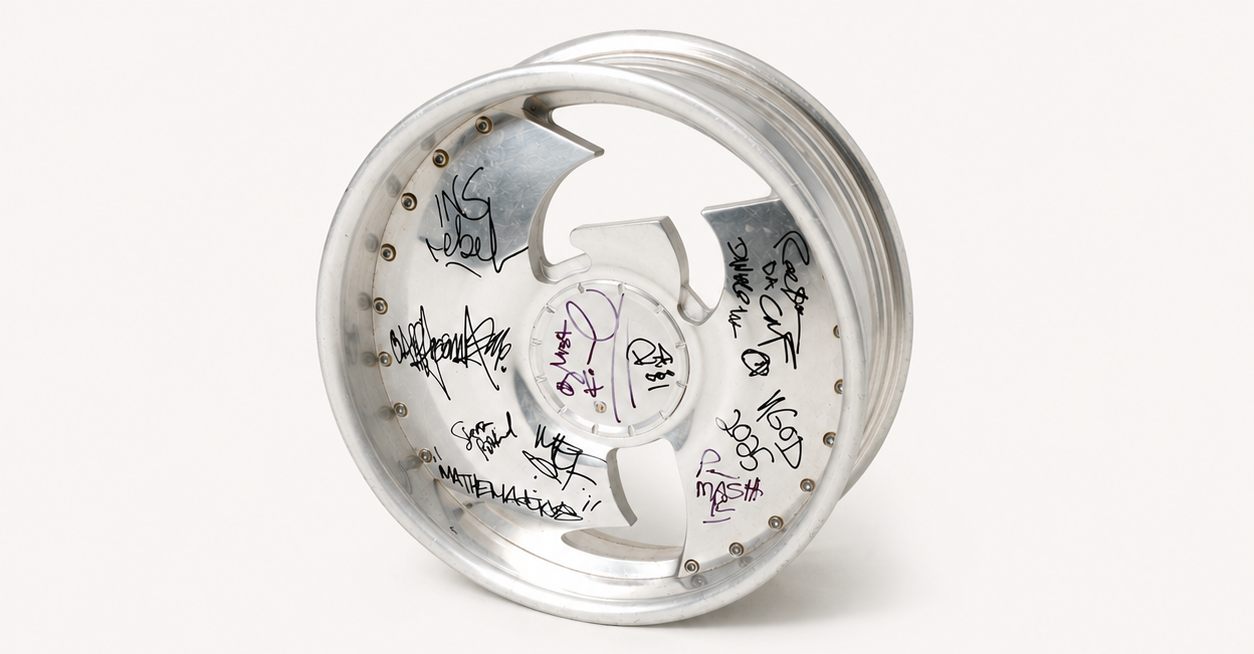
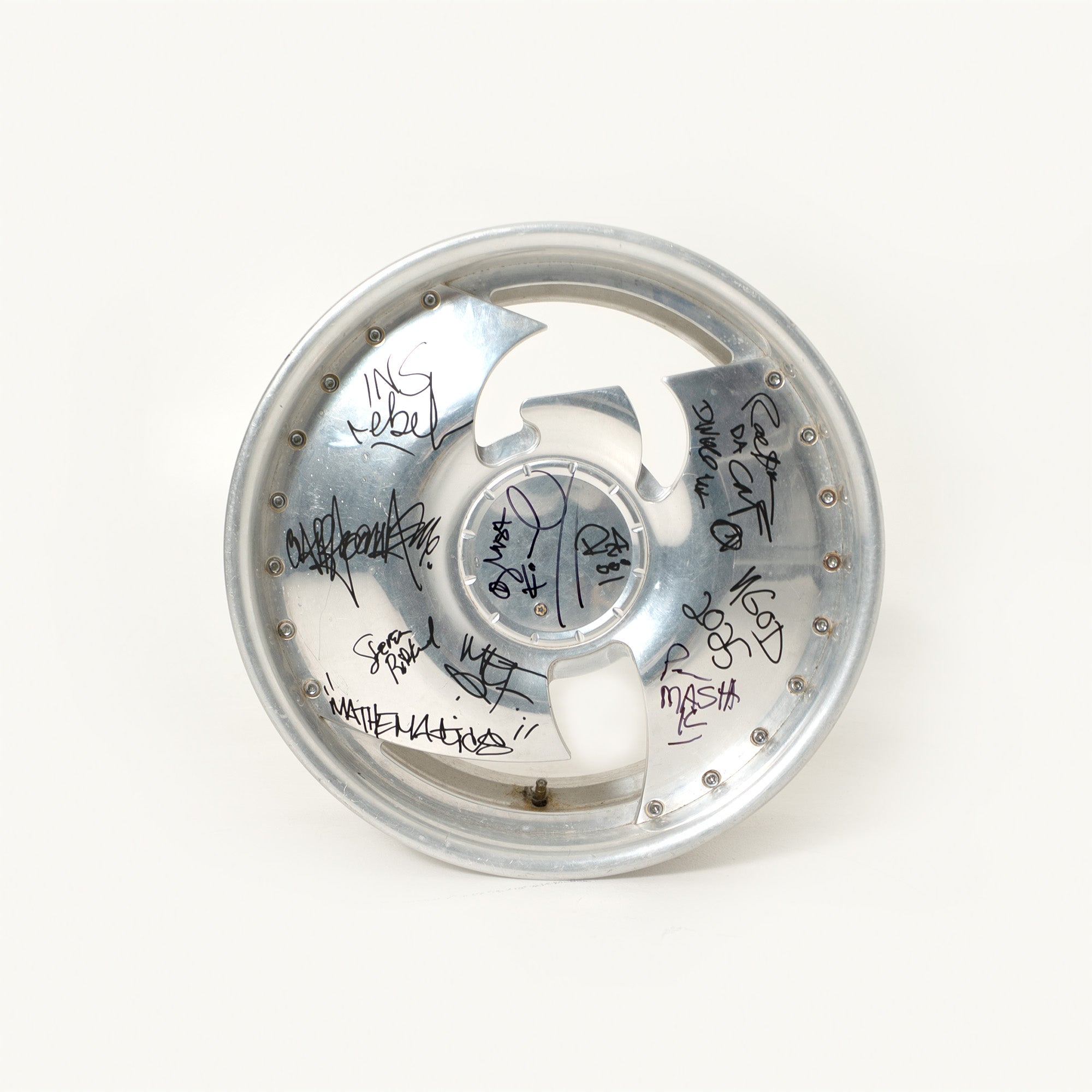
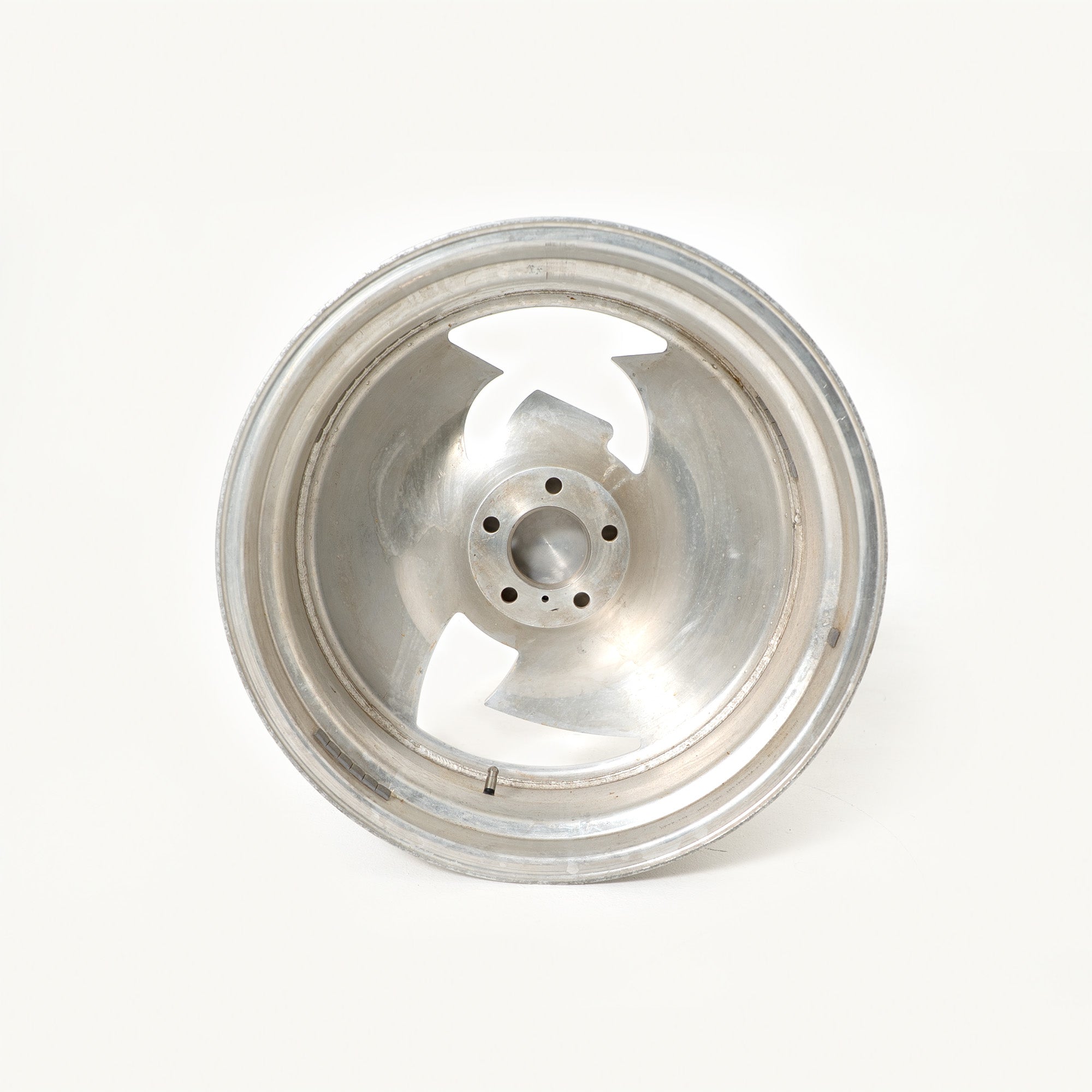
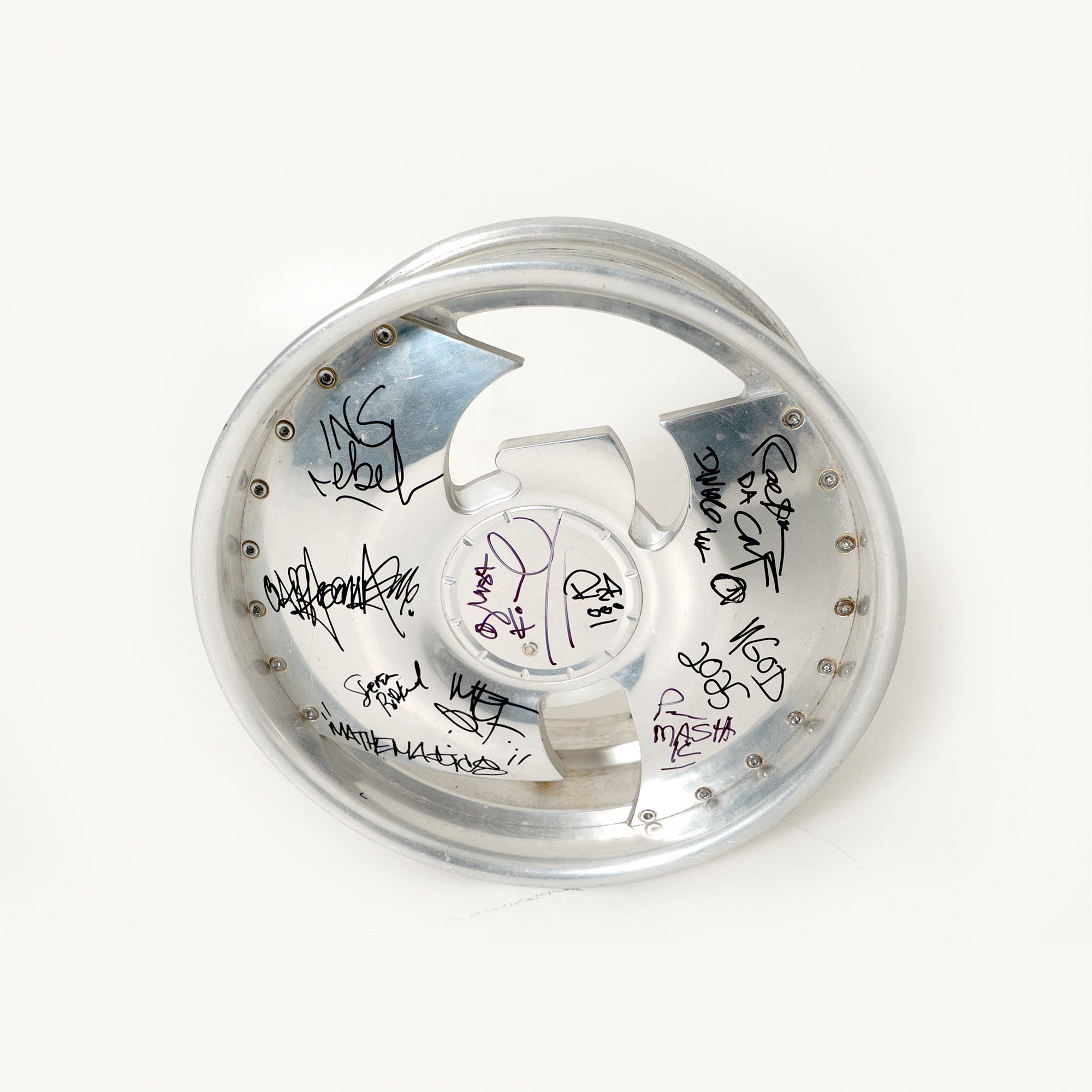
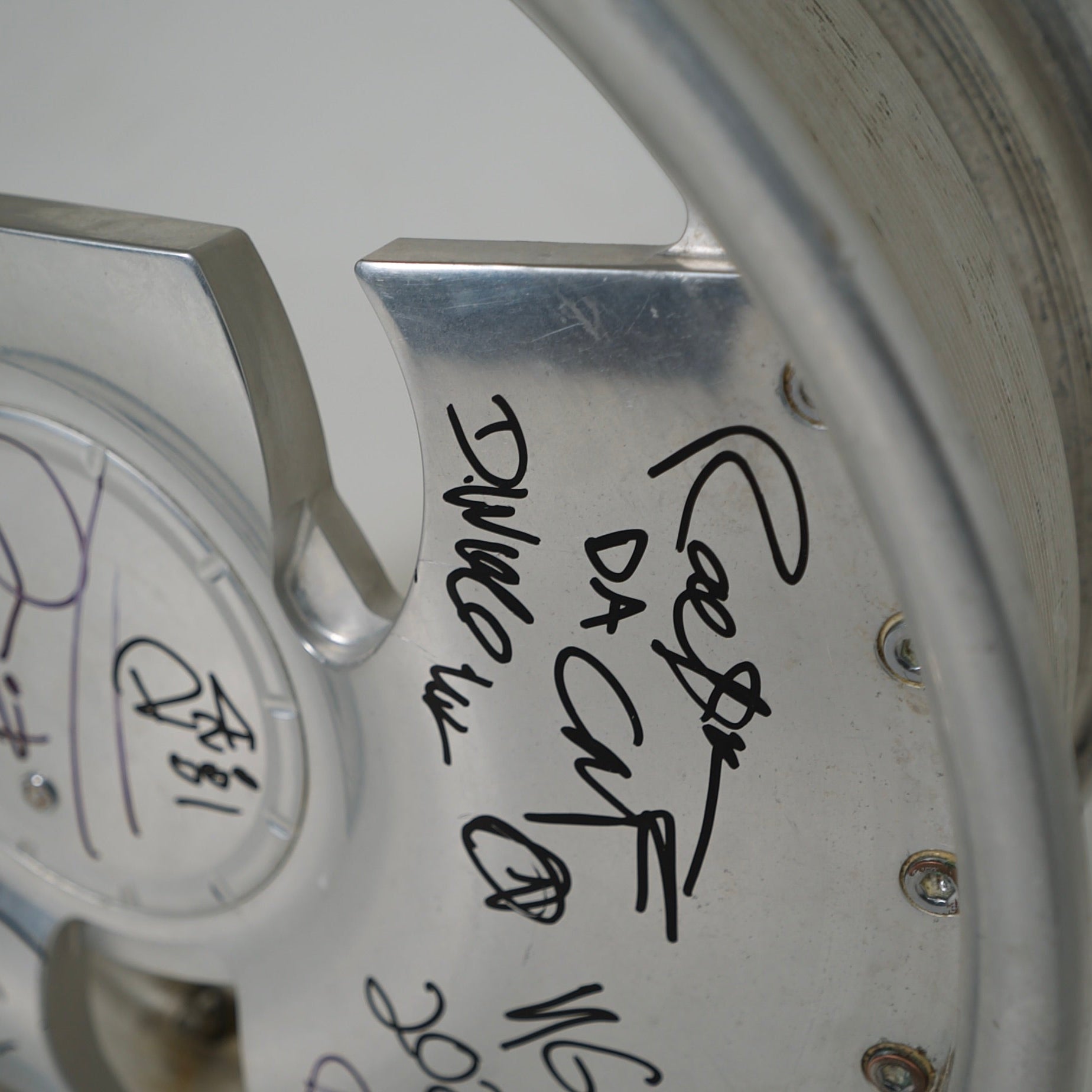
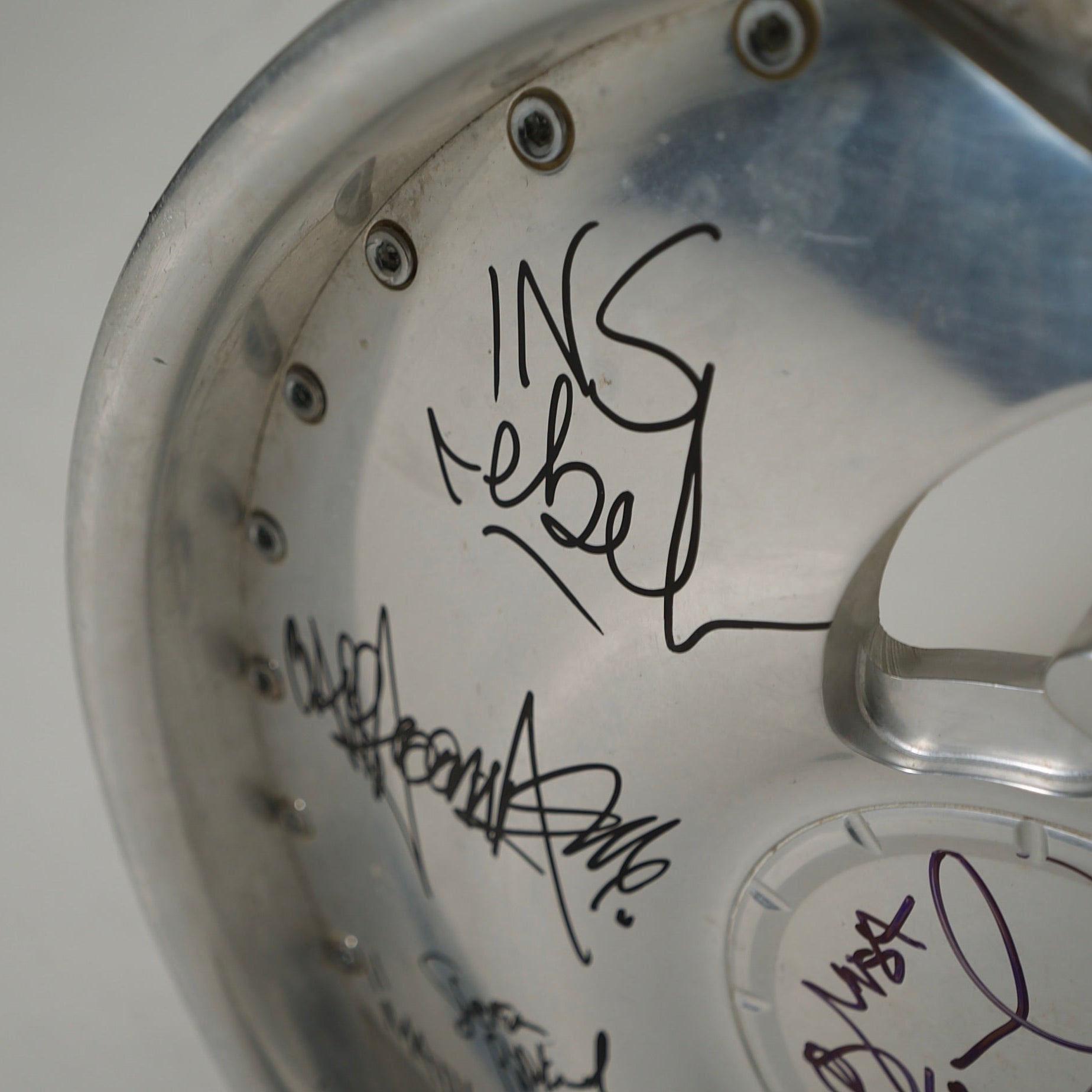
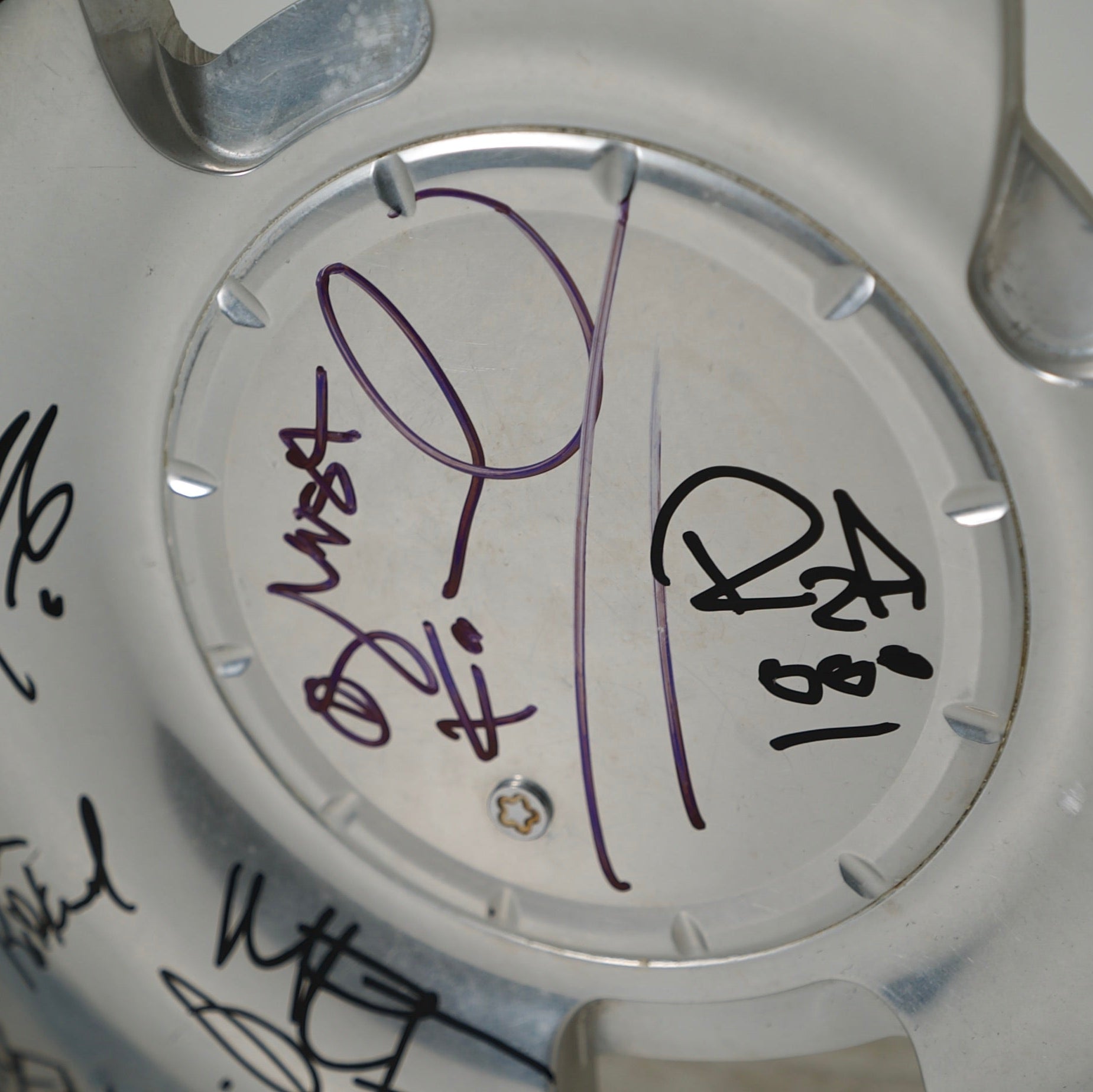
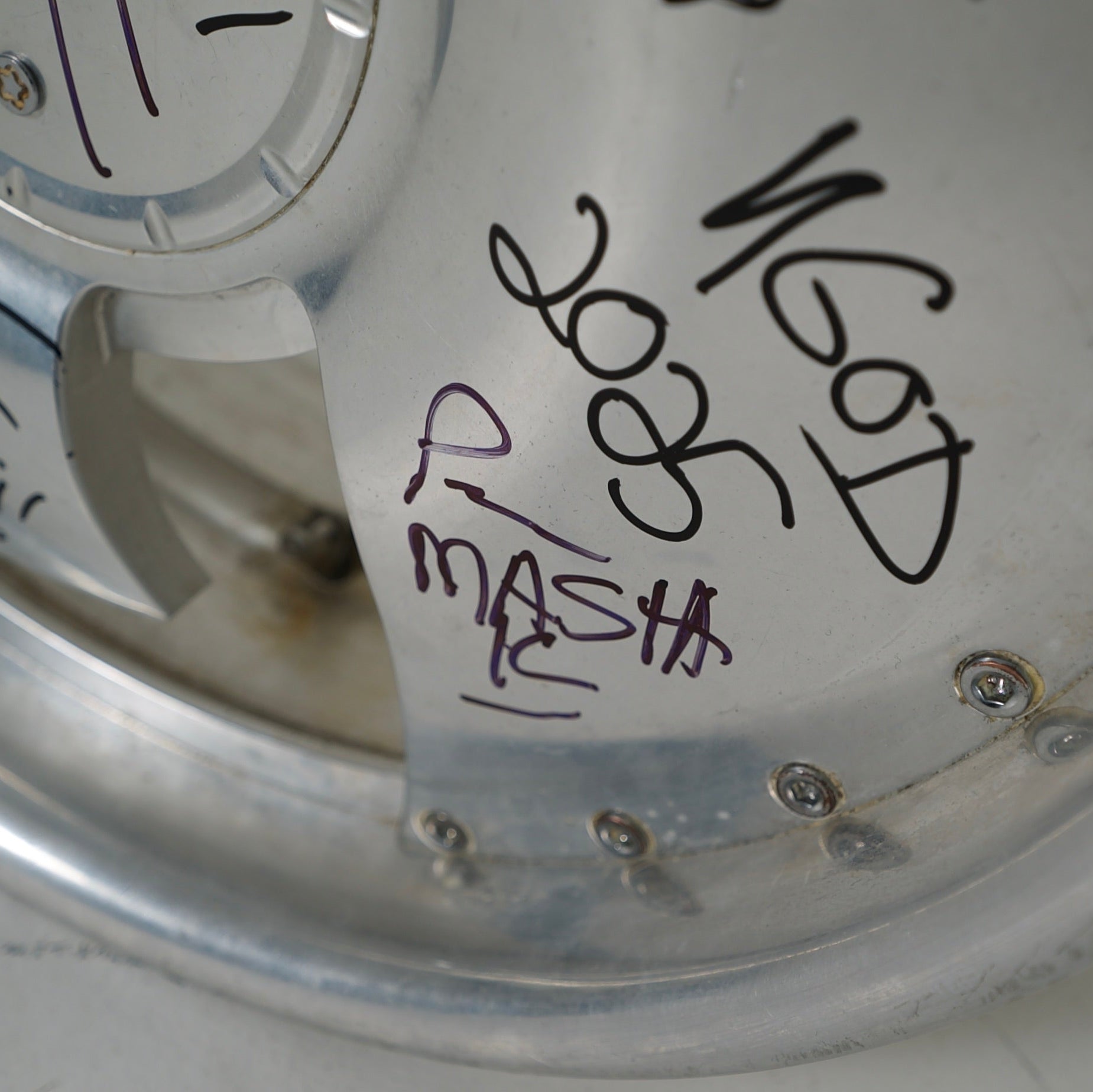
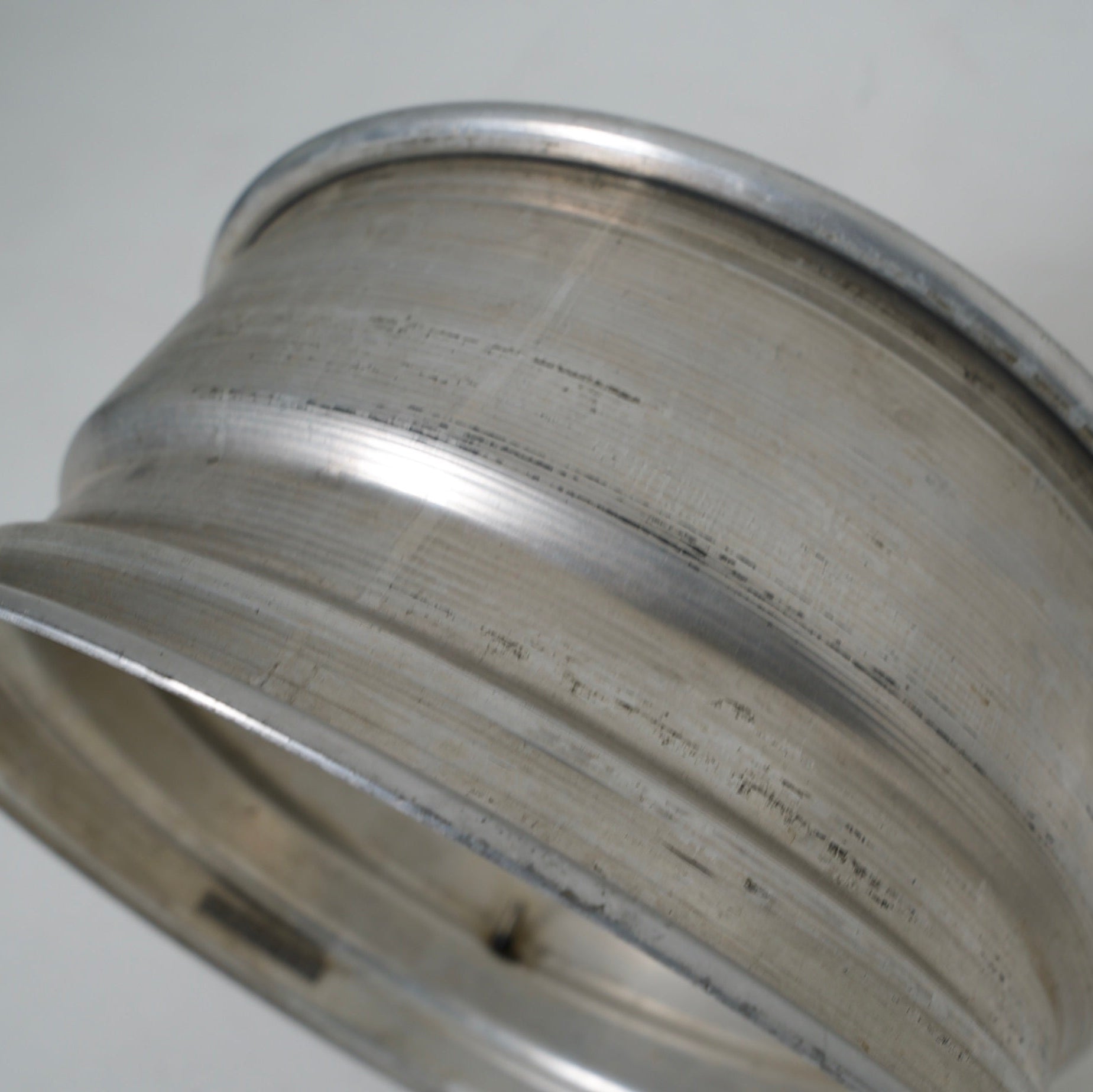
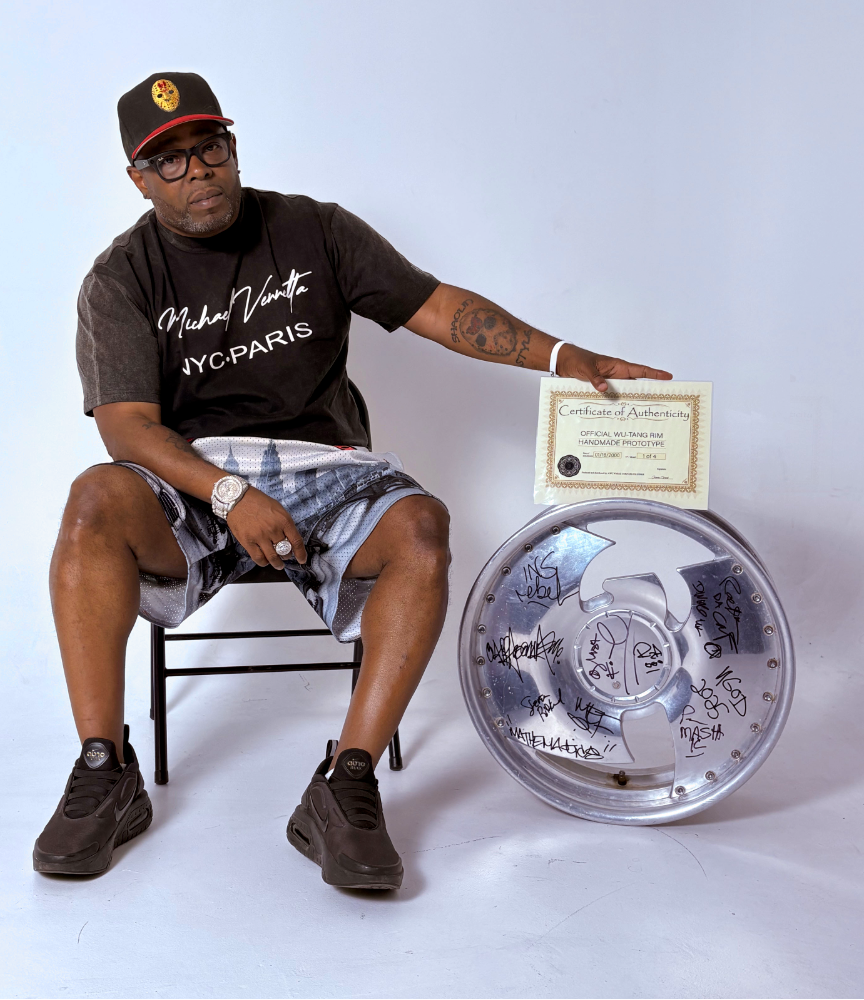
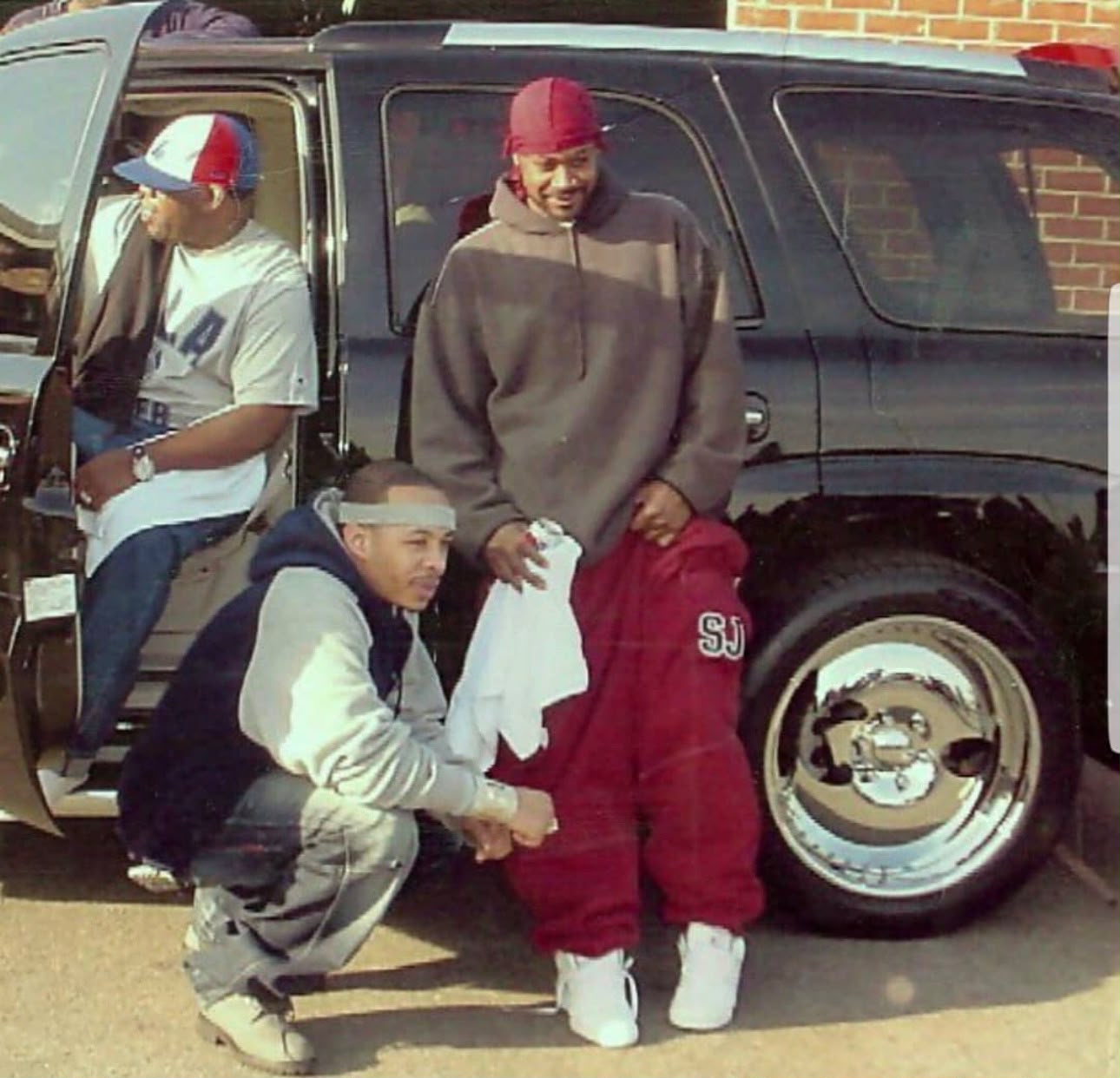
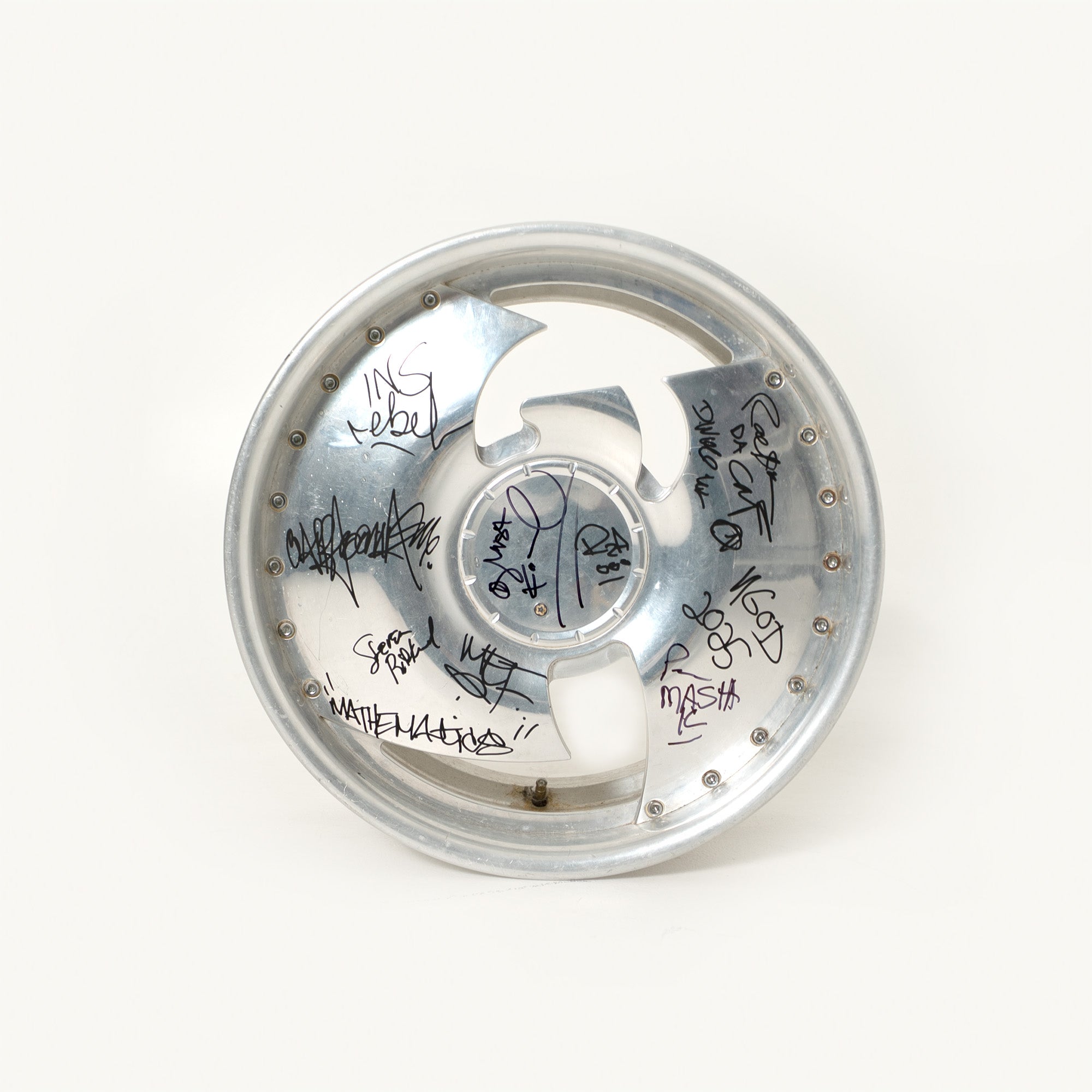
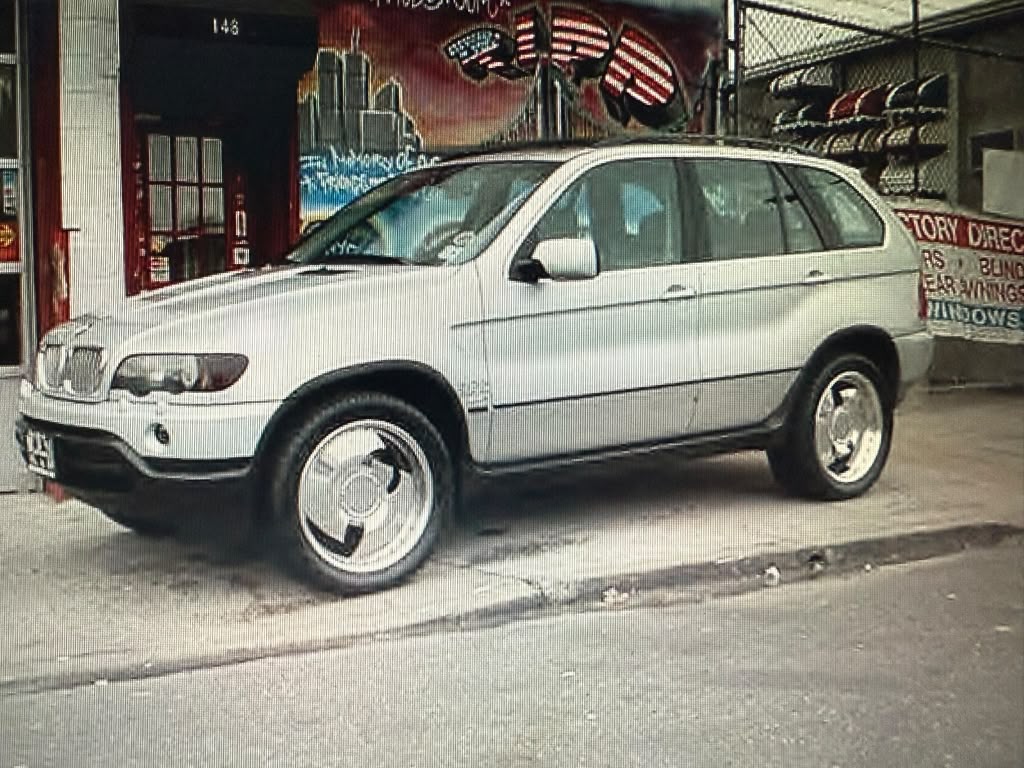
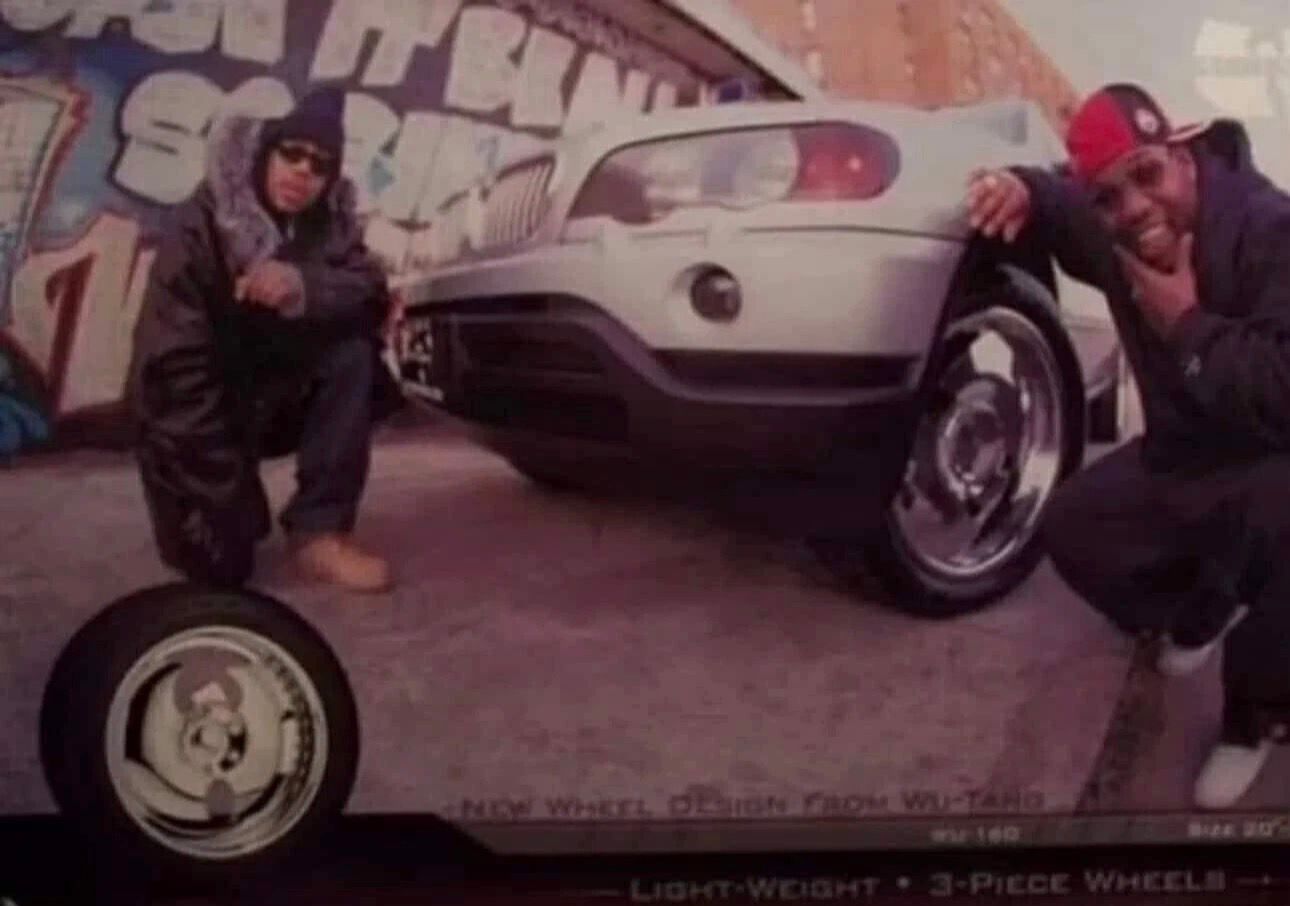
This 20” alloy wheel prototype, signed by the eleven members of the Wu-Tang Clan was one in a set of four produced in 2000 for a “lost” joint venture between the Wu-Tang Clan and Raceline Wheels. Built around a Wu-Tang Clan “W” insignia rim, It was fabricated specifically for Raekwon's BMW X5 for a rim launch that never reached the market. The wheel instead went unseen, used only in promotional photography that was never released, and as a prop during the Clan's 2000 U.S. tour supporting The W.
The early-2000s "bling era" saw hip-hop artists increasingly stake claims in the custom car and rims world, and Wu-Tang Wheels would have marked the Clan's own entry into that space.
"This is the original rim prototype that we did when we started the partnership," says Duane Grant (Wu Wear, Queen Ruby Holdings), who oversaw the venture. "This is the actual prototype that we put on Rae's X5 for the rollout... it was set for the BMW X5, because that was the hot truck back then in 2000."
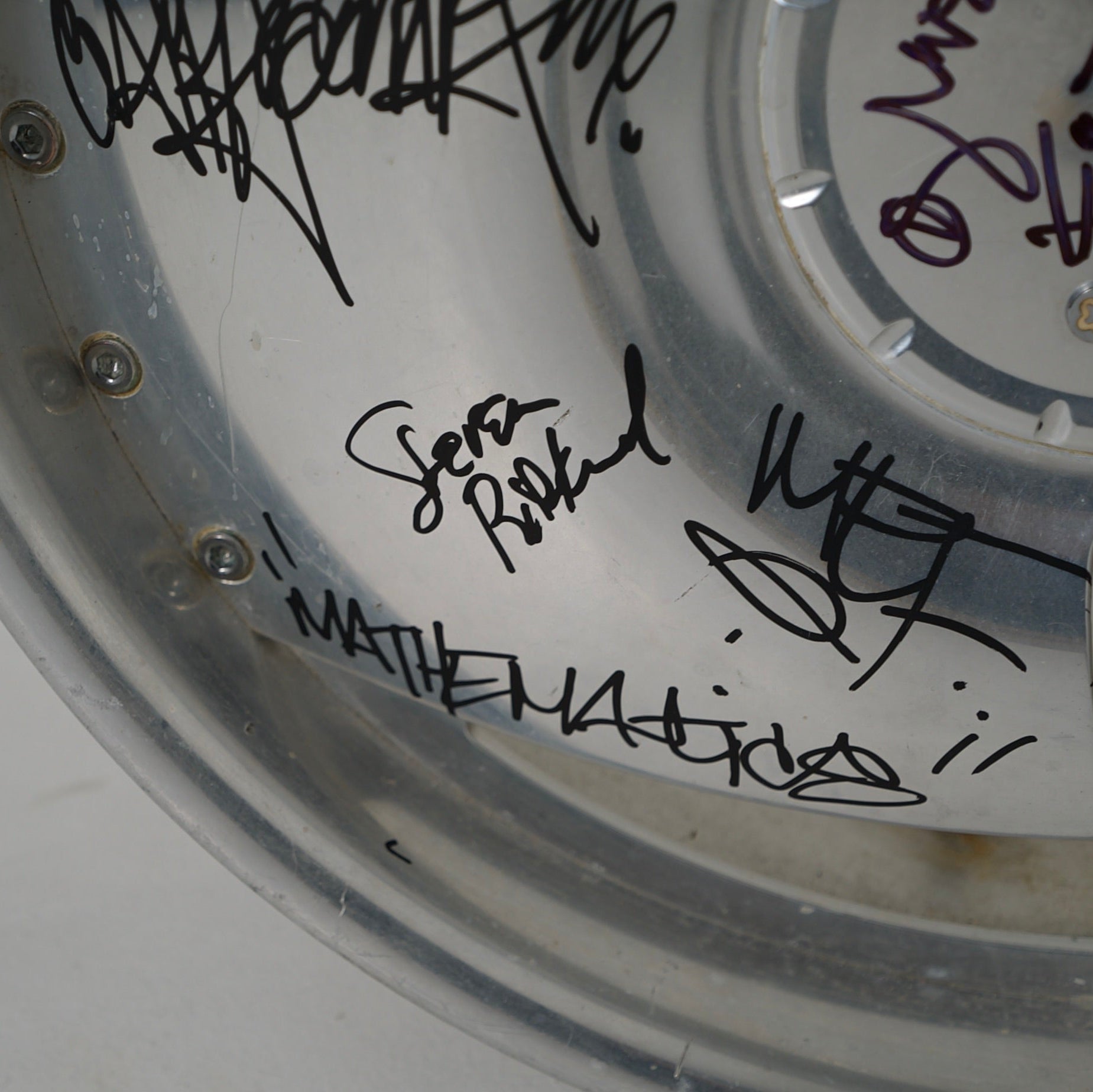
Twenty-five years later, on July 17, 2025, the wheel was signed backstage at Wu-Tang Clan's concert at Prudential Center in Newark, New Jersey, in smudge-proof water-based paint marker, by seven of the eight surviving members of the Clan's "core nine" (all but GZA), plus longtime affiliates Cappadonna and Mathematics, Wu-Tang manager Mitchell "Divine" Diggs, and Loud Records founder Steve Rifkind. The signing closes a 25-year loop on an object that otherwise never left prototype form.
Key Details & Collectability
- One of four prototypes produced in 2000 for the unreleased Wu-Tang Wheels venture (Wu-Tang Clan x Raceline Wheels/Allied Wheel Components)
- Fabricated specifically for Raekwon's 2000 BMW X5; used as a tour prop and in unreleased promotional photography
- 11 signatures: Raekwon, RZA, Ghostface Killah, Method Man, Inspectah Deck, U-God, Masta Killa, Cappadonna, Mathematics, Mitchell "Divine" Diggs, and Steve Rifkind
- Signed backstage at Wu-Tang Clan's July 17, 2025 concert at Prudential Center, Newark, NJ
-
Accompanied by a 1-of-1 promotional poster of Raekwon and U-God with the X5, never distributed
- Sole surviving example of a shelved hip-hop/auto-parts crossover venture; never available at retail
Provenance
Disclaimer: Use of Recorded Material or Photography
By bidding on or purchasing any item from this collection that includes recorded audio material (such as master tapes, demo recordings, or unreleased sessions), or photography you agree to the following terms:
- These recordings and photographs are sold strictly for private, non-commercial use by the winning bidder only.
- Ownership of the physical item does not grant any rights to the underlying recordings, compositions, performances, images or intellectual property. All rights remain with the original rights holders.
- You may not reproduce, copy, distribute, publish, share, broadcast, perform, licence, monetise, or otherwise exploit them in any form.
- They must not be shared with third parties in any format, whether for free or for financial gain.
- Any unauthorised use may result in legal action, including claims for copyright infringement, injunctive relief, and recovery of damages and legal costs.
By proceeding with a bid or purchase, you confirm that you understand and accept these terms in full.
Before you bid
Before you bid:
Please note that, on top of the final bidding price, you (the buyer) will be charged the following:
- Buyer premium of 20% on top of the final hammer price. E.g. for a winning bid of $100, you will pay $120 plus shipping, insurance, and taxes. The buyer premium helps us invest in curation, appraisals, verification, content and platform development.
- Shipping, packing, insurance & handling costs - see 'shipping' section below for more details
- Import duties and taxes - these vary by location and are payable by the buyer upon delivery, if applicable
Shipping & insurance
Shipping method: All orders are shipped tracked.
Insurance: For all orders over $200 we will include 1.3% on top of the hammer price to cover insurance.
Packing: We work with trusted packing teams to ensure the best delivery of your items. This will be added to the final cost.
Expected delivery: Item ships 2 weeks after auction closes. Delivery time varies by location.
The bidding process
We run a popcorn bidding process. This means that if you put a bid in within the last minute of the auction, the clock will extend for another 5 minutes. This allows everyone time to get their bids in fairly.
one of the most unique pieces of hip-hop branding history.
This 20” alloy wheel prototype with Wu-Tang Clan “W” insignia rim was one in a set of four produced in 2000 for a “lost” joint venture between the Wu-Tang Clan and Raceline Wheels. The prototype was fabricated specifically for Raekwon’s 2000 BMW X5 and used in never-seen promotional advertisements for Wu Tang Wheels and also featured as a prop on the group’s 2000 U.S. tour in support of The W album.
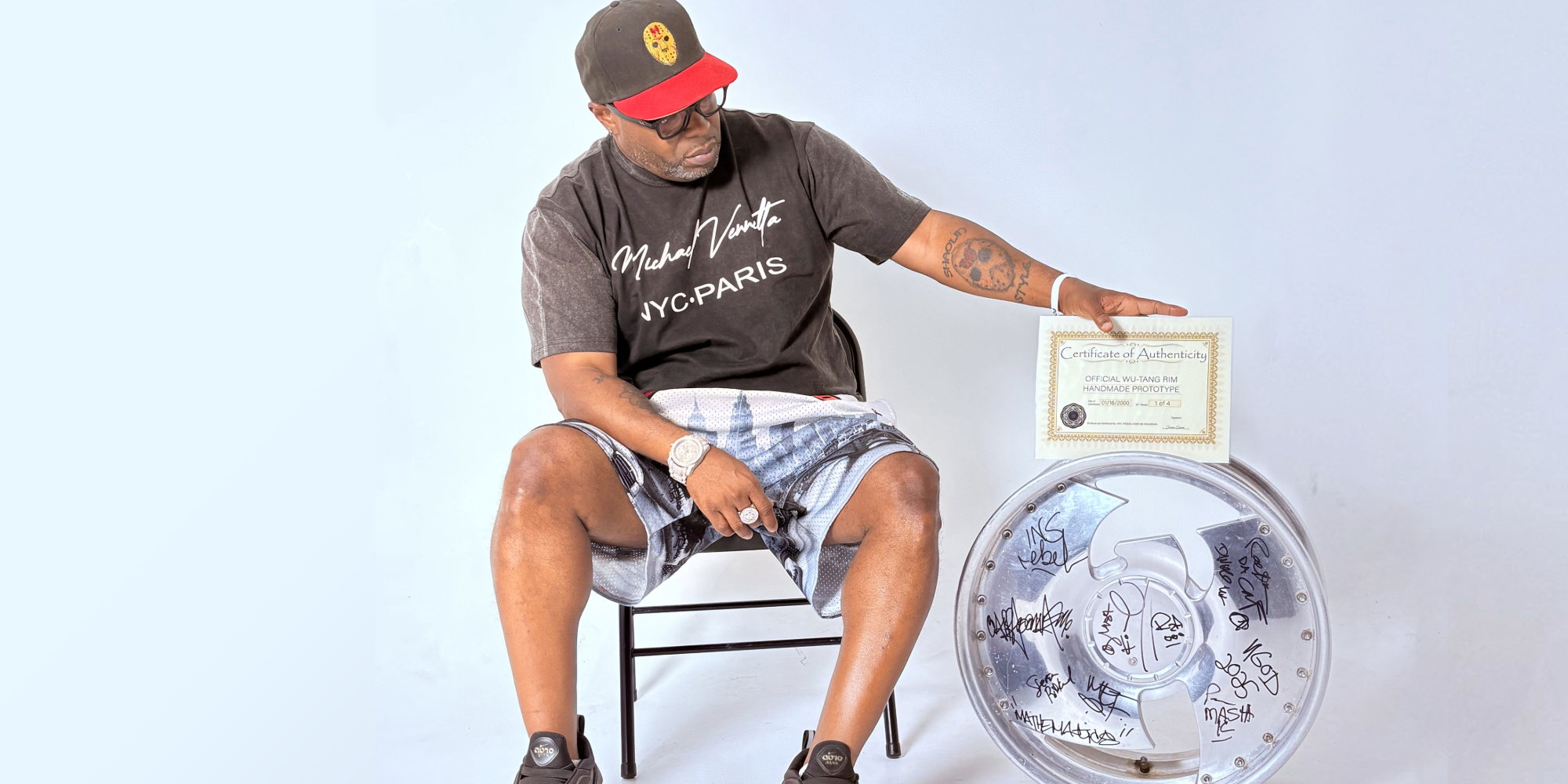
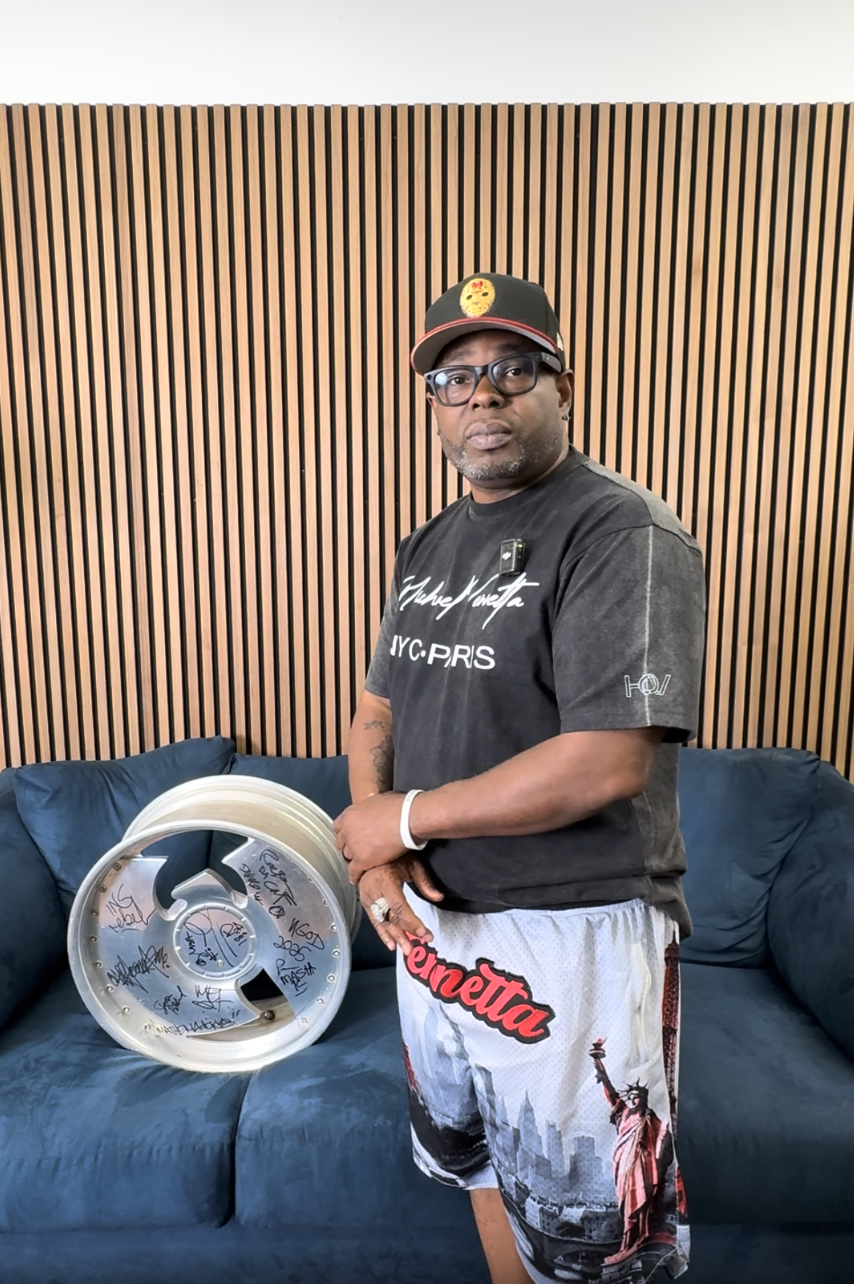
This is the actual prototype that we put on Raekwon's X5
Hear the story behind the ideation and development of this piece.
Enter The Merch: From Wu Wear to Shaolin Style, Staten Island’s Duane Grant shares the stories behind the rise of the Wu-Tang Clan’s brand empire
BY JESSE SERWER
Duane Grant was eighteen years old when his cousin, the late Oliver “Power” Grant, enlisted him to design hoodies for a nascent Wu-Tang Clan to give away in their Park Hill, Staten Island neighborhood. That project soon developed into Wu Wear, the pioneering apparel brand and retail store that opened the floodgates for hip-hop brand extensions when it launched in 1995. Over the years, Grant has remained an integral part of the Wu-Tang braintrust, working alongside Power (who died in February at age fifty-six, following a battle with cancer) to extend the Wu’s reach into video games, skateboarding, and rims via partnerships with Activision, Vision Street Wear, and Raceline Wheels, respectively. Here, he discusses Wu Wear’s guerilla roots, taking the brand from Victory Boulevard in Staten Island to Manhattan’s Fashion Avenue, and the challenges of getting nine MCs to align on deals—as well as some of the drops that never made it to the streets.
I was trying to look up dates for Wu Wear before we spoke, and there's hardly anything online from then. It was such a big moment at the time. But this was before the Internet was there to capture everything.
Duane Grant: On top of that, a lot of the behind-the-scenes stuff, we kept it that way for a reason, you know what I'm saying? I've always wanted to maintain that sense of privacy.
How did you get involved in the business of Wu-Tang? Power is your cousin, and he’s involved with backing the group from jump. At what point does he approach you?
I was eighteen at the time, and he came to me with the idea of doing a clothing line. He showed me the W logo. He knew I was an artist, I always drew, so he asked me, “What do you think?” I said, it could work, it depends on how we do it. So he pieced together some concepts, he showed me some t-shirts, hoodies, and things. In the beginning, the hoodies that we were using were regular Hanes hoodies, and we were taking a sticker and sticking it on the actual shirt. So it wasn't really a piece of clothing per se, it was just that hoodie with the Wu-Tang sticker, because that was the most cost effective way to get noticed. We could put that sticker on a thousand hoodies and just give them out. And everybody's walking around the neighborhood, now they got Wu-Tang on for free. A lot of people, they're gonna take something for free.
What year are we talking about?
We're probably talking ’92. The first “Protect Ya Neck” single had dropped.
And then the next year it explodes.
It was a lightning flash. It caught us all by surprise, to be honest. With the music part, I wasn't too much in the mix. They’re all a few years older than me. Power was my cousin, but he was also like my older brother. So he kind of took me under his wing. He said, “Yo, I want to do a store. I'll put up the money, but I need you to find the space.” My thing was it has to be in the area where it makes sense. I did a little research and found the spot on Victory Boulevard. Back then, bruh, the rent was like $700 or $800 a month for the store. So, you know, we jumped right on it. It took about six to eight months to get it [how] he wanted it. And then we went to a print shop on Staten Island, and had them do the print work on the first run of t-shirts and hoodies. That was all we had access to. We’re young Black kids, we don't got access to factories. So we gotta go the grassroots way. We gotta hit the print shop up. Nobody really believed that it would work. Not the artists per se, but the other parts of the team, they thought my cousin was a little crazy for putting money into it. But he took a gamble and it worked out beautifully.
The Wu brand begins with the incredible “W” symbol done by [producer and Wu affiliate] Mathematics. When did you grasp the power of that logo?
I mean, everybody amongst us, when we first saw it, we knew it was something. We just knew we could do something with this. We could start a movement, you know what I'm saying?
Wu-Tang being so vast in membership, there are the inevitable power struggles. How many hands were in the cookie jar when it came to branding and merchandise?
As far as the clothing brand goes, Power was the one. He established that early: Wu-Wear is my baby, this is my project. He executive produced the music, but he focused on Wu-Wear and the Wu-Tang brand. Until the day he left. As far as designs, did he ask the guys, “Yo, what do you think of this? What do you think of that?” Of course. But the final say-so with the clothing was all Power. Power had carte blanche.
What background did he have in terms of style and fashion?
He was that guy. Everybody in the neighborhood looked up to Power—when it came to cars, when it came to dressing. Him and Cappadonna, they were the style guys.
Now, Wu Wear starts growing from a mail-order business with inserts inside the album, and a store in Staten Island to something that’s in stores nationwide…
The thing that really set it off was we were the first hip-hop brand in Macy’s on 34th Street. When that happened, people started to open their eyes, because we got the whole first floor [window display] of Macy’s flagship store. This was around ’98 or maybe ’99. We had just got the office on Fashion Avenue. Macy’s gave us real estate on that whole first floor. All of the window displays were Wu Wear. They were focusing on the Killer Bees shirt, because it was so different. I tell people all the time, Wu Wear was really the first brand in stores—we're not talking about Enyce and Karl Kani, and those guys— tied directly to hip-hop, a hip-hop group.
So how do you get from Victory Boulevard to Fashion Avenue?
We spent the first year or so doing the print shop thing. We were able to make [enough] money after that first year to go overseas, and get real manufacturing. Now, our numbers totally change. The margins, they’re so different when you get to that cut-and-sew level. That’s the point where Macy’s took notice. Of course, the designs play a major role, because it was stuff people had never seen before, and it was all centered around that Wu-Tang symbol. Power had the vision to keep spinning it off in different directions. Like, “We did t-shirts, we did windbreakers, now we need to move into denim. Let’s do velour.” Everybody had a Wu Wear velour suit. That was one of the best sellers. Once we got to that manufacturing stage, that’s where stores and companies started calling and saying, “Hey, we wanna do a joint venture, we wanna do this, we wanna do that.” Macy's opened a lot of doors, but we’re still young Black guys pitching a brand, so it didn't necessarily guarantee us space in other spots. The ability to have joint ventures with companies like Aspen Apparel opened those other doors for us. Because now it’s not just us, it's us and Aspen Apparel, or whoever.
Within the first year, one thing [Power] did that was probably the best thing he ever did, was he hired a young lady, Cynamin Jones. She became the go-to. A lot of the success as far as product placement, getting it in WWD, she rocked all of that. Power didn't have those connections. And Power didn't want to deal with that. Cynamin came in and lined everything up perfectly. She was the sales girl in the store at first. But he was like, “Yo, I need you to come to the office.” Wu Wear became her baby, too, and she curated that like no other.
The Wu-Wear store was a big thing, and then we never heard of it again. I think it went up to four or five stores around the country.
We had New York, Philly, Virginia, Atlanta, and one in L.A., which was gonna be on Melrose, that never made it to opening.
In the end, what was the reason the business scaled down so fast?
It became an issue of oversaturation versus competition. Now you’ve got FUBU, Rocawear, Ecko, Sean John, G-Unit. Everybody’s dropping these hip-hop-based brands. Your market share is shrinking. As a business person, you look at the overhead versus what you're making, and those numbers are coming down. And the group wasn’t the hot thing anymore. All of these brands now are taking our blueprint and running with it. Not that their stuff was better, but now you have options. Back in the day, if you wanted that hip-hop outfit, you were getting Wu Wear. At a certain point, you take a step back and say we gotta go back to the drawing board.
When did the Staten Island store close?
Maybe 2005, 2006.
That was the last one, right?
Yeah, first and last.
One of the other brand deals around this time is the video game, Wu Tang: Shaolin Style.
After a few years, I took a step away and got a government job. I needed benefits. Around ’98, I was working for the EPA, and Power called me, like “I wanna do a game.” This was when the first PlayStation was moving. He wanted to do a chess game at first. As you know, that was big in our community. We all play chess. I ended up getting in touch with a guy named Michel Kripalani. I went out to San Diego, we sat for a few days, and he gave me the quickest education on software and video-game publishing. And connected me with Adam Goldberg at Activision. I spent a month in Cali, which allowed me to figure out, if we're doing PlayStation, we can't really do a chess game. So we came up with the arena fighting concept. To this day, the game is a love-hate thing. People love it, or they’re like, “I didn't like the graphics!”
What was that process like?
Each guy had to individually approve their artwork, their fatalities, the move sets that they had. It had to be realistic to their brand. We did something for Ol’ Dirty, and Activision shut us down right away. We gave him a flask. Part of his move was he would drink from the flask, drop the flask, and then do his fatality. Activision was like, “We can't do that.” When we drop the game in November 1999 now, we're dropping alongside Tony Hawk. While [Activision] was working Shaolin Style, they were also working Tony Hawk’s Pro Skater. When the numbers came back, Tony was number one in the country. We were number two. We were able to sell 400,000 units in the first week. That was big.
Tony Hawk becomes a major franchise, and we never hear about a Wu-Tang game again. What happened?
Tony Hawk is one guy. Wu-Tang is nine guys, seven managers. Sixteen people are never gonna agree on everything. Tony can say, “I like it, let's do it.” I gotta go to nine guys: “Alright, you cool with it?” Some of the guys were like, “I don't wanna do another game, I didn't like how the first one came out.” We had a release party at 36 Chambers, the studio we had in the city, and the guys came to play as their characters. U-GOD was playing against Meth, and he’s yelling at me, like, “Yo, why you made my man so weak?” And I'm like, “Bro, you gotta know how to play him.” Then, when he was beating Meth, he was like, “Yeah, this is my guy right here.” You’ve gotta deal with those personalities. So a lot of things that could have been didn't go where they needed to. Sometimes it’s not about the money. Sometimes it’s: Do I want the headache that comes with the making of the money? Some people don't wanna deal with it.
Tell me about the connections that get made between Wu and the skate world.
Around 2000, the X-Games was going really crazy, and that was the route that the Clan went, because they needed to really re-establish themselves. The intersection made sense. Skateboarders were Wu-Tang fans. Why not hit that market also? We had the option to do skateboards with a lot of companies. A lot of people wanted to use that Wu-Tang symbol. Everybody had their own idea of what they could do with it. Vision Street Wear were more of an underground brand. That's what we liked about them, because we came from the underground. At this time, we were going back to back with different activations: the video game, rims, skateboards. And a lot of other stuff that didn't see the light of day, because of internal drama. That became the constant tug of war that hampered a lot of deals. [Power] was street educated which doesn’t always transfer over into business. I always used to try to tell him, “Look, we can't have meetings where I’m nervous that I’m gonna go to jail.” We can't go in trying to bully people. But this was a different time. This was that Suge Knight, strongarm era.
Tell me about some products and collabs that didn’t come to fruition.
I did a Wu-Tang watch, which was phenomenal. We didn't get to finish it, unfortunately. We dropped a few for press, product placements, and stuff like that. Everybody fell in love with the watch, but it was the wrong time. If I showed you the designs, you'd be like, there's no way you designed this twenty years ago, because it looks like watches now. But, back then, there was no high-end goods and hip-hop. The only way it really translated was putting it on the artist. The consumer couldn’t afford it. You're talking about marketing a $30,000 watch. Who’s gonna buy that in 2000? Who had the money, except artists? The first set of watches that they showed me—this is how I knew I had to design them—they took blank watches, and just put the Wu symbol on it. Nah, we're not doing that. That's not our brand. We're not gonna slap the symbol on everything, roll out, and think that that's cool. Now it looks like we’re selling out, bastardizing the brand. So, at that point, I was like, alright, let me design the way the watch should look.
Who is the harshest critic? Who’s hardest to please?
Rae. That's like my brother. But he's very specific about what he wants. He has a brand. He is a brand. He has to protect the integrity of his brand. You gotta respect that. At a certain point, I had to start pitching the guys individually, not as the Clan. “Okay, Meth, do you wanna do this?” “Alright, Tone, you wanna do this? Rae, you wanna do that?” I had to pitch them like that, because everybody felt like they were being taken care of. And that was always the key for me. I always wanted to do deals where everyone was taken care of.
If you have any questions, you are always welcome to contact us. We'll get back to you as soon as possible, within 24 hours on weekdays.
-
Shipping Information
Use this text to answer questions in as much detail as possible for your customers.
-
Customer Support
Use this text to answer questions in as much detail as possible for your customers.
-
FAQ’s
Use this text to answer questions in as much detail as possible for your customers.
-
Contact Us
Use this text to answer questions in as much detail as possible for your customers.