


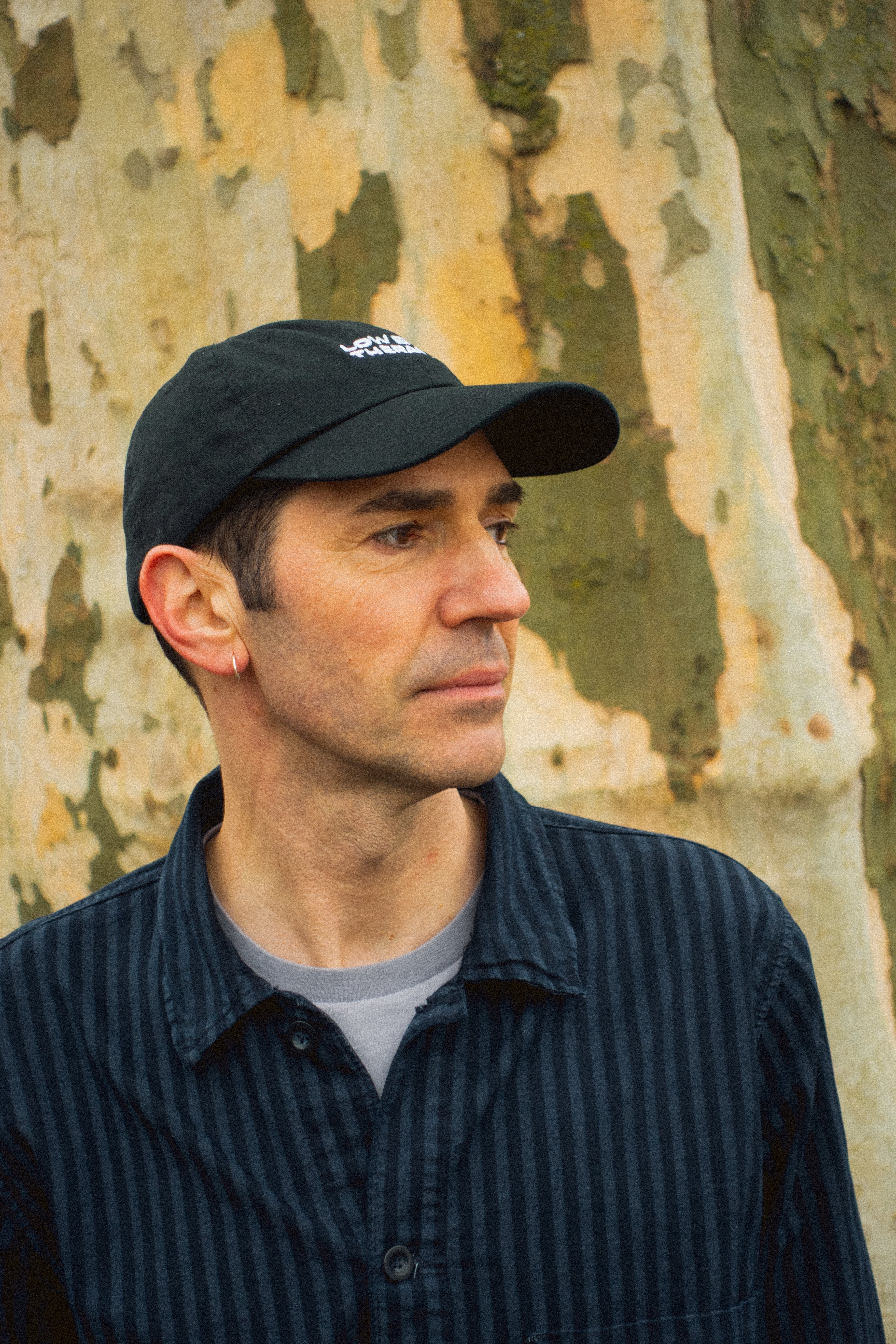
With a career spanning more than two decades of releases, the DJ and producer Martyn has created his own lane in bass music. And with his latest record, Music for Existing, the Dutch-born, Washington DC based artist pushes beyond the dancefloor, drawing as much from free jazz and field recordings as electronic music.
The post-dubstep and drum & bass influences that shaped his early work—and the exploratory spirit of his Brainfeeder years—remain, but they’ve settled into something more spacious and reflective. It’s an album concerned less with genre than with sustaining curiosity: preserving the “childlike enthusiasm” of making music while negotiating the compromises of life’s unpredictable middle third.
Over the course of our conversation, Martyn reflects on collaboration as conversation, why AI misses the point of art entirely, and the value of saying no—a lesson learned from Inga Copeland as much as from years spent refining his own practice.
What are your ideal conditions for making music?
“For the first couple years I started making music I was the sort of person who spent hours in the studio smoking cigarettes, not taking care of yourself, that sort of thing. But I slowly started maturing, I got married, we had a kid and had to make adjustments and build a new daily rhythm.
“I still love disappearing into the studio for hours, but most of the real work happens outside it. Ideas begin as notebook sketches or field recordings rather than sounds. Then I sit with them for a long time, making tiny adjustments to preserve that off-the-cuff feeling.”
You came up alongside the dubstep and beat scenes, both of which have a distinct sense of place—London and LA. What was that experience like, and how did it compare with Eindhoven, where you’re from?
“I was already into electronic music, but when drum & bass came along, around 1995, I felt like I could play a role in it musically. EasyJet had just started flying from Amsterdam to London, so we’d spend weekends going to raves, buying records, then flying home full of ideas.
“We wanted to bring that energy to Eindhoven. It meant making our own versions of London nights like Metalheadz at Blue Note, or, later, our own take on LA sounds. They weren’t copies so much as translations, and translations are imperfect. We were adding influences that people in London or LA didn’t have. That’s where the hybridization started—first as promoters, then in the music itself.”
As in the liminal space in between sounds?
“Exactly. The most interesting ideas usually come from outside a genre. Most innovation happens millimetre by millimetre, but every so often someone introduces something unexpected. Marcus Intalex brought deep house into drum & bass. Digital Mystikz folded dub reggae into UK garage. That’s when genres suddenly open up again.”

What are you trying to say with Music for Existing that you haven’t expressed through your previous records?
“When you first start making music, you don’t really know what you’re doing. There’s a kind of innocence to it—you make music because you have to, and mostly you’re making it for yourself. As music becomes your career, it gets harder to hold onto that childlike mindset. Touring, responsibility and sustainability all begin shaping what happens in the studio. I think many artists who’ve been doing this as long as I have wrestle with that balance: how do you keep that original enthusiasm alive while building something sustainable? There have definitely been records in my career where one side outweighed the other.
“That’s really the conversation at the heart of Music for Existing: the relationship between your inner world and your outer world. The inner world is the studio, that private space where making music is still driven by curiosity and joy. The outer world is everything else—the career, the expectations, the practical realities of life. This album is about trying to let those two worlds exist together.”
You collaborated with Duval Timothy and Lucinda Chua, among others, who play live instruments. What did you learn from the experience?
“It’s funny how electronic music still carries this idea that you’re either an electronic artist or a ‘real’ musician. That divide has always seemed strange to me.
“Over the last few years I’ve worked with more and more instrumentalists, and we’ve reached a point where we’re just musicians making music together. I bring the electronics, someone else brings piano or cello, but everyone’s contributing equally. I’m more like the instigator—I send a sketch, someone responds, and we have a musical conversation.
“Sometimes Duval Timothy would send back stems that didn’t fit the original track, so I’d build an entirely new piece around them. That’s how the album evolved. It wasn’t managed like a project—it was more like a shared Dropbox folder where ideas were constantly exchanged.
“This reminds me of a session I did at Maida Vale when I was signed to Ninja Tune. Suddenly there was this pressure to make studio music look live. They wanted to bring in string players to recreate parts from the record, which felt backwards. If the music was conceived in the studio, why force it into another format just because that’s easier for people to understand?”
Almost like reverse engineering.
“Exactly. I asked Inga Copeland to perform with me and she agreed—but only if she could sing with her back to the camera. She didn’t want to give in to what she called the ‘coffee-table-isation’ of the music. Of course, nobody got it.”
She’s quite the provocateur.
“She is, [laughs]. “But I learned a lot from her. Back then I was signed to a bigger label and felt a pressure to say yes to every opportunity. Inga was the opposite. She said no to almost everything because she was completely committed to doing things on her own terms.”
To my recollection, Music for Existing includes one of the first full spoken word interludes from your catalogue; why Musa Okwonga and why now?
“Musa is a longtime friend, he and Ryan (formerly Illum Sphere, who released music on 3024 .ed) do Stadio (the football podcast) together.
“They're both in Berlin and we always meet up when I go for gigs and have these conversations about sports, politics, state of the world, and community building. And we had one of those conversations after a gig at Tresor and when I flew back home and decided to make it part of the record as if it were a piano stem or a field recording. So he wrote the piece and then recorded it a couple times to get it right and I field recorded some stuff at a restaurant that we usually meet at.
“So, it was kind of photoshopped together that way. It's funny because if I listen to it now, it feels like it's the theme of the record.”
Yeah, that was my take.
“The placement of where it's at on the record and also what it's talking about obviously feels super current and important, but at the time it was just a summary of a regular conversation that we've had.
“It was not the idea beforehand of, ‘oh, we're going to put the theme of the record right there’, it just happened that way.”

Listening to the record, I couldn’t help wondering whether it’s, in part, a riposte to AI. Be it as an artist or label owner, and I know this is a broad question, but what are your feelings on AI?
“The first thing is that AI means so many different things. As a tool, I don’t really have a problem with it. Artists have always used new tools, and if something helps you realize an idea or create something new, that’s fine.
“Where I lose interest is when AI stops being a creative tool and becomes the creator. For me, the essence of art is that it’s an expression of a person’s experience. If there’s no personal history, no heritage, no community, no emotion behind it, then whatever it produces doesn’t really communicate anything. Musa’s contribution matters because it’s rooted in lived experience. That’s what makes it art. If there’s nobody behind the work feeling anything, then, for me, it becomes meaningless. So, I’m not especially afraid of AI because it doesn’t really affect how I experience art.
“I also think we’re encouraged to believe we all need to have an opinion on it. Maybe we don’t. It’s a bit like social media—you can choose not to participate. I’d rather carry on making the work I think is important for the people I think it’s important to.”
I enjoyed your ‘supermarket’ analogy on music streaming and artists sustainability in an interview with Cant Get Much Higher. It’s a tough market but beyond streaming, artists can make money through touring, sync, brand endorsements and merch sales. What’s been your experience in those other areas, and what advice would you give to younger artists?
“Half the things you mention depend on commercial opportunities, and the other half you can build yourself. Making your own music, releasing it on streaming platforms or Bandcamp, producing your own merch, putting on your own events—those are all things you control. Publishing, sync and advertising are different. They depend on what your music sounds like and what those industries are looking for. Great music doesn’t automatically make for great sync music.
“For younger artists, I’d focus on the DIY side—building your own audience, owning your work and creating things you have control over. In electronic music, those industry opportunities should be viewed as a bonus rather than something you rely on.
“One source of income that’s often overlooked is teaching. In classical and jazz, most musicians aren’t performers—they’re teachers. Electronic music is now 40 years old, yet we still expect established artists to tour indefinitely. Maybe more musicians should spend ten years performing, then pass on what they’ve learned. Teaching is not only valuable, it’s probably a more stable income than most of the opportunities people chase.”
Finally, let’s talk about your Collection for Wax Poetics. Was there a ‘grail’, a particular item you’ve agonised over including?
Probably the Moog Sub Phatty (1st edition). I had a woodworker that I know customize the side with the (3024) label logo on it. It's a first edition as well and there was a problem with the keys not being bleached properly. So as you can see they're like the color yellow which is a mistake. But they still work and I think it’s probably the most special item on the list, and also Moog’s synths are super good.
EXPLORE THE MARTYN COLLECTION


Wax Poetics Summer Issue - Mariah Carey, Tupac, Mannie Fresh, Nightmares on Wax - Editor's Letter
Redirection