


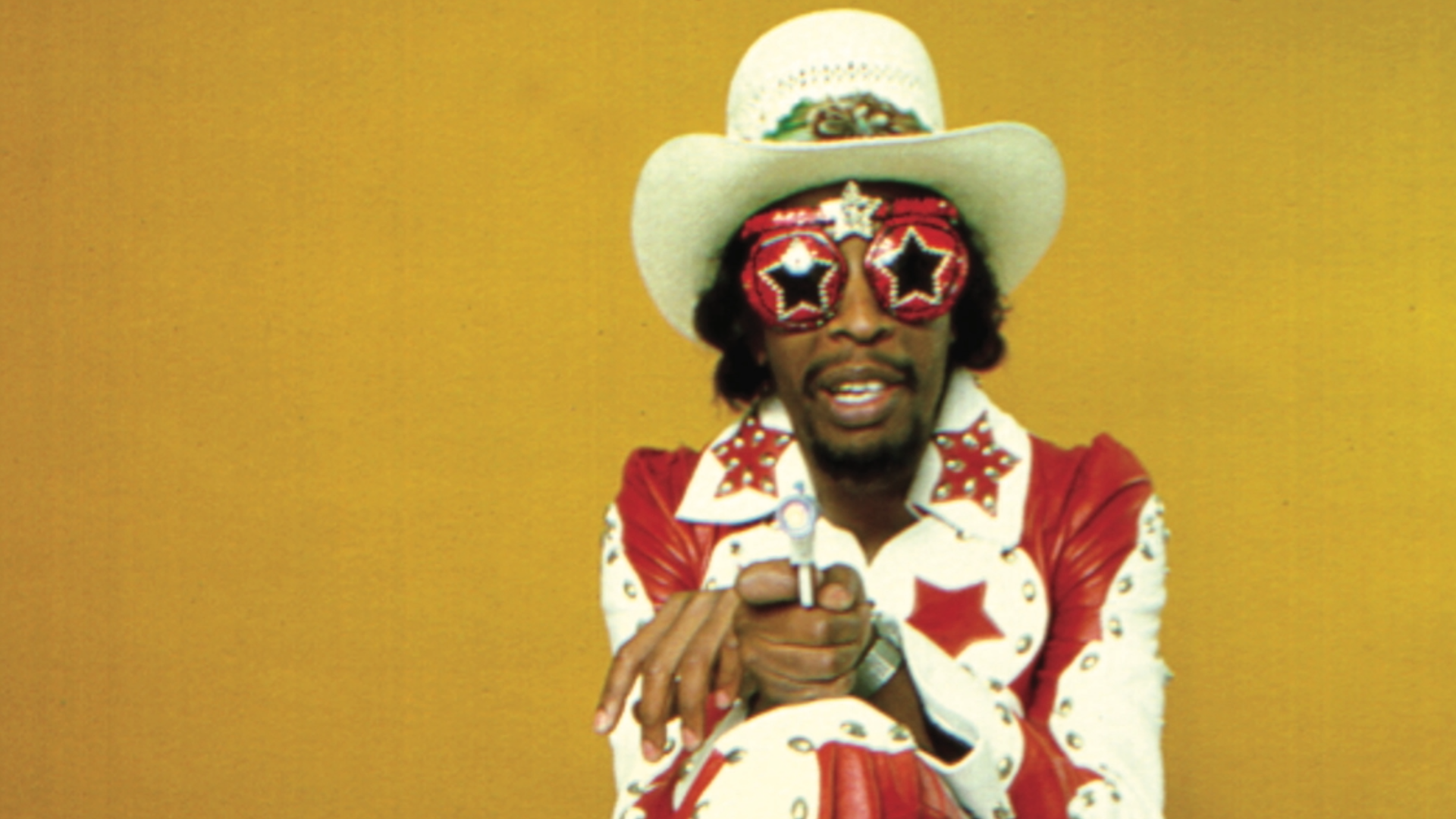
STRETCHIN' OUT WITH BASS LEGEND WILLIAM “BOOTSY” COLLINS
For the sake of history, let’s start at the beginning.
Well, my mom, she grew us up. No dad. No dad in the house, but I always felt responsible for the things that went on in the household. And Mama always had a belt, too! And she would wear us out. I never got a male perspective of that, so I was always out in the streets. Looking up to the males in the streets that did certain things I dug, like entertaining—the players on the streets—the hustling. But then I got interested in music, because I wanted to be like my brother, “Catfish” [Phelphs]. He was playing guitar. I really got interested in music, and I think that’s what started it.
During the Player of the Year tour, a pre-concert cartoon told the story of a paper boy who was transformed into a superhero. Throughout your work, the lyrics and the licks seem to be referencing a silly seriousness. Growing up, did you watch a lot of cartoons?
Oh yeah, I loved them. That was the thing coming up. When we went to school, we’d have the subject book—English, whatever it was—that would be the book the teacher would see. Then you’d have your comic book inside of that book, ya know? Th e teacher would say, “Did you hear me, William?” “Oh yeah, I got it. I got it.” And at the same time, I’d be reading Spider-Man or Batman. We was just in to the comic thang, and I guess it just spilled over into the music. We just wanted to have fun with it—music. And since we looked like cartoons anyway, we just ran with it.
How did you end up at King Studios?
Oh, that was a blessing! Well, actually, a guy in Cincinnati was an a&r guy. His name was Charles Spurling and he would go out and look for new talent, new people to come in and record. So he came out to a club one night. We always played benefi ts. We never got paid and weren’t looking to get paid. At that time, we was just looking to have fun and have a good time. Th at’s pretty much what it was all about. So he came out and saw us playing and said, “Yeah, I want y’all to come over to King’s and be my recording band.”
We was like, “Yeah, King’s. Ain’t that where James Brown is?” He said yeah. Our whole thing was, okay, if we get over in King’s, we’ll get to meet James Brown, Hank Ballard, the Isley Brothers. We were cocky kids off the street, and, like, “Yeah, we bad!” And we really believed that. We got over there and lot of the diff erent producers that was producing top acts at that time wanted us to perform on their records. Once we started doing that, word start getting around. Th en Mr. Brown heard about us. He didn’t want to be left out. It was like, “Who are these young dudes over here making all this noise. Making all these records?” And it was like, “Yeah, that’s Bootsy and them.” He said at some point, “I’d like to meet them, send them out on the road with Hank Ballard and Marva Whitney.” And, actually, that was our fi rst professional gig.
Where were you when James Brown’s band walked out on him? Do you remember the night in 1969 when that phone call came?
I’ll tell you exactly where we were. We were on Gilbert Avenue at the Wine Bar playing a benefit for the door, and I think it was just us and the bartender. And we was just as loud as I don’t know what. And everywhere we played, we just played loud, whether we had one person in the audience or a thousand people. It didn’t matter, ya know? Th en all of the sudden, the phone rang. The bartender came up to me and says, “Hey, Bobby Byrd wants to talk to ya. He wants to talk to you about playing with James Brown. We had took a little break. We was like, “Yeah right, Bobby Byrd want to talk to us about James Brown.”
So we kind of laughed it off , and he was like, “Nah, he’s on the phone.” So, I went and answered the phone and sure enough, it was Bobby Byrd. And he says, “How would you like to play for James Brown?” And we’re like, “You’re joking. You must be joking.” And actually, we had kind of made friends with Bobby Byrd, because he was the only one we could get to back then. He really befriended us and brought us in before we even got with James. So, yeah, he was like, “James really want y’all to be the band. Actually, I’m going to fl y y’all up.” We was like, “No, no way. James’s jet! No way.” So we had never flown in a plane before. So we was like, “Okay, we’ll be ready. We’ll be right here when you get here. See ya when ya get here—yeah right.” And he actually fl ew up there within about forty-five minutes.
He was there at the club: “Come on, we got to go now.” So we had on our tiedyed jeans, my Afro was leaning to the right. And we were wearing them little round eyeglasses from back in the day. Just cool. I said, “Well, can’t we go get cleaned up? We don’t want to go like this.” He said, “No, we gotta go right now. James is waiting on stage.” We said okay. Next thing you know, we was on an airplane, my Afro was in the back of my head and we was fl ying up forty thousand feet in a Learjet. And I had never been on a plane before. I’m seventeen years old, fl ying on the Godfather of Soul’s plane and I’m like, what is going on? Talk about a kid trippin’.
I didn’t know what was going on. So when we get to Columbus, Georgia—I never will forget the look on the people’s faces when we got there. We came through the back door. I already had my bass out, ready to throw down. And as we were walking in, people started hollering, “You’re late!” We didn’t know what that was about! They asked us, “Y’all James Brown’s band, ain’t y’all?” We didn’t know we were James Brown’s band yet! So Bobby Byrd says, “Let me take you back here so you can talk to the Godfather.” So we get back there in James Brown’s offi ce—I got to get y’all in James Brown mode. I’m going into his voice now. He says, “Look here, Bootsy, y’all some bad boys. But y’all playin’ with the Godfather tonight. So when I drop my arm down like this here [Bootsy motions], I’m gonna call out the songs to you. Y’all ready?” We looked at each other and said, “Yeah, Mr. Brown, we’re ready.”

But y’all knew the songs already?
Oh yeah, inside and out. And he knew we knew them. So we hit the stage and sure enough, he calls out a song, drops his hand down, and we were on it! I mean, we were onstage with the Godfather of Soul! Man we were going to wear that mutha out! We thought we were wearing it out. We hit every move. We knew all of his moves. If you noticed, it wasn’t so much about his singing and screaming, it was all about his body. His moves. You had to pay attention! I ain’t never paid attention that much! I mean, every little move he made, if it was with his foot, you had to be on it. Wasn’t no getting high, I’m sorry! If you were high on that set, you wouldn’t have made it. Done. So that’s the straightest time I’ve ever been onstage! And that’s the truth!
So what did you learn from him? Jab’O said that your style of bass playing had the most movement he’d ever heard. But Brown had to focus you on “the One.” He was the one who brought that to my attention. Because I thought I was doing something different. It was like, I don’t want to be like other bass players, just holding the foundation down. I wanted to play a lot of things. “Son, listen to me now. I’m the Godfather of Soul.” He always had to lecture me, and it was cool because, like I said, I didn’t have a daddy back home, so I guess he felt like he had to fi ll those shoes. And he was like my dad.
“Son, you got to stop doing all them things and just give me the One.” So when I started doing that, he started to like it and I could tell. So I fi gured, if I could give him this One and play all them other things…I think he’ll like me. So I started giving him that One that he needed, and playing what I felt. See, a lot of people at King liked that we played what we felt. In fact, James’s string arranger asked me and my brother if we could read music. And we said, “Oh, yeah, we got this!” So he counts it off and says, “Okay, play what’s in your face.” And so we said, “Just count it off and let us hear a little bit of it before we start. We want to make sure we’re on point here.” So they count it off and the rest of the band played. And then we said, “Okay, count it off again.”
We was on it. So after the session, the arranger called me and Catfi sh back in the room and says, “Everybody just loved what y’all did, but y’all can’t read a lick.” So we were like, “Yeah, you right.” But I said, “We wanted to play with y’all so bad, and we knew we had to know how to read.” And he said, “No y’all don’t, because the feel y’all got—don’t nobody else got a feel like that right now.” He said, “Don’t worry about it. I’ll work with you.” So that’s how we got the gig of playing with the big orchestras. First, I lied, and then I came back and ate the lie, but at the same time, I gave them the some thing that they wanted.
But you did eventually leave. How did that happen?
Well, really, the reason I left was because of the older people that had been there––because I was the one who could get his way with Mr. Brown. Yeah, I was the young one. Th ey’d say, “Let Bootsy do it!” You know, like that old commercial [for Life cereal] used to say, “Let’s get Mikey to do it! He’ll do anything!” “Let Bootsy do it! He’ll do anything.” So they kind of used that with me, with James. Like, “Tell Bootsy to tell Mr. Brown that we need so and so. Th at we need this.” And I’m saying to myself, “I don’t need nothin’. I’m just groovin’!” And it’s like, “Okay. If y’all want me to go in there and do that, I’ll just go in there and tell him and see what he says. And every time I would go in there, he’d do it, ya know.
But this last time, they said, “We need a raise! You know, he should be paying our hotels and he should be doin’ this that and the other. Bootsy, you need to go in there and tell him!” I’m like, “Okay. I’ll tell him. All he can say is no.” So I say, “Okay, cool.” So I go in there, “Mr. Brown, everybody’s feeling like they need some more money, you know.” He said, “Now, Bootsy, let me tell you somethin’, son. Now I know they puttin’ you up to this.” In other words, he knew I didn’t have sense enough to go in there and do that! Which I didn’t, ’cause I wasn’t thinkin’ about nothin’ like that. You know, all I was doin’ was havin’ fun with the girls, watchin’ the artists get off ; it was just a great time in my life.

You traveled to Nigeria with James Brown’s band. Talk about meeting Fela Kuti. Africa, man—we got off the plane and they started bowing down to us: “Yeah, James Brown’s band!” And I didn’t really know how to take that other than, “Yeah, we James Brown’s band, but I didn’t feel worthy of the praise they were giving us, because I was just this knucklehead, long-haired sucker from off the street, and all of a sudden, I’m with James Brown’s band, and then I got a bunch of people praising me. We go to the hotel, and we find out that Fela Ransome [Kuti] has invited us to his club.
And he was like James Brown over in Africa, so we went. And, man, I told them to take all those praises back, because they were the ones that needed to be praised. ’Cause them mugs was so on it. Th ey had some grooves there that I had never heard or felt in my life. And I couldn’t believe it. I just could not believe it. I mean, you could be ten miles away and you could hear the drums. You could be carrying on a conversa tion and the next thing you know, your body starts movin and you can’t control it! And you’re like, “Damn, what’s wrong with me? I know I ain’t high!” So it was a whole other experience. And speaking of high—can I go there?
You got to.
We’re in the car. It’s me, Bobby Byrd, Vickie Anderson, Catfi sh, Clyde, and an African driver. And just so you know, they didn’t have policemen, they had army men policing the place. And they did not play. For instance, this one guy came to the show. He was blind, couldn’t see nothing, but he busts into the dressing room, run up the steps, yelling, “I want to see James Brown!” And then the army guys just fell out, laughing. And we were like, “What are they laughin’ at?” The cat is blind, and they laughing, saying, “You wanna see James Brown? He can’t even see!” And that really killed me. And then they clubbed him all the way back down the steps. So when I saw that, I thought these cats couldn’t give a dang about me if they did that to him.
So what I was thinking while we was riding in this car, and I got some dirty stuff on me, right? We’re riding and all of a sudden we see the army men coming up. And I start getting a little nervous because we’re in the car gettin’ a little tipsy. And the Army guys are coming towards the car, and I’m like, “Uh oh.” We got to put this stuff away. We got to roll the windows down and get this stuff out of the car. All of this is going on in split seconds. Dude comes up to the car and right before he gets there, I say, “Vickie, put this in your purse. Th ey won’t look in your purse.” She said, “No, I’m not taking that stuff .” She says, “Put it in your boot.” So I put it down in my boot, right? So dude comes up to the car and says, “Okay. What’s in the boot?”
Damn!
And I did exactly what you just did. I could not believe he saw that. I was saying to myself, “How did he know I had put that stuff in my boot?” So he kept talking and the guy was trying to explain to him. I don’t know what they were saying. Th e two men were speaking an African language. So the army guy says, “Okay, but I want to see what’s in the boot!” So, okay, I’m getting ready to give in now, because I know I’m busted. I start to go down to my boot and the driver gets out and walks to the back of the car…to the trunk. Th e boot is the trunk! Ah man. I mean, my heart was in my boot! So he goes back and checks the trunk and says, “Okay, you’re good to go.” I looked at Vicki and Bobby Byrd, and I was through! My high was gone. I said, “Here, y’all can have this stuff . Just take it!” I mean, it was the bomb too. That stuff over there was the bomb! And I just gave it away. I quit getting high for two days.
Do you think you changed the direction of the James Brown thang?
That’s what people say. I think I brought what I did to the music. But I can’t say that I changed James Brown’s music. I can only say I was so glad to get an opportunity to be there. I mean, whatever happened, just as long as I was there and learned what I learned. I can’t take credit for that. All I can say is that, that was probably one of the best times of my life. Clyde and Jab’O—I had some of my heroes behind me. I mean, they were just like heroes for real. Even when I got there and was able to really get to know them, they were still heroes. It’s like, say you’re with a chick; you think she’s this way or that way, and you get to know her, and you say, “It’s not exactly how I thought.” But you know I can’t say that about the James Brown experience. It was everything that I thought and more. So I would hope that I brought something to it because that was a great time.
Let’s jump to Detroit circa 1971. Y’all thought you had your own style until Mallia Franklin says that you guys have the same vibe as Funkadelic and that you should meet George. Do you remember meeting George for the first time?
Yeah, I defi nitely remember that. Wow. Mallia had come down to this club called the Love Club. It was a place where all of the youth would get together; you know, the young bands would go on stage and kind of compete for the gig. And that’s what we did a lot. Th at’s where “Let’s Take It to the Stage” came from. Competing and taking each other’s gigs. So Mallia heard us, and the other bands heard us too, and they were like, “I don’t know who these mugs are, but we’re not going on before them and we’re not going on after them.” So the reputation started going around, and George started hearing about us. And the Mallia says, “You need to go talk to George, because y’all got so much in common. I think his band is gettin’ ready to leave him. Th ey’re having all kind of problems over there. Not enough drugs, what ever. Th ey have had it up to here with George.”
So she takes us over the next day. I remember walking in the house— I’m kind of semi-trippin’ too. Walk in, and George didn’t have no furniture; got about three rooms. When you look straight through the house, you could see all the rooms. No furniture in none of them. And he sittin’ in the last room, in the corner, got his legs in like a Buddha thing—you know, with his head down. He got a star on one side and a moon on the other shaved in his head and the rest was bald. He got a sheet on. His feet—you know he got these big “Boy, I say, Boy” feet. You know who I’m talking about: Foghorn Leghorn! Actually, I nicknamed him that. Yeah, but y’all ain’t heard that from me! But he had these big feet stickin’ out from under his thing. And I’m like, “Dang, this is gonna be fun.” So I walk in and started talkin’ and next thing I know, we just started clicking. It was like, “We’ll go out with you, but I gotta make sure I keep my band’s name. The band name is the House Guests. But let me back up a li’l bit. Before that even happened, the Spinners had called us up to come to Detroit to play behind them.

Find the full article, and our entire archive catalogue when you purchase the Wax Poetics digipass

Everything Is Everything