

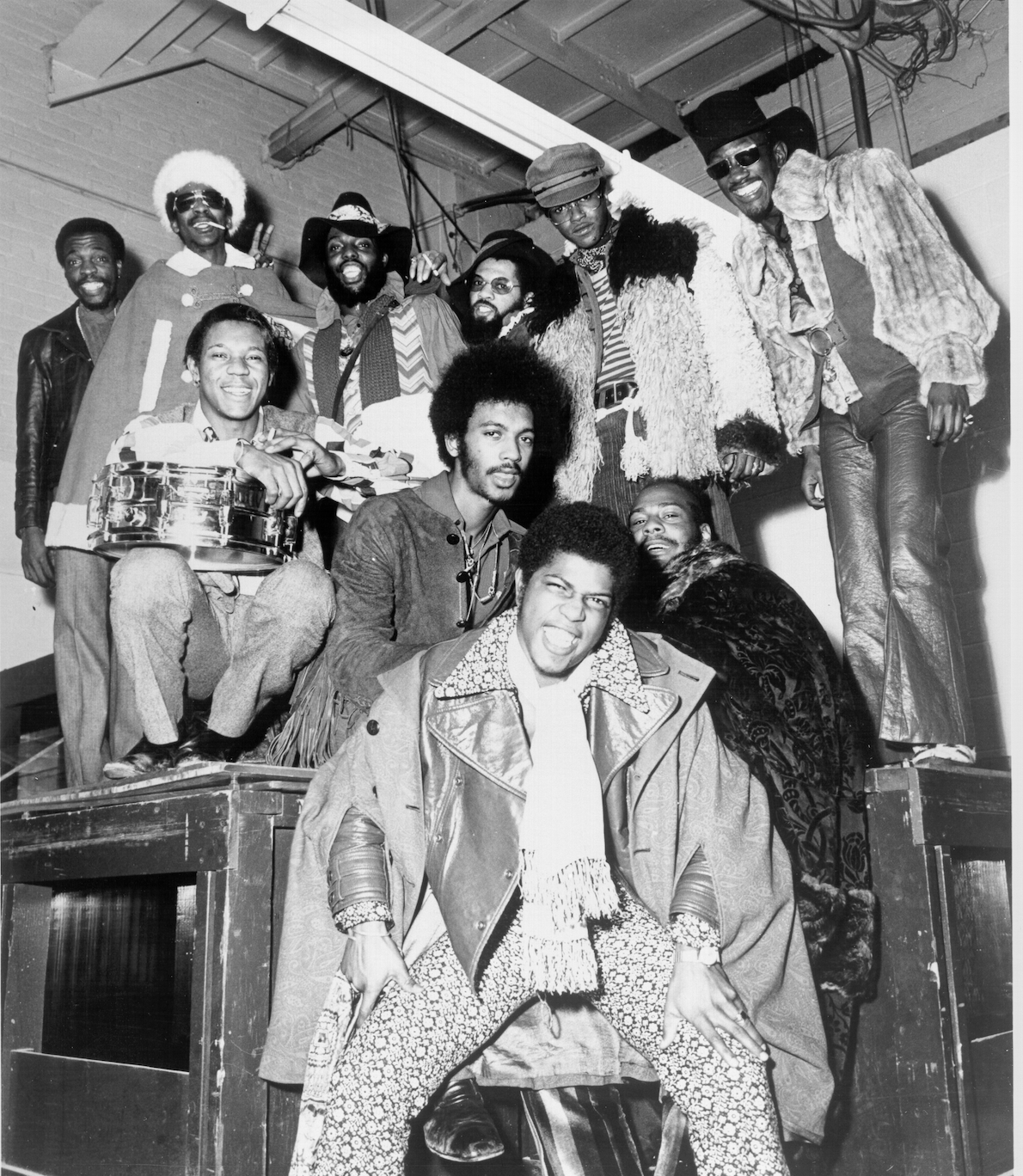
Funkadelic’s America Eats Its Young was a purposeful message to the youth of the United States. In 1972, that younger generation was facing conscription into a war in Vietnam that had become increasingly senseless and nihilistic. Turning to heroin and alcohol to self-medicate only further trampled the bloom of youth. The government offered little solace to their returning soldiers or the families and communities that had been left behind, and, particularly for Black Americans, it seemed as if the promise of a brighter future announced so fervently with the previous decade’s civil rights movement had been met with a withering plummet back to inequity. It was this tumultuous mood that George Clinton’s progressive group of musicians attempted to capture with their fourth album, an admittedly phantasmagorical and occasionally downright scary affair. “It was scary because it was real,” Bootsy Collins puts it plainly. “We were just doing what the situation called for at that particular time.”
The story of virtuoso bandleader, musician, and producer George Edward Clinton begins in Kannapolis, North Carolina, during the early months of the United States’ entry into World War II in 1941. Coming from humble beginnings, Clinton’s mother, Julious Keaton, gave birth to him one summer day in July that year. Once the war ended, his family left from North Carolina to resettle in Washington, D.C., and a short time later moved to Chase City, a small town in Virginia. In 1952, they relocated to Newark, New Jersey. By 1955, a teenage Clinton formed his first vocal quintet, the Parliaments. Their lineup consisted of Clinton, Fuzzy Haskins, Ray Davis, Grady Thomas, and Calvin Simon. They were influenced by Frankie Lymon and the Teenagers’ doo-wop stylings. During this juncture, the group members worked at (and Clinton soon became the owner of) a barbershop named the Silk Palace in Plainfield, New Jersey, and performed their songs to their patrons. While hearing the group sing their songs every day, a few of their younger customers eventually began jamming with the collective. One of those younger musicians was keyboardist Bernie Worrell.
He shared his experience of first meeting George Clinton and how he was enamored with being in the barbershop back then. “My family moved to Plainfield, New Jersey, when I was eight years old,” said Worrell in an interview with this writer in 2012. “I started playing music at the age of three. My first concert was at four years old. I was brought up in a strict household. My mother would always tell me that I wasn’t going to be hanging out with those hoodlums on the corner,” he laughed. “I was the church organist for the Episcopal Church, but word got out that some new kid moved to town and was some type of a genius. I used to sneak out of my bedroom window and go down to the barbershop and get my hair processed. Sometimes, my mom would know where I was going, but that’s how I got to meet some of the ‘riff-raff,’ as my mom would call them.
“They weren’t riff-raff to me, because it gave me a chance to meet other people outside from the church,” he continued. “I had fun listening to barbershop talk. My mom would come down with switches and get me out of the barber chair with the stuff still in my hair,” he laughed. “This is where I got to hear some of [the] Parliaments’ songs. I had a chance to go to a Parliaments show to see them play in concert. They were doing doo-wop stuff back then. It was there where I got to meet George, Fuzzy Haskins, Ray Davis, Grady Thomas, and Calvin Simon, because they were all barbers in the barbershop. One day, George asked me to write some lead sheets up. I did that, and he said one day when he could afford me he would call.”
Soon thereafter, the Parliaments began regularly performing at the Apollo Theater, local high schools, and community centers. Over the next couple years, they cut two singles for two different recording labels: “Poor Willie” in 1959 for APT Records and “Lonely Island” in 1960 for Flipp Records. Within the same year, the collective signed a recording contract with Motown Records’ New York–based office. Because of inner conflicts between the New York and Detroit offices, they were unable to release any songs for the burgeoning record label. Despite this slight setback, Clinton began traveling weekly to the label’s New York office to begin producing for artists such as Roy Handy, the Pets, and other acts. He collaborated with the songwriting trio Holland-Dozier-Holland on one song for Roy Handy titled “Baby That’s a Groove.” A few years later, the Jackson 5 and Diana Ross and the Supremes covered two unreleased songs originally performed by the Parliaments, “I’ll Bet You” and “Can’t Shake It Loose,” respectively.
After failing to make it big in New York City, the group relocated to Detroit with their recording deal set to expire. Once their deal ended with Motown, they signed with Golden World Records in 1965. As soon as they released their only singles for the label, “Heart Trouble” backed with “That Was My Girl,” the label was purchased by Motown Records, which left them to search for another label to call home. (“That Was My Girl” would be rerecorded for Funkadelic’s America Eats Its Young album in ’72.) Around the same time, Clinton sought to incorporate a backing band into the Parliaments’ doo-wop formula for background work and touring. Their initial lineup consisted of guitarist Frankie Boyce, his brother, bassist Richard Boyce, and drummer Langston Booth. By 1966, LeBaron Taylor, a former executive with Golden World, formed Revilot Records with Don Davis and signed the group to a new contract. Their first single, “(I Wanna) Testify,” finally landed them on the Billboard music charts. Immediately, Clinton constructed a five-person backing band to go on tour to capitalize on their newfound success. Because the Boyce brothers and Langston Booth had enlisted in the army (and, tragically, after only four months of duty in Vietnam, Frankie Boyce was killed in combat), Clinton had to replace them. He recruited some old friends to rejoin him, specifically Eddie Hazel, Billy “Bass” Nelson, and Bernie Worrell.
Worrell recalled the moment when Clinton asked him to join the group. “I was [touring] with Maxine Brown after college in Bermuda, and then my wife called me saying that he wanted to meet with us at the Apollo,” said Worrell. “So she went and met with him. After meeting with him, she called me back and told me he was ready. He had just moved everyone to Detroit from New Jersey. He asked me if I would move to Detroit. I had to think about that one, because the Detroit riots had just ended. Anyways, I made the move, and the rest is history, as they say.”
He selected two more musicians, guitarist Lucius “Tawl” Ross and drummer Ramon “Tiki” Fulwood to complete his vision. Sadly, their newfound success would be short-lived, as the new label went insolvent, and Clinton lost the rights to use the name the Parliaments. By the end of the 1960s, the group found themselves at a crossroads. Here, the concept of Funkadelic was born.
The collective was being inspired and influenced by the psychedelic music and culture, led by Jimi Hendrix, Sly and the Family Stone, and Cream, that were spreading across the country. From a suggestion made by Billy “Bass” Nelson, the group renamed themselves Funkadelic. Toward the end of the 1960s, they abandoned their doo-wop and Motown sensibilities, began hanging out with Michiganders the Stooges and MC5, and embraced their multicolored hippie attire and the LSD lifestyle. In 1968, Funkadelic signed their next recording deal with Westbound Records.
Label founder and chief Armen Boladian briefly explains why he signed the collective: “I had heard the group off of previous small-label recordings that they had done and felt they had tremendous potential,” says Boladian. “I thought their sound was unique and not anything like the music of the late 1960s.” Boladian wouldn’t be the only one captivated by the mega-talented ensemble. Somehow, the crafty Clinton managed to secure another recording contract with Invictus Records at the same time. This allowed him the opportunity to have his two groups, Parliament and Funkadelic, releasing music simultaneously, beginning in 1970.
The combination of Funkadelic’s first three albums—1970’s Funkadelic, 1970’s Free Your Mind... And Your Ass Will Follow, and 1971’s Maggot Brain—is one of the most impressive three-album runs in the history of music. But the album most people tend to overlook in the collective’s enduring catalog is their fourth effort from 1972, America Eats Its Young. The album’s title spoke to an existential crisis that the United States was living in at the time. As the Vietnam War continued to press forward, Black people in this country were living in a dystopian nightmare. By the end of the 1960s, the assassinations of prominent leaders, such as Malcolm X, Dr. Martin Luther King, Fred Hampton, and Robert Kennedy, the growing heroin and homelessness epidemic, anti–Vietnam War demonstrations in major cities and college campuses, riots in predominantly Black cities, rampant political corruption, and of course the Vietnam War quagmire had this country on the brink of true revolution.
This was the backdrop before and during the making of America Eats Its Young. This album was the first double album recorded by Funkadelic and the first one with the legendary Funkadelic trademark design on the gatefold cover. Inside of the gatefold, the liner notes were attributed to the highly controversial Process Church of the Final Judgment, rumored to be tied to cult leader Charles Manson. The members of Funkadelic were first introduced to the Process Church in Boston by their road manager, but their association with it was short-lived. In addition, it was the first album that the group wasn’t under the influence of acid. They spent close to two years recording it between three different countries: England, Canada, and the United States. Most importantly, it introduced the House Guests, formerly known as James Brown’s backing band, the J.B.’s. The House Guests were comprised of bassist William “Bootsy” Collins, guitarist Phelps “Catfish” Collins, saxophonist Robert McCullough, drummer Frank “Kash” Waddy, and trumpeter Clayton “Chicken” Gunnels, and featured United Soul members guitarist Garry Shider and bassist Cordell Mosson.
Bootsy Collins remembers when he first met George Clinton and how he began working with Funkadelic. “I met George in Detroit because of [singer] Mallia Franklin,” Collins tells me. “We met her in a club when we was playing in Detroit, and she told us that we looked like Funkadelic, and I should talk to George Clinton because he was having problems with his band back at that time. That was around in 1972. Once George and I hooked up and started talking, I actually went over to his house and we talked about it. He was telling me what he was wanting to do. He was saying if I helped him with Parliament-Funkadelic recording, writing songs, and tracks, he would help me get a label that I could sign to, for my band. That’s where Bootsy’s Rubber Band came from.”
Coming off the critically acclaimed success of 1971’s Maggot Brain, George Clinton was inspired by the previous works of the Beatles and the Who and wanted to challenge himself to make a concept record about the plight of Black citizens in the United States. To his credit, he abstained from hard drugs while constructing the album, and it became his most ambitious effort to tell the unfiltered truth about the country of his birth. The cover art for the 1972 album America Eats Its Young sent a clear message to Funkadelic’s fans and the music industry. Clinton collaborated with then manager Ron Scribner to replicate a one-dollar bill, with variations, for the cover concept, which artist Ron Weldon completed. Instead of an olive branch and arrows, the eagle in the Great Seal is clenching a hypodermic syringe and child. The Statue of Liberty has devilish, bloodshot eyes and vampire fangs penetrating into one of the babies she is holding. The baby is missing half its skull and brain. It was quite the statement in 1972, but Clinton knew that through a potent combination of genre-bending musical expression and sociopolitical messaging that this could be one for the ages. Also of note, the first-edition album contained a booklet and color poster illustrated by artist Cathy Abel, both that have the first-known examples of the now-classic Funkadelic logo.
George Clinton reflects on the mindset he and the group had while making the album. “With the Vietnam War beginning to end and people coming back, everything was in play,” says Clinton. “Coming out of Motown where there was love, partying, and dancing, I was going psychedelic. From Free Your Mind... And Your Ass Will Follow, Funkadelic, and Maggot Brain, everything was going psychedelic at all costs. Forget being straight and clean-cut; we was just going crazy all at once.
“By the time we got to America Eats Its Young, we could show what we knew having been in the business a long time,” he continues. “The musicians could play very well. We had a good taste for all kinds of music. A lot of the songs had clean sounds and everything, but the topics were scary like biological speculation, violence, and the drug insinuation. All of that was coming into play, especially since the whole psychedelic thing was beginning to end. We had to figure out a way to be a part of it, and then change it to something new at a quick notice. That’s why you see, right after that, it started being R&B psychedelic until Bootsy came with us, and we went straight funk with horns and things. That’s when we started with the horns on America Eats Its Young. Bootsy had horns with him, so we had to write cuts with horns on them on that album.”
On the collective’s previous albums, they touched on various societal issues and the perilous conditions that Black people were facing in the early 1970s. Their native cities, Newark and Plainfield, New Jersey, as well as their adopted hometown, Detroit, Michigan, were inundated with riots during the “long, hot summer” of 1967 because of the incessant police brutality happening in Black- and Latino-majority communities, combined with abject poverty and an overwhelming sense of neglect and hopelessness. Looming in the background was the expansion of the Vietnam War conflict. As the war continued, the draft was selecting primarily young Black men from their communities to serve on the front lines during combat missions. Because of these actions, the results were devastating for Black soldiers in particular. There were several incidents of soldiers losing their limbs, suffering from brain trauma, and turning to heroin use to deal with their jumbled reality. If they returned home, many of them came back with mental health issues and debilitating drug habits. Several of these young men were the same ages of the members in Funkadelic. These issues were front and center on the minds of not only Funkadelic but many of their musical peers, such as Marvin Gaye, the Chi-Lites, Sly and the Family Stone, Gil Scott-Heron and Brian Jackson, the Last Poets, the Watts Prophets, among others.
Additionally, there were numerous young Americans dodging the draft by escaping to Canada. George Clinton began spending more time in Toronto, Canada, during the late 1960s and early 1970s. While the collective toured on the college club circuit, Toronto was one of the familiar cities they would often perform in. While some of the album was recorded stateside at Artie Fields Studios in Detroit and at Mastercraft in Memphis, he made the decision to record the majority of America Eats Its Young at three different studios in Toronto: Manta Sound, RCA Studios, and Toronto Sound. He also chose Olympic Studios in London, England. It became the first album that the collective had mostly recorded outside of the United States. During their recording process in Toronto and London, they were able to get contributions from rock royalty such as Canadian bassist Prakash John and by using a famous drummer’s set in London.
Clinton recounts their earliest experiences in London and Toronto. “When we were recording ‘Everybody Is Going to Make It This Time,’ we was in London, and we used Ginger Baker’s drum set,” says Clinton. “Jimmy Miller was there recording the Rolling Stones, and Cream’s setup was still in the studio, so we used Ginger Baker’s drums. He didn’t know it then.” Clinton continues, “Yonge Street [in Toronto] was lit all night long. It was live for people on the street. It was pretty chill and everybody got along. Lots of music clubs everywhere, and lots of hippies there and college kids all over the place. People came from Detroit and from Buffalo up to Toronto and Montreal. It was jumping. John Lennon was up there, and Yoko was there while we were there too. We had a chance to experience a lot of different things going on in ’69 and ’70. There was three studios up there that we recorded in, and that’s where I met Prakash John, who was the bass player for Alice Cooper. He played on a few of our songs for this album up there. We just met them. They were all part of Toronto Sound.”
After making the decision to record in Toronto, Clinton began working with legendary engineer Lee DeCarlo and his assistant engineer Rick Capreol at Manta Sound. The studio was located in the heart of downtown Toronto, 311 Adelaide Street East. Rick Capreol recalls working with the group after they finished recording some material at Toronto Sound. “They basically just arrived and started recording,” says Capreol. “I knew they did some recording in Toronto at Toronto Sound. I believe their main engineer was Terry Brown. I think he actually did some of the Funkadelic stuff when he was in England. They came in and some of the tracks had actually been recorded as jams at Toronto Sound. We would throw up the 16-track, and they would basically cut the two-inch [tape], and George would edit them into the format that he basically decided was going to be the tune. Then we would commence overdubs, as if it was recorded as an arrangement. Some of those songs were basically created through surgery from multiple jam sessions. Some of them were, and some of them weren’t. Keep in mind, these guys had been on the road for a couple of years. Some of those tunes went back, and I guess it was not a situation where the band came in and rehearsed songs. These guys came in, and they just ripped it up. It was only a matter of George deciding the tempo for a jam on the tune was a little better than the tempo on another jam, but they were playing the arrangements as such. I’d venture to say that we were in there for six weeks to two months. Although we would be out of the studio for a day or two here and there, while they were doing film scores and big Coke commercials and stuff, because it was one of the few rooms where we could have seventy musicians.”
Bootsy Collins, Bernie Worrell, and George Clinton became the creative triumvirate to assist their bandmates with refining their ideas and turning them into full-fledged songs. Collins’s influence is omnipresent throughout America Eats Its Young. His pulsating bass lines paired alongside the keyboard wizardry of Bernie Worrell and the creative foresight and musicianship of Clinton led to the creation of what he calls “progressive funk.” Worrell’s extensive classical training background at the Juilliard School and New England Conservatory gave him the ability to expand his skill set to cultivate horn and string arrangements. Collins’s experiences with James Brown prepared him for the rigorous studio and tour grind with Funkadelic.
Collins shares the importance of having George Clinton leading the group while cutting songs for the album and their studio routine. “We’d all kind of drag in, probably around twelve, one o’clock,” says Collins. George was good from two o’clock on, and we’d go. People would be falling down in the studio and take a little nap, and then wake up and start hitting it. Once we got in there, it was on. There wasn’t no stopping until the last man dropped. Once the last man dropped, we were out,” he laughs. “It was an all-day, all-night thing, depending on the songs and what we were coming up with. Every day was different, as far as the material we came up with and who George decided to record with that day. For the rest of the guys, we were just hanging around unless we were doing vocals, which I got a chance to do some vocals as well. Doing vocals was really his thing. He made sure all of that stuff was done right. If the band had anything they wanted to do, a couple of them would just start jamming and put stuff down, then George would walk in, and off the top of his head, he’d start singing. It was like he was making something out of nothing. A lot of things happened like that, and all we had to do was finish it. Each song had its own transformation. We were funking for fun.”
For the fourteen songs on the double album, they highlight the melodic, harmonic, and chaotic contributions of not only the members of Funkadelic and United Soul, but the Toronto Symphony Orchestra, David Van DePitte (who was responsible for arranging Marvin Gaye’s What’s Going On album), and a quartet of female vocalists—Diane Brooks, Pat Lewis, Mallia Franklin, and Debbie Wright—who provided their exquisite lead and background vocals. Not to mention a plethora of other musicians that were brought in by George Clinton. “That Was My Girl” and “Pussy” were two songs featured on the album that were redone from previous recordings, respectively, by the Parliaments in 1966 and Parliament in 1970 (listed as “I Call My Baby Pussycat” by A Parliament Thang on Invictus). What stands out on this particular effort is how eclectic the music and subject matter were in relation to the time period. Clinton offers some insight into the versatility of the group’s sound. “America Eats Its Young was one that painted a picture of that particular time,” says Clinton. “It’s relevant like it is now. It’s one of those albums that really marked our existence, our coming onto the scene. We told our story, in our way, from the Motown era to doing this Funkadelic psychedelic music. This album showcased our ability to make any kind of music that we wanted to make. That was my intention to give us that ability to do anything we wanted to do. For us, we were just doing progressive music. We knew most of the Beatles and all the different groups. As a songwriter, I was trying to do all the different styles and the music that I appreciated. Having a band that was allowed to play what they wanted to, as opposed to having someone telling us what to play, made all the difference. I never wanted to change their style.”
In the midst of working at Manta Sound, Rick Capreol witnessed the leadership of Clinton while working with the group and engineer Lee DeCarlo. One of the ways he communicated with the main engineer was by using his right hand to tap the top of his head when he thought the music was going in a direction that wasn’t what he had in his mind for the actual rhythm for a song, or when the band was doing the best version of what they were trying to accomplish and the two-inch tape was running out of real estate. It meant that the engineers had to stop the Studer tape machine and the reels of tape, stack them, flip them upside down, thread them through the guides, and start recording again going backwards on the tape. This happened quite frequently during their time at Manta Sound.
Capreol tells an incredible story about Bernie Worrell while working on one of the songs with the Toronto Symphony Orchestra. “There is one rather unique story I can share,” says Capreol. “They had the strings being added to one of the up-tempo songs. The symphony players always took a rather condescending attitude when they came in and played on rock sessions. They were all in there talking about their golf game and what they did last weekend, and it’s just a roar coming off the floor. Then, of course, Bernie walked in dressed up in his usual psychedelic stuff, with his high boots. Everybody’s basically snickering, “Who is this guy?” He started dropping music [charts] as he walked around the orchestra. You could just see across the floor everybody shut up. As soon as the music hit the stand, and he progressed his way across the orchestra, there was this deathly silence that was so obvious. He came back into the control room, and what he’d done was, he charted out his left-hand clap part. He made the cellos play it. It was as hard as anything any of these classical guys have ever tried to play. All of a sudden, they got it, like, this ain’t no party. The neat thing was, they really got into it. It was the first time I’d ever seen the principal cellist for the Toronto Symphony come into the control room to listen to see what they did in context with the track.”
Bernie Worrell was a force of nature. Both George Clinton and Bootsy Collins agree that Funkadelic would not have been as successful without the extraordinary gifts of Worrell. “Once we started with America Eats Its Young, I started letting Bernie tell us what to do so we did it correctly,” says Clinton. “By this time, he had figured out the funk thing that he could do and mix it with the classical.” According to Bootsy Collins, “Bernie was all up in the mix. We couldn’t go nowhere without the keys to the ship, and Bernie had the keys.” Bootsy Collins’s lone song contribution to America Eats Its Young was “Philmore,” but it was a harbinger of things to come for the newly minted member of Funkadelic. Together with his brother Catfish Collins, Harold Beane, Eddie Hazel, Garry Shider, and Cordell Mosson, their signature styles complemented each other tremendously on the collective fourth studio offering. Through the making of this album, most of the Funkadelic members’ ages ranged from their early to late twenties. Within the gatefold of the album, there was a declaration that America Eats Its Young was for the young people of America. In many ways, the message still resonates today.
Bootsy Collins expresses why the title and content for the album remain pertinent today. “When people heard America Eats Its Young, it was like, ‘Ooh, that’s scary,’” says Collins. “It was scary because it was real. Then, forty and fifty years later, you realize they really are still doing this. We were just doing what the situation called for at that particular time. We didn’t have no idea forty or fifty years later that it would be as relevant as it was then. I think it might even be more relevant now. There should be some kind of change. You would think it would have been some kind of real change, but they’re doing it to you in your face now. It’s like they used to hide it, but now, they don’t even care. What you going to do about it? It’s a sad situation, but I think we will prevail because of the funk. Even in the cotton fields, we always sang our way through. We always made it through that day. I feel the same way today. We’re going to make it through this time.”

Miles Davis - Black Satin
LaBelle - Equal Rights