

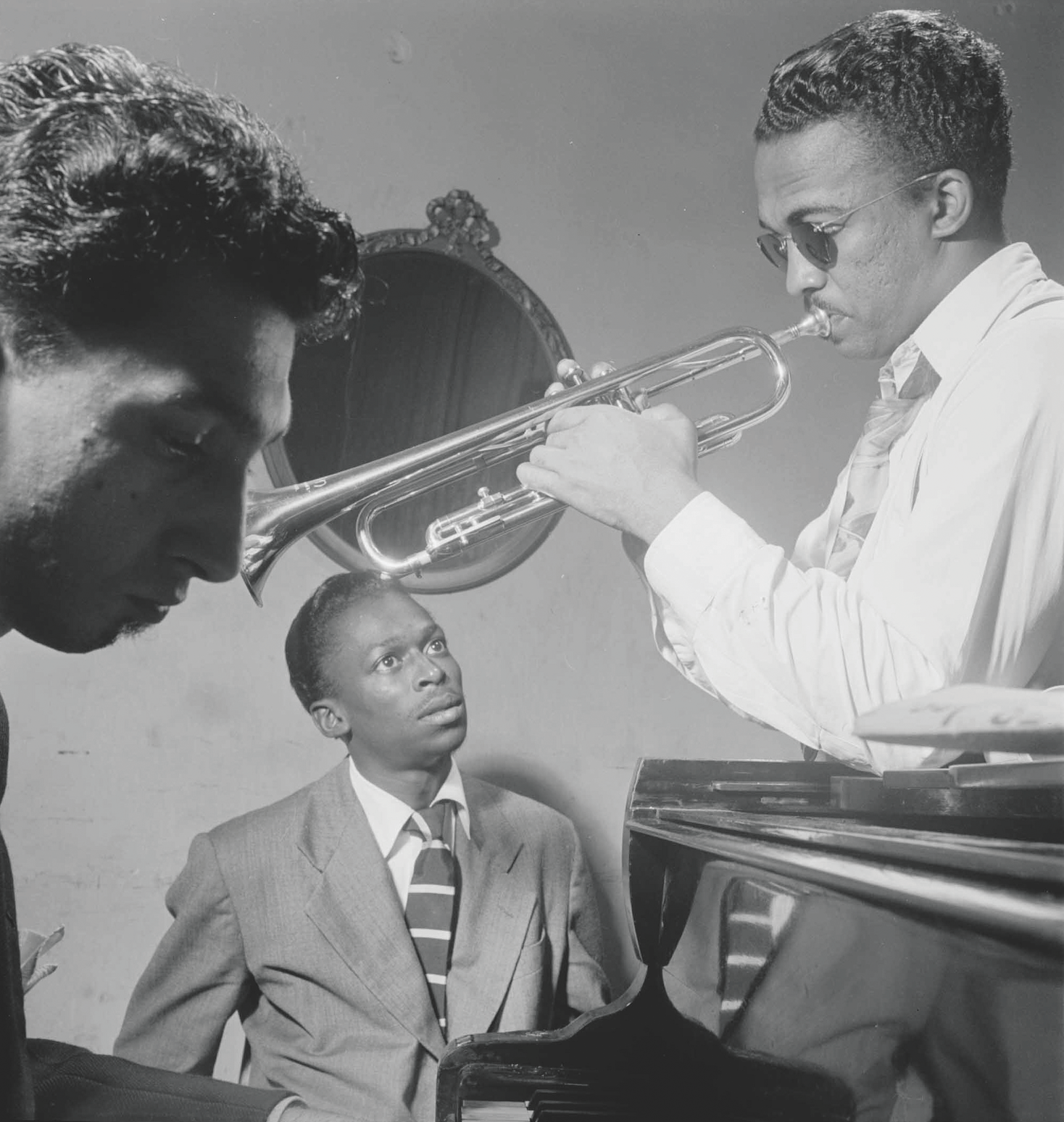
Miles Davis was called one of “the best dressed men of the twentieth century” by both GQ and Esquire magazines. Looking sharp in his Brooks Brothers suits during his Birth of the Cool era, he quickly changed things up by embracing the Ivy League look while creating classics like Kind of Blue. As the 1960s heated up, Miles swapped the casual campus garb for slick Italian suits as he pursued his angular, modal sound. Each time he changed his music, he changed his look, and the 1970s brought us Electric Miles and an eclectic wardrobe that matched Sly Stone. After a brief hiatus, Miles came back to the world and embraced the color and visual pop of the 1980s and celebrated Japanese fashion designers like Kohshin Satoh and Issey Miyake. Long after his passing, the fabric of his music and fashion remains with us.
----
I came to appreciate Miles Davis as an artist when I was working at an AM radio station in Cincinnati, Ohio, in the early ’80s. I did the overnight jazz show on 1480 WCIN, even though I knew next to nothing about jazz. This was a year or so before the advent of the CD, so we were still working with 12-inch vinyl discs, which allowed for incredibly impactful album cover art. One of the albums that caught my eye was a vintage Miles Davis live album called My Funny Valentine: Miles Davis in Concert. The cover photo was Miles focused somewhere other than on the camera, with close-cropped hair, holding his trumpet, and wearing a dark suit and dark polka dot tie.
Up until that point, the only Miles I was aware of was “electric Miles.” So the acoustic, melodic subdued tone of this album was shocking, but in a good way. The album inspired me to get into his music in a way that I’d never considered before.
As time went on, I started reading about him and was fascinated by the walking contradiction that made up the man who would become known as the “Picasso of jazz.” Almost every book that I read always mentioned his fashion sense, but in passing. One day, I saw a smashing color photo of Miles taken by William Claxton, one of the giants of jazz photography. Miles was standing there in a brown suede jacket, gray flannel slacks, a scarf wrapped around his neck, holding a cigarette, and looking pissed. At that moment, he was the coolest guy I’d ever seen, and it hit me: Why not write a book on the fashion of Miles Davis?
----
Michael Stradford has had a long career as a music and entertainment executive who enjoyed a long run as content creator for Sony Pictures Home Entertainment. The following interview quotes—presented here as an oral history—and much of the text are excerpted from his book MilesStyle: The Fashion of Miles Davis.
----
LEGEND
Reggie Hudlin: Writer/director known for the classic hip-hop film House Party.
Clark Terry: Jazz giant, trumpet player, and Miles Davis mentor. Passed away in 2015.
Prof. Monica L. Miller: Author of Slaves to Fashion: Black Dandyism and the Styling of Black Diasporic Identity.
Bryan Ferry: Singer-songwriter and founder of Roxy Music.
Dr. Todd Boyd: Professor of Cinema and Media Studies at the USC School of Cinematic Arts.
Quincy Jones: Jazz trumpeter/bandleader/composer/arranger; produced Michael Jackson.
Frances Davis (née Taylor): Model, dancer, actress; Miles’s first wife (1959–1965). She appears on the covers of Miles’s Someday My Prince Will Come, In Person, and E.S.P. Passed away in 2018.
Charlie Davidson: Tailor and owner of the famous Andover Shop in Cambridge, Mass. Styled Miles Davis and Chet Baker. Passed away in 2019.
Marcus Miller: Bassist/multi-instrumentalist, producer, and composer; bassist on The Man with the Horn and We Want Miles; musician, composer, and producer on Tutu, Music from Siesta, and Amandla.
Darryl Jones: Bassist on Decoy and You’re Under Arrest.
Lenny Kravitz: Singer-songwriter; godson of Miles’s third wife, Cicely Tyson.
James Mtume: Percussionist, composer, and producer; played with Miles from 1971 to 1975, including on On the Corner.
Ron Carter: Legendary bassist/composer who played in Miles’s “Second Great Quintet”—with Herbie Hancock, Wayne Shorter, and Tony Williams—from 1963 to 1968 (and recorded with Miles until 1970).
Michael Henderson: Singer-songwriter and bassist; played bass with Miles from 1970 until his hiatus; appears on Jack Johnson, Live-Evil, and On the Corner, among others.
Betty Davis (née Mabry): Singer-songwriter and sometime model; Miles’s second wife.
Andrea Aranow: Fashion designer who created looks for Jimi Hendrix and Miles Davis.
Anthony Barbosa: Photographer who shot the iconic photo of Miles in front of his closet of clothes; also shot countless album covers including You’re Under Arrest.
Kohshin Satoh: Japanese fashion designer who clothed Miles and Andy Warhol in the 1980s.
Mikel Elam: Painter and personal assistant to Miles from 1987 until his death.
Jo Gelbard: Painter and girlfriend of Miles from 1984 until his death.
Vince Wilburn Jr.: Drummer and producer; nephew of Miles; now helps oversee the Miles Davis Estate. Appears on The Man with the Horn and You’re Under Arrest.
----
I. BIRTH OF THE COOL: 1926–1949
Miles Dewey Davis III was born in Alton, Illinois, to Cleota, an accomplished violinist, and Dr. Miles Dewey Davis II., a successful oral surgeon and dentist, who soon moved the family to an all-white neighborhood in East St. Louis. Dr. Davis, who went on to earn three degrees, was a man who liked nice cars, fine clothes, and refused to be limited by demands of the white majority. This was a lesson that he passed on to his son, who embraced his father’s philosophy. Miles refused to accept treatment that he felt was unfair or prejudiced.
His gift with music helped him stand out at a young age, and he was mentored by local St. Louis trumpet player Clark Terry. In his autobiography, Miles recalls, “Clark had on this hip coat and this bad, beautiful scarf around his neck. He was wearing hip butcher boy shoes and a bad hat cocked ace-deuce. I told him I could also tell he was a trumpet player by the hip shit he was wearing.”
In the fall of 1944, after high school, Miles took his “hip Brooks Brothers suits” to New York City to study at Julliard by day, and, by night, chase down Charlie “Bird” Parker, Coleman Hawkins, and Dexter Gordon. Hawkins took to the young trumpeter and would often give him clothes that he bought from a fashionable shop in midtown Manhattan.
But it was the elegant saxophonist Dexter Gordon who taught Miles the toughest lesson about fashion in the big city. Miles admired the way clothes fell on the tall, slender Gordon. It wasn’t uncommon to see Gordon sauntering around New York in finely tailored double-breasted suits with deep pleats and two-inch cuffs. Even though he thought Gordon was as sharp as a tack, Miles still thought his Brooks Brothers look was the business, until Dexter set him straight. “Miles, that ain’t it, ’cause the shit ain’t hip. See, it ain’t got nothin’ to do with money; it’s got something to do with hipness…. You gotta get some of them big-shouldered suits and Mr. B shirts if you want to be hip, Miles.”
Reggie Hudlin: First off, his sense of style is him being a complete artist. Everything was a canvas, including his clothing. Second of all, being from East St. Louis and knowing the importance of style in East St. Louis, he’s being a product of his environment. One of my favorite things reading his autobiography was the importance of the stiff, starched collar and how fly that look was.
Clark Terry: We’d all try to outdo each other dressing. You had to look sharp to be sharp. I just had a desire to look better than most people. My first nice suit was a blue double-breasted pinstripe suit that I took my first promo photos in. I always love a double-breasted suit. In those days, I was a little cat, and a double-breasted made me feel bigger. [laughs]
Prof. Monica L. Miller: When I look at Miles Davis, especially in his Brooks Brothers period, I see a Black man provoking a discussion, both with his music or art practice, as well as his sartorial practice.
Bryan Ferry: I was very taken by those early photographs of him playing alongside Charlie Parker, and I even have one of those pictures on the wall of my recording studio in London, which gives me great inspiration. Sartorially, the look of bebop perfectly matched the music, and the sharp-suit, shirt-and-tie look has been pretty much my way of dressing for most of my life.
Clark Terry: [Miles] used me as kind of a model, but he would come up with all kinds of ideas on his own. He was the first person that I saw wear a suit with a raglan sleeve.
Dr. Todd Boyd: Birth of the Cool is an album that he lived in the way he carried himself. It was more than just style. It wasn’t just some stylist taking him shopping and buying him some nice clothes. When he put those clothes on, he really wore them. They didn’t just hang off his body. The way he carried himself, some of it is conscious. It’s just the way he is. He embodies this ethos. He wears it, he defines it. He is it.
II. YOUNG MAN WITH A HORN: 1950–1962
The civil rights movement started to gain traction in the 1950s. For someone like Miles, who had always been aware of and sensitive to racial discrimination, he was more than ready for the times to catch up with him, culturally and socially. After spending time in Europe with admiring audiences—a revelation—his return to his oppressive country led him to depression and ultimately a grueling heroin addiction.
Shortly after his return from the fog of heroin, Miles made a sartorial shift. Gone were the big-shouldered, full-pleated suits favored by cats like Dexter Gordon; instead, Miles embraced the clean Ivy League style and the idea of having his clothes fit close to his trim, boxer-honed physique. On the East Coast, he became a regular at the Andover Shop in Cambridge, where master tailor Charlie Davidson worked with him to find the right cut of fabric and color for his suits and sport coats.
Soft shoulders and English tweed jackets with narrow lapels became Miles’s regular outfit. Button-down shirt collars were the norm, memorably captured on the cover of his 1958 album Milestones, where a relaxed Miles rests in a chair sporting a green button-down cotton shirt (sans tie) with the sleeves rolled up, a nonchalant look on his face and his trumpet on his thigh, at the ready. Pants were slim, flat front affairs, often in khaki or wool. Miles loved solid-colored ties and repp striped ties, and often completed his look with Weejun loafers.
In the spring of 1958, Miles met his future wife, Frances Taylor, a stunning professional dancer who “was a big influence on me in another way outside of music,” Miles would write in his autobiography.
This era peaked with the release of the highly successful 1959 album Kind of Blue. But behind this success was the reality of being a Black man in America. Miles would be given a violent reminder of where he was one evening outside of Birdland, the club that he was playing at. When a local patrolman told him to move along, a defiant Miles explained that he was playing at the club and even pointed to his name on the marquee. From behind, a detective cracked Miles on the head causing a wound that took five stitches to close. He was taken to the police station where he was charged with assaulting an officer. In handcuffs, with a white bandage on his head and blood on his cotton sport coat and button-down shirt, Miles Davis exuded style even when banged up and bloody.
Miles said in his autobiography that the incident “changed my whole life and whole attitude again, made me feel bitter and cynical again when I was starting to feel good about the things that had changed in this country.”
Dr. Todd Boyd: You put on your armor before you go out to do battle. When you’re dealing with racism, when you’re dealing with what it means to be a Black man in America at the time Miles was doing his thing, you need every tool available to you to stand against that.
Quincy Jones: He wanted to pretend that he came from the street. Miles is from a very wealthy family. But that was not cool to tell the guys back then. You had to come from the street. He found out very early that stylin’ would work, and he played it to the hilt. It was not an accident. I think it was pretty organic. Part of his essence was to be different. But he had a business mind. He’d say, “Fuck it. You don’t have to give me nothin’—just give me a Ferrari.”
Frances Davis: We were so chic, both of us, when we’d get in the Ferrari, that sleek Ferrari. The way he dressed, the way I dressed, we were something to behold. I always had my style and Miles had his style.
Charlie Davidson: I knew Miles very well. We had a lot of mutual friends. In spite of the fact that many people say he was so difficult, he and I had a very nice time together. He knew exactly the length he wanted the sleeves, the length of the coat. He was a very complicated guy. Part of his image was not to talk so much about it. He was so sharp, but he didn’t want to have to discuss it much. More concerned about being cool, than explaining it too much.
Marcus Miller: There’s a really popular black-and-white video of Miles with Trane, Paul Chambers, Wynton Kelly on the piano, and Jimmy Cobb on the drums. I played it for Miles, and he said, “Man, you can’t tell, but that’s a green gabardine suit.” He said, “It was cold-blooded, but the big thing was that I didn’t have a tie on.” He wore a scarf, and that was a big deal.
Darryl Jones: The point that he was wearing the Ivy League stuff, that was a pretty new statement for a Black man. I think that was in its way cutting-edge. I don’t think Blacks were really exposed very much to the Ivy League look at that time, so for him to have chosen that was, again, a bit of a statement.
Prof. Monica L. Miller: When I see Davis in…a freshly pressed pair of khakis and an immaculate white button-down shirt, I see a man claiming his rightful “class” position [associated with Ivy League whites at the time] while at the same time confounding white expectations of his class position based on his racial identity. Additionally, he’s wearing this “campus” garb on a jazz stage, a place of entertainment previously associated with “low culture” and, often, clubs on the edge of respectability. Davis was, to extend the metaphor, “schooling” people with the combination of his music and look.
Charlie Davidson: He really was ahead of his time. The original Ivy League model was really quite dumpy, very casual, a natural shoulder and all of that. Miles liked it a little bit sharper. Plaid jackets, very trim trousers. He got it immediately.
Dr. Todd Boyd: He was a new type of celebrity for Black culture. When he blew up in the late ’50s, things were changing rapidly, and Miles was very vocal about not wanting to be seen as an entertainer. He wanted to be seen as an artist. There was this need to break away from a cat like “Pops” Louis Armstrong, who came from a different generation and had a very different way of doing it.
III. MILES AHEAD: 1963–1966
In the late ’50s and early ’60s, Italian culture was making its presence felt, via popular films like La Dolce Vita and suave Italian movie stars like the charismatic Marcello Mastroianni and the gorgeous Sophia Loren. During his tours of Europe and his restless search for the next thing, Miles was likely exposed to and attracted to the rule-breaking style of most Italian men: loafers with suits, unbuttoned collars on a button-down shirt, wearing watches on a shirt or jacket sleeve, and close-fitting, well-tailored black suits with sunglasses.
Ever ahead of the pack, Miles segued from his iconic Ivy League look to a more continental style, drawing heavily on the elegant, severely tailored, slim-cut Italian look.
His style was such that his onstage and offstage outfits were included in his concert press releases. Descriptions include a one-button beige pongee suit, a pink seersucker jacket, and handmade doeskin loafers. Down Beat magazine observed in 1960 that Miles was so fashion-forward that he was modeling what they often referred to as “what the well-dressed man will wear next year.”
Frances Davis: I used to go with Miles to his Italian tailor, Mario. Italian chic.
Lenny Kravitz: His style was an outer expression of his music and soul. It said, “This is me at this moment, but don’t blink, ’cause it’s gonna change in a minute.”
James Mtume: What a lot of people didn’t understand was, every time he changed his music, he changed his look. You go back and look at those slick-assed Italian suits from the ’60s, the Milestones cover, and ultimately go into Bitches Brew, and you will see an evolution of the look. He was beyond the music, because he set trends, not just musically, but every time he changed the music, he changed the look, and everybody started dressing like him.
Charlie Davidson: Miles was very, very fashion conscious, always. He’d come and sit around the shop and critique clothes that other guys were buying.
Ron Carter: He had to get his clothes made. When he was working out at the gym, he was getting more muscular than off-the-rack suits would tolerate, I think. He had a sense of how he wanted to look. That it was his sense and not how everybody thought he should look.
Frances Davis: I loved his suits. The way they fit! They were sensational looking.
Ron Carter: When I joined the band [in 1963], he had us go to this place on Forty-Eighth Street, around Rockefeller Center, and had the guy who owned the place, Jack Reitbart, fit us with tuxedos and matching jackets and slacks, so he had the band tuned into his style of clothes right away.
Frances Davis: He knew what he wanted. He would explain to the tailor, and the tailor would do exactly what he wanted.
James Mtume: He dressed like he played. Whatever it was, it was always the slickest shit for that time. He had no corners in his house. They were all smooth because he didn’t like corners. Every slick dude saw a part of himself in Miles. And how to be proud and Black.
Dr. Todd Boyd: Here’s this dark-skinned Black man at this particular moment in time who makes it clear he’s not gonna take any shit off anybody. He’s even kind of confrontational in that way. And this is the era when the Nation of Islam emerges. This is the era when eventually Muhammed Ali emerged, and it’s the era of a new style of Black masculinity. He pissed white people off, because he wasn’t going to play the role that society had assigned him to.
IV. SORCERER: 1967–1975
Creatively, Miles kept pushing, changing musicians as often as was needed, and edging ever closer to the new sound he was trying to capture. The trio of Miles in the Sky, Filles de Kilimanjaro, and In a Silent Way—with their blend of jazz ideas tweaked by electric instruments and rock foundation—would ultimately lead to Bitches Brew. A possible clue that helped shape Miles’s new vision is Filles’ “Mademoiselle Mabry,” dedicated to his soon-to-be second wife, the twenty-three-year-old model (who briefly studied at New York’s Fashion Institute of Technology), singer, and songwriter, Betty Mabry (aka Betty Davis), who was also featured on the album’s cover.
Their relationship and subsequent marriage was short-lived, but Betty’s influence on Miles had long-lasting effects, resulting in a change from Italian suits to snakeskin clothes (though she modestly claims not have have helped with his sartorial evolution), and musically from Trane, Diz, and Max to Hendrix, Sly, and Cream.
Frances Davis: When I left, he started wearing some weird-looking clothes, to me. His hair was kind of wild.
Michael Henderson: He had a hairdresser, James Finney. James Finney did Jimi Hendrix’s hair—Jimi’s hair didn’t just look like that on its own. He did Ashford & Simpson’s hair. On occasion, he’d do my hair. He was the fashion guy who kept Miles’s hair together.
Frances Davis: Everybody said when it came to me and my clothes, that he really wanted to be me. So maybe he let that all out after I left. Sometimes, he looked like he could’ve been wearing makeup or something. Totally different from the chic Miles that I was with.
Betty Davis: He was very self-conscious about the way he looked. He was very into the way he looked. He knew how he wanted to look before he got dressed. I didn’t voice my opinion, because it was the way he wanted to look.
Andrea Aranow: He was always pushing the limits. He was always encouraging me to push out a little farther. He was a good client.
Betty Davis: He wore great suits…. He just didn’t want to wear suits anymore. I guess it was the times, and he was interested in dressing differently. I liked him in the suits, I really did. But that was his taste at the time, and I had to go along with it.
Darryl Jones: I even heard once that him and Sly Stone were in a contest to see who could wear the hippest stuff.
Anthony Barbosa: He had all those clothes in the closet in 1971. He told me he would go and buy expensive shirts, but after the concert was over, they were so sweaty, he’d throw them away. So you never saw him in the same shirt. And he wasn’t spending twenty dollars on his shirts.
Michael Henderson: We were in Italy walking around, up in the hills at a ski resort. There were some glasses in a window. We went up to get the glasses, I put the glasses on, and Miles said, “They’d be a motherfucker if you take the rubber off the rim.” So we bought the glasses and took the rubber off, and those are some of the glasses you’d see him wearing. I started to wear them too, then they started manufacturing the glasses like that without the rubber on them.
Andrea Aranow: It was a time when a lot of styles were being explored at once, like Edwardian dandy. Miles was pretty much into that dandy thing, as far as clothes I made for him. Not necessarily for the shapes but dressing up with accessories. He was never looking for the Marlboro Man type of aesthetic.
Monica Miller: Dandyism—the play with “fancy” or elite clothing in an ironic and knowing way—can provoke questions about “proper” masculine presentation, about sexual orientation, about what counts as “beauty.” In terms of Miles Davis, I do think, especially as he matured, he was very interested in breaking boundaries and pushing perceived limitations, both musically and in terms of his image.
Michael Henderson: [I] was heading to New York to do the Apollo and a club date. Miles came down to the club and he was dressed! He was with Betty Davis. I think [he was in] suede pants, the boots were sort of patchwork—green, red, silver—a suede jacket, silk shirt, and sunglasses. Betty Davis was dressed pretty much like Miles was.
Lenny Kravitz: Miles had iconic looks in every era, but his look in the ’70s really spoke to me. The leathers and suedes in rich earth tones.
Michael Henderson: If he saw me with some nice shit on, he’d say, “Hey, Michael, ah shit! You lookin’ kinda fly and shit. Go ’head, Michael, go ’head!” He inspired me to free my style up from suits and ties, to just get loose. In 1971 to 1972, Marvin Gaye was changing, his clothes were evolving, and I was working with both of them! This was a hell of a time. It seemed like everything changed in the world, and he was ahead of all of it.
Anthony Barbosa: He’s a Gemini, there’s more than one personality there. The way you see him is the way you think he is, but to other people, he’s a different way. He’s a very complex person, a very complex person.
Reggie Hudlin: In terms of America’s relation to him, it’s no accident that he did an album called Jack Johnson. He was [one of] those pioneering Black men, who felt no obligation to smile and had no problem expressing their full masculinity.
V. DARK MAGUS: 1975–1980
Due to a bad hip and other ailments, and racism that made him “sick spiritually,” not to mention a substance-abuse problem that included pills, cocaine, and drinking—all adding to a creative lapse—Miles Davis took a self-imposed, now mythologized, five-year sabbatical during the last half of the ’70s. “His organism is tired,” Gil Evans noted. “And after all the music he’s contributed for thirty-five years, he needs a rest.”
“It was getting harder and harder for me to play constantly like I was because my hip wasn’t getting any better,” Miles wrote. “I hated limping around the stage like I was, being in all that pain and taking all them drugs. It was a drag. I have a lot of pride in myself and in the way I look, the way I present myself.”
Not many photos are available from this period, and of the ones that have surfaced, few are complimentary. One could argue that clothes and fashion found themselves at the bottom of his list of priorities during this period (drugs, drinking, and women were the start and end of that list). When anything is written about how he looked while on “sabbatical,” he’s either described as being dressed in all black with his large wraparound sunglasses (whether day or night), or rumpled and disheveled.
With the help of his former love, Cicely Tyson, whom he would soon marry, Miles would slowly emerge from his dark days, still ill and still struggling with addiction, but ready to make music again. His nephew, drummer Vincent Wilburn Jr., helped him get his chops back, worked with him to put a band together, recorded, and toured with him. As Miles started playing live again in 1980, photos show a man in true sartorial transition before his full bloom in the new era. It wasn’t uncommon to see him in a loose-fitting one-piece jumpsuit, with a pair of clogs and a knit skull cap. Given that his health was still unstable, and his physical state was fragile, this type of dressing was more comfortable, and beyond that, it was equally low-maintenance.
James Mtume: Nobody else changed the complexion of music from the ’40s all the way through the ’70s. That’s just incomprehensible. Most great jazz musicians are remembered for a single composition. Monk: “Round Midnight.” Dizzy: “Night in Tunisia.” Duke Ellington: “A-Train.” Look at all of the different compositions that we know Miles for. Different evolutions of the music.
Lenny Kravitz: I found Miles to be dark and mysterious. Not dark in a negative way, but deep in tone and vibe. When he was in the room the mood changed.
Darryl Jones: In all areas of his life, there was always a creative flair to it. When you talk about Miles, it’s really much more style than it is something like fashion. It is a kind of way of life for him. He said, “Man, if I look down and everything doesn’t look just a certain way, I can’t play right.”
Marcus Miller: When I first met him, he was wearing some weird stuff—headbands—you could tell he was in transition. He said, “Help me find something to wear for the session today.” I opened the closet and all of the clothes were from ten years ago! Bell-bottoms and fringes, all these crazy colors and the shoes had these little platforms and heels on them. I was like, “Miles, there’s nothing in here that we can work with. You can’t be wearing nothing from here.” He started putting on layers of stuff. Like, it would look like 1975 if you put one outfit on, but if you put layers of two to three at the same time, it looked like some futuristic stuff. That’s how he got by that day. He had on three jackets!
Michael Henderson: He’s a serious, confident man, and a spiritual person. The colors he wore, when he put these certain clothes on, he had a different swagger going on. He held his head high. You could see the confidence in him. He looked good, so he played good. Everything was good.
Marcus Miller: When we went on the road, the stuff he was wearing wasn’t that remarkable, style-wise. You could tell he was just starting to get himself back together. He was trying to figure out if he was going to go with the mustache; he had a trucker’s hat one time. He was trying to find his chops on the trumpet, and he was trying to find his style chops too.
VI. WE WANT MILES: 1981–1991
With the arrival of the ’80s, fashion found a new foothold by marrying the latest styles with the hottest music, via the explosive new communication breakthrough, the music video. Disco was winding down, while hip-hop was heating up. Fusion was still banging around, but moving towards a more melodic, rhythm-based, accessible sound. Rock music’s identity continued to fray, while the British-based new-wave trend wound up short-lived but influential. In America, R&B was still a powerful force that hadn’t yet consistently topped the pop charts, but artists like Michael Jackson, Prince, Lionel Richie, and Whitney Houston were making it difficult to keep pop “pure.”
In the midst of all of this activity, Miles Davis was tentatively taking his first real steps out of the brownstone on West Seventy-Seventh Street. As his former and future love Cicely Tyson made dramatic moves that might have actually saved the life of the embattled legend, it was Miles’s nephew, drummer Vincent Wilburn Jr., who rekindled his interest in his one true love, music. Miles began playing with Vincent and his young band, but it was a slow return to form. In poor health and with an out-of-shape embouchure, the legend struggled to find his footing.
After 1981’s warm-up album, the critically disappointing The Man with the Horn, and its subsequent, commercially and critically successful live venture, 1982’s We Want Miles, Miles began to find his footing both creatively and personally. As his health improved and his strength returned, along with his curiosity and love of the spotlight, Miles Davis embraced the style of the ’80s wholeheartedly. During his string of successful albums—Decoy, You’re Under Arrest, and Tutu—you’d see Miles in linebacker shoulder pads, genie pants, leather, silk, metal fabrics—nothing was too outrageous. To describe his look as an intergalactic, rock-star pimp would be putting it too lightly and watering down the impact. Japanese designers like Issey Miyake, Kohshin Satoh, and Eiko Ishioka, who designed the artwork for the Tutu album, captured his imagination. Miles was being feted around the world as both a legend and rock star. He dressed the part.
He also found the time to complete his hotly contested autobiography, Miles: The Autobiography, coauthored with Quincy Troupe. The item that has haunted his legacy more than anything else and continues to cast a dark cloud over him is his admittedly shameful violence against women. In the book, he acknowledges that his past behavior was inexcusable, and voices regret for his actions, but this unfortunate behavior has already become a permanent part of his narrative. After changing the face of music more than once, reinventing himself personally and professionally countless times, burning with an endless curiosity that led him down and through many a bumpy road, Miles Davis earned his final rest and leaves a complicated legacy.
Before his death in 1991, Miles began opening up more in interviews, engaging with the public, and sharing more of himself—at the same time, he began to almost bury himself under layers and layers of oversized exotic outfits, from the thick curly helmet (his weave) on his head, to the pitch-black shades that nearly covered his face, to the outfits that were draped so large and dramatically, one could barely see the artist inside. Perhaps he felt it necessary to build a sort of protective armor because of his inconsistent health. Maybe because he was beginning to show so much of his heart that this last stylistic turn was his way of keeping something for himself. Or perhaps, he just liked looking like no one else on Earth.
Reggie Hudlin: He was forward-thinking through different eras of style. He kept making a big impression on multiple generations. He was always a visual representation of what he sounded like. And that’s good. [In his final years, he] wanted you to pay attention. “Look at me. Listen to me.” You stop and you look. Miles could have worn beautiful, dark Armani suits, and he would have been stylish as hell. But he didn’t want to disappear. He wanted to pop! He was playing “pop” music and his music popped. I don’t see it as a contradiction at all. I see it as a natural extension.
Charlie Davidson: [The last time I saw Miles, it] was at a jazz festival when he had gone completely over to the electric stuff. And he was wearing pretty outlandish stuff. A complete change. Many years ago, when I was being interviewed for something else for Vanity Fair, I said, “Deep down, sometimes I think Miles wanted to be Prince.” Miles wanted to be a star.
Quincy Jones: He understood the power of show business, like the rock-and-roll people do. He understood the drama. He was a drama monger. If it works—and people respond to it.
Bryan Ferry: Sometimes people get bored with how they look and want a change. It goes without saying that I prefer Miles’s earlier, more sober appearance, which seemed to match the well-measured quality of his playing. In his later career, I think he was perhaps trying too hard to appeal to a newer, younger audience.
Kohshin Satoh: He looks good in anything, even if it was too big for him.
Prof. Monica L. Miller: In his later years, he also experimented with a more “African” sense of pattern and color in his clothing. As such, he was identifying with his heritage, but never expected or wanted that identification to be static. He was always, until the very end, moving himself, his sound, and his look along, always hoping to get to an unexpected, anticipated place.
Mikel Elam: He had leather pants in every color. He had lizard shoes and boots. He had big leather and shearling coats. Fashion was getting very avant-garde. He had a fashion show [in 1987] with Andy Warhol, where he was asked to model, at the Tunnel. That’s when he met Kohshin Satoh. Koshin’s work was very avant-garde, and Miles wore anything he sent him.
Jo Gelbard: Shoes were another thing that he was crazy about. It was nothing for him to buy a dozen pair at a time. These narrow, European shoes that hurt his feet. His feet were in terrible shape, because he had diabetes too, so his feet got worse. Then he found these Frankenstein shoes, which is what Koshin was doing.
Mikel Elam: When we got to Japan, he went to Koshin, and he must’ve spent $50,000 in ten minutes. It was everything he showed him. Miles never said no to anything.
Vince Wilburn Jr.: He told me when I used to go shopping, never look at the price tag. That was because he just picked what he wanted. These stores would just let him pick whatever he wanted, and they’d bill the accountant. In his mind, when he saw something he liked, he would know how it would “drape” on him, as he called it, and they would pack it up and send it to the house. I mean five, ten, fifteen, twenty thousand dollars, it didn’t matter.
Mikel Elam: He said, “Sometimes you gotta buy stuff and sit on it ’til it hits you.” Another line was: “You gotta rehearse outfits before you wear it.” I can’t tell you how many times he’d be posing all day.
Vince Wilburn Jr.: I’ve never seen anybody change clothes five to six times a day. He called it “rehearsing.” He would lay them out in the morning, then after a couple of hours, I’d look up and he had something else on. Look up again, and he’d have something else on.
Jo Gelbard: He spent hours doing extensions. He was very dedicated to getting that right. But he would have been great bald, he would have been beautiful. I suggested it, but he was not ready for it at all. The truth is that he was vulnerable and insecure at that point, because he knew how sick he was. Had he been in top form, he would have gone bald. But he was feeling weak, so he needed the extreme clothing and hair to prop him up.
Lenny Kravitz: I had just finished a leg of an American tour shortly after Miles died, and I went by my godmother [Cicely Tyson’s] apartment to say hello. When she came downstairs, she had a red leather jacket in her hand. She looked at me and said, “Miles would have wanted you to have this.” I was stunned. I couldn’t believe she was giving me this jacket. It was the fringed jacket that was in so many photographs, and he wore it on his 1983 Grammy performance. It is one of my extremely treasured objects.
Quincy Jones: This motherfucker, in the middle of his sixtieth birthday, he gives me this [black-shawl-collared tuxedo jacket] and fucks up my shirt. Motherfucker came over with my shirt and fucked it all up. He painted a chick with her legs open and it says KISS ME. You know I could never get rid of that. He was something else, man.


Funkadelic - America Eats Its Young