

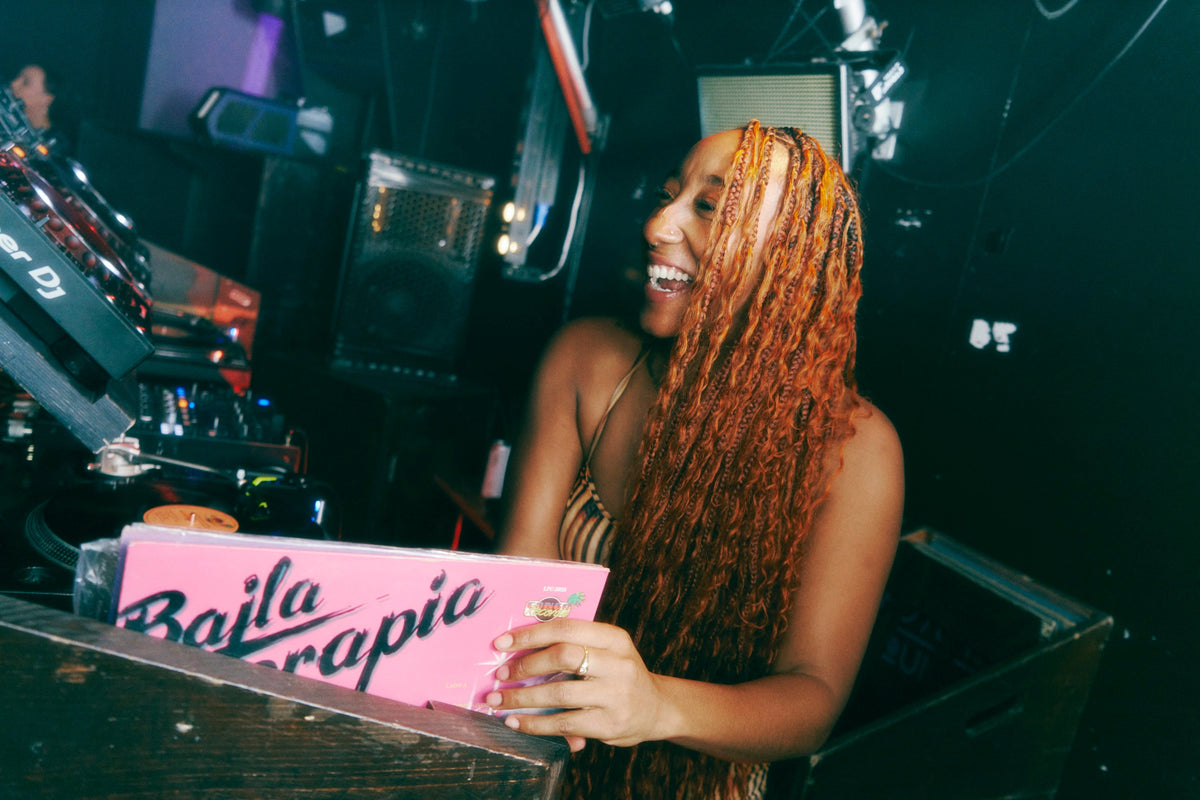
Jamz Supernova unites and educates people on the dance floor. The BBC 6 Music broadcaster, DJ and Future Bounce founder has cemented her reputation as a respected tastemaker. Her selections approach sound as storytelling. Through her appearance on festivals like We Out Here to main stages across Europe, she celebrates music as a vehicle for connection, identity and cultural exchange.

In her first compilation Dance Around The World with legendary independent label Mr Bongo, Jamz Supernova presents a 16-track collection that travels dynamically across time and space.
Split between two halves — Day and Night— it explores the contrasting energy each place can hold, from sunlit storytelling and live instrumentation through to after-dark club sounds and dancefloor experimentation. It’s a result of years of listening, travelling and building meaningful relationships across global music communities.
Jamz said: “Each country and region explored within this compilation has used music as a form of resistance in response to colonialism. We can never forget how colonial history has shaped the world, but I'm also interested in how music moves us forward.”
She continues: “Music and dance have always brought communities together. On the dance floor, you'll find people from different races, classes and backgrounds, but the space has a way of levelling everyone. “
Step into the sounds and stories behind Dance Around the World. In a mini Record Rundown we picked five tracks from the compilation and gathered words directly from the artists involved. They discuss their cultural histories and personal experiences that shaped the tracks.

Groundsound - Bittersweet
“Bittersweet” is a dark love song about sugar. Given how around 5 million enslaved Africans were brought to Brazil, “Bittersweet” begins with an Afro-Brazilian Jongo pattern that brings the listener to the sugar plantations of Brazil’s Paraíba Valley. Under moonlight, our ancestors escaped to jungle clearings and drummed illegal drums to invoke the spirits, plan rebellions, dance, chant, and wail to release tension. With spiritual guidance, our ancestors survived the dangers of the field: snakes, cutlasses, the smoke of burning cane and the processes of making sugar and rum.
Gavsborg and I had to acknowledge this bitter side of sugar, often invisible when we measure it into a recipe or sipping a Cuba Libre. Gavsborg honoured traditional call and response that shared across all Afro-diasporic music with simple, chantable lyrics.I wrote lyrics that would feel like a work song. In the Kingston studio, Jesse Golding played with his eyes closed and let the drum take him from Brazil to Haiti. I guided him into the history and Jongo started to stir Yanvalou, the fluid Haitian serpent dance to honor Damballah and Agwé.
Century-old rhythms of Africa survived in our ancestors so that we could survive today. From Jamaica to Brazil to Hispañola, Louisiana and beyond, African rhythms persist in these Americas. “Bittersweet” is our attempt to pulse with that living legacy.
Esa Williams - Vanguard Drive (Kwaai Dub)
“Vanguard Drive” is based on a road that shaped my childhood. I travelled this road almost every day for five years to my grandparents’ home, while my mother worked long 12-hours shifts as a nurse. It cuts across Cape Town and through communities marked by apartheid's Group Areas Act.
Those journeys became a kind of musical education: the sounds of Cape Town waking up, taxi horns, music from taxi ranks, people heading to work and conversations spilling onto the streets created a living soundtrack that stayed with me. During a demo session with Robin G. Breeze, those memories came flooding back. Horn arrangements were inspired by taxi traffic, synth lines reflected the movement of the city, and the rhythms echoed life on the Cape Flats.
Growing up in Cape Town taught me to hear music as an inseparable part of everyday life. The city is full of overlapping musical traditions: Jazz, ghoema, house, soundsystem culture and music arriving through records, cassettes and taxis all fed into how I think about rhythm and storytelling. Music and dance are also inseparable from daily life in South Africa. People participate in music, rather than consume it. The most uplifting music emerges from communities that have carried immense histories and challenges. How joy and struggle can coexist within the same rhythm continues to inspire my work.
Brenda x Diva Cruz - Sin Africa
Diva Cruz: The song is about the struggle of African nations’ independence, the need to free ourselves from colonialism. It’s also about the lies of Africa’s colonial history which I was taught in school as a child. Every African leader like Patrice Lumumba has been killed because they wanted freedom for their people. I learned about Lumumba when I was an adult and never heard his name or King Leopold in any history book when I went to school. Most people still see Africa as a poor continent and don’t realise that without the contribution of Africa’s natural resources and raw materials our current society would instantly collapse.
Writing songs is like therapy for me to process my own traumas living in Sweden as an Afro-Colombian woman. With this track, I wanted to shed a small fraction of light on the racism I faced. I wanted this electronic club track to be a raw, energy-packed homage to Patrice Lumumba and everything he stood for.
I always think about the struggle of my people, their resilience and their physical and mental wounds. My mother is from the Pacific coast of Colombia, so music and dance was something that I grew up with. My family was always listening to music and dancing currulao, salsa, cumba, bullerengue, vallenatos, boleros, mapele and merengue.
Brenda: This track is a tribute. It looks towards the future while keeping alive the memory of the hopeful vision that Patrice Lumumba fought for. It is ultimately about resilience; the importance of protecting, celebrating and carrying forward the cultural and sonic legacies that continue to shape so much of the music we dance to today. It is both an act of remembrance and a gesture of continuity.
For me, it goes beyond rhythm, although rhythm is undoubtedly one of the defining characteristics of our region. It also has to do with the realities of making music from Colombia. The resources, infrastructure and opportunities available to artists here are often very different from those found in the Global North. Over time, that limitation becomes a creative force in itself.
In Colombia, music and dance are woven into everyday life from a very early age. We are surrounded by the sounds of South America and the Caribbean from childhood, and those rhythms stay with us for life. Colombians are deeply curious listeners.There is a genuine appetite for discovering sounds from elsewhere and imagining what they might become when reinterpreted through local perspectives. Perhaps that is what excites me most about Colombian music culture today; there is a constant hunger for the future.
Jamz Supernova x Sam Interface - Tan Toddy (Feat. Lateena)
Sam and I had the pleasure of working with the drummer Moses Boyd. The drums on this track came from Moses playing over soca.
For vocals, I reached out to Lateena Plummer, a Jamaican vocalist based in Switzerland. Lateena is a really important voice in dancehall and reclaims the space for Trans women. Dancehall has a complex relationship with LGBTQIA communities, defined by deep-rooted homophobia alongside a resilient underground culture.
As Trans people are increasingly being targeted, voices like Lateena's feel even more important to amplify today. Her delivery is so unapologetic and braggadocious, and what she came back with was pure filth. It was funny working with such sexually charged lyrics. After hearing them on repeat and figuring out what to keep and how to make it flow, the whole process turned me into a dancehall queen.
I have always loved a specific “bashy” kind of dancehall that comes out of the UK, often heard strongest in cities like Manchester, Bristol and Sheffield. An offspring of Soundsystem culture, it's where the UK bass scene and Jamaican toasting collide. You can't uncouple the UK's electronic music landscape from Soundsystem culture. Black British culture is in everything we do and create, even in the way we cook.
Mokotron - Colonised Existence
“Colonised Existence” represents my childhood, growing up in Indigenous communities with my Māori mother, and then being torn away from my language and culture when relocated to the city.
Unlike the rest of my repertoire, which includes traditional chants in our Indigenous languages and are accompanied by taonga puoro, our traditional Māori musical instruments. This song is written in English and uses cold electronic instruments to express what it means to be colonised.
The melody and synths express the unfolding tragedy of a family breaking apart. The bleak acid line and drums in the second half represent being lost in the city and screaming soundlessly into the urban void. The lyrics express the contradictions of a colonised mind; self-hate, self-harm, violence, resistance, submission, subsistence. The final lines speak to the ever-shifting goal posts of assimilation; you are now one of us, you are not one of us, you will never be one of us.
I use music as a way of expressing what it means to be urban and Indigenous, and as a way of celebrating our language and culture and sharing it beyond our community. I combine that with elements of UK Bass culture; breaks and heavy baselines. For me this is a way of bringing together the two main streams of our country, Māori and British, in a way that is complex and complementary.
Our ancestors invited British people to these lands so we could learn from their culture to strengthen our own. For me decolonisation doesn’t mean removing British settlers, it means moving beyond an oppositional mindset and fulfilling the vision of our ancestors; a bicultural society grounded in Māori tradition and British innovation. The question my music explores is, how do we combine Māori folk music and dance with electronic music to create a hybrid culture that celebrates our unique identity in the world?

--- ENDS ---
Photos courtesy of Jamz Supernova and Nado Creative

A LIFE SPENT FUNKIN'