

By David Ma
I. “I’m the rebirth, so now you gotta see me first. I kick more facts than paperbacks for research.”
There’s no substitute for experience, as Christopher Martin and Keith Elam would tell you in 1994 if you ran into them. They were four albums deep, and their song “DWYCK” blanketed the New York summer. The pair, also known as Guru and Premier (aka Keithy E and Preemo, respectively), were outdoing themselves—creatively and career-wise—at every turn. There’s a saying, “There are decades where nothing happens; and there are weeks where decades happen.” Hard to Earn, the fourth album enshrined in Gang Starr’s glowing career, was the latter. An artistic rebirth that came as the group was cresting, a batch of material that felt like a deliberate growth spurt. Says Preemo: “Moment of Truth is probably our most important album, but Hard to Earn is my favorite Gang Starr album.”
--------
Up for auction now: Gang Starr’s “Words I Manifest” 12-inch test pressing, inscribed to Marley Marl, the Daily Operation press kit photo and cassette, and promotional posters for Moment of Truth and Full Clip.
--------
At the end of Daily Operation (their third release, prior to Hard to Earn), we’re presented with “Stay Tuned,” a closer declaring that new things were afoot in the Gang Starr universe. The song’s slow rhythm spoon-fed listeners a sense of where the duo were headed as artists and how they felt about New York. On it, says Guru: “There’s too much suffering, too much struggle / Too much injustice, and don’t it bug ya? / Enough for you to press on harder / Against the odds, the way our forefathers made away...”
Vintage Guru, clear and simple diction, at ease navigating the space between contemplative and streetwise orator. Leaning more into brooding content with complex undercurrents, he had a greater sense of self-awareness than before. Preemo’s high level of excellence could also no longer be contained. Production like his beat for Jeru the Damaja’s “Come Clean,” released as a single in October ’93, was fresh on the minds of many, swelling Premier’s venerated rep. Cuts like “Take It Personal” off Daily Operation showed an aesthetic that was later emboldened on Hard to Earn. Familiar but with noticeably darker energy. Keithy E and Preemo had always been formidable, even as young transplants to New York, but they were light-years away from Boston and Texas by this point.

Photo by Danny Hastings
II. “So precise, my insight will take flight in the night.”
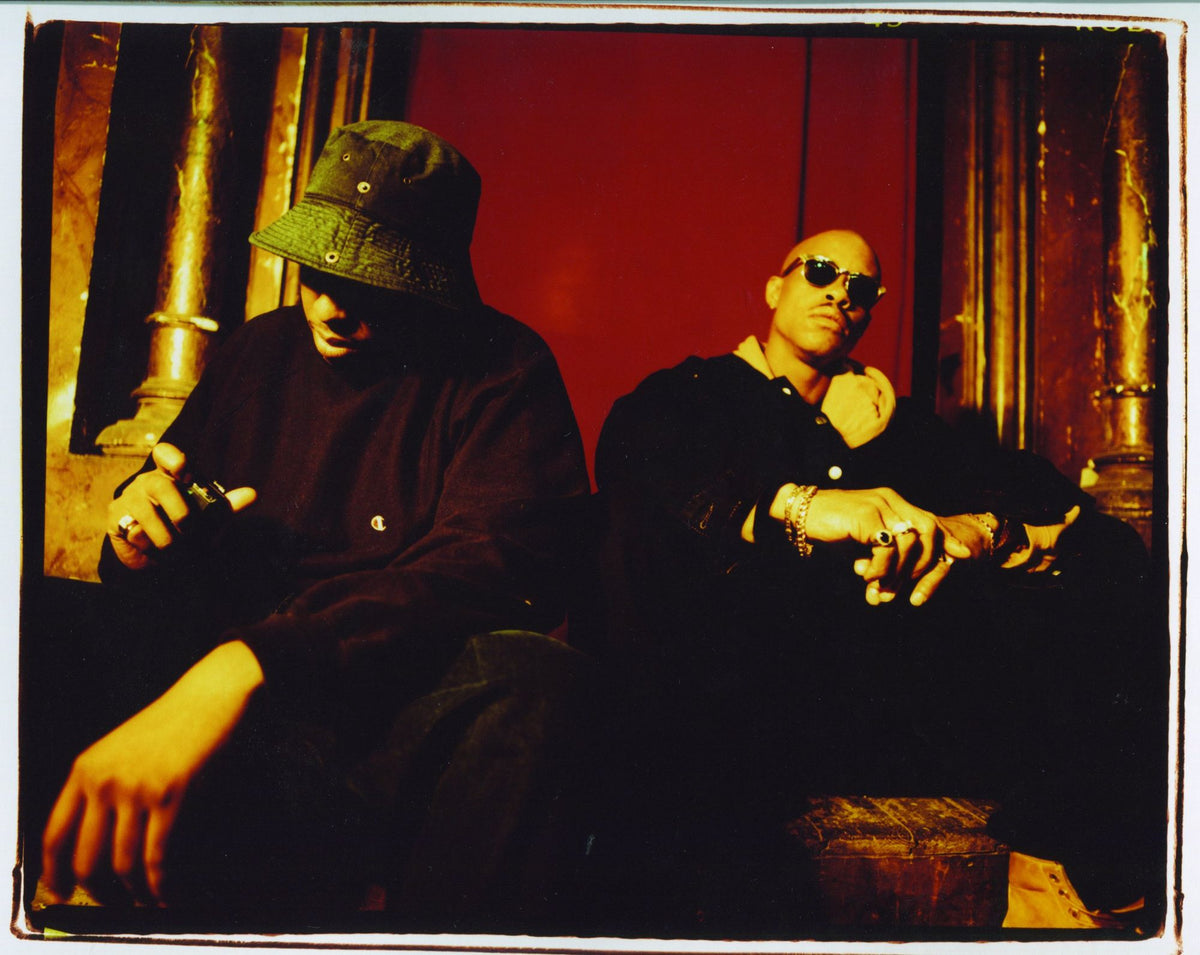
Hard to Earn’s iconic red-orange cover shows the pair lounging beneath the Gang Starr logo. Shot by Danny Hastings in his signature oversaturated style (check Raekwon’s Only Built 4 Cuban Linx from the following year for another example), the photoshoot took place in the same Lower East Side building, a former church, where Hastings shot Wu-Tang’s 36 Chambers cover the year before. Face shrouded by a bucket hat, the figure on the left doesn’t even really resemble Preemo. Guru is sitting to his side, leaning back, Baldhead Slick mode. “Guru told me to always put Preem in the front,” says Hastings, “because the DJ never got enough dap.”

Photo by Danny Hastings
The album’s back side is a group shot with members of the Gang Starr Foundation—Jeru the Damaja, Lil’ Dap, Big Shug, and Melachi the Nutcracker, dead center in military garb with a blunt in his ear. Guru, the most prominent voice, stands in the rear, hoodied up and humble, despite his looming presence. And Preemo, the unifying factor for it all, is nondescriptly pictured on the side. In this time of tactile media, Hard to Earn’s cassettes, CDs, and LPs weren’t just releases—they were subversive business cards, invitations to explore the personnel depicted throughout its packaging. Their names and titles neatly written for all to behold. The entirety of Hard to Earn, from the artwork to everything in its orbit, was a Trojan horse sent from the ground floor to the penthouse.
“We wanted the whole family on board,” Preemo explains. “If people were going to know who me and Guru were, they were damn sure gonna know who the Foundation was too. We slowly introduced members before, but this was direct. The industry uses artists all the time, so this was us using the industry and [making] sure everyone on the team got the attention they deserved. When they eat, we all eat, you know?” He continues: “We knew we were successful. You could feel the energy all around us. We were in demand and working with all kinds of other artists. We felt that the timing was special and that we had to present ourselves a little differently to go to that next step.”

Photo by Danny Hastings
III. “Who am I? I’m the substance that’ll make your third eye cry. Too potent, too high in intelligence quotient.”
The next step, for Preemo, was to combat what fans and industry guys had said about their sound, calling them “jazz rap,” a label Preemo and Guru felt was reductive. Their first three releases relied heavily on jazz; they even had hit songs with “jazz” in the title, and notably, there’s Jazzmatazz, the album title of Guru’s side project that further added to image. As a result, Preemo shifted his focus to less-musical fare, droning effects and sirens, tension over melody—noticeably more Devo than Ahmad Jamal. Ironclad samples that at one time defined Gang Starr had become a nuisance at best, and artistically constrictive at worst. “I love jazz, of course,” says Preemo. “But we felt like it was dismissing everything else we had done. People kept lumping us into a small group, and we felt that wasn’t fair. Guru and I were artists, so we’re constantly thinking of ways to create and innovate. We were like, ‘Don’t ever say that we’re just one thing.’”
There’s an entrenched firmness on Hard to Earn, an album considered by many to be Gang Starr’s finest. While that’s up for debate, there’s no question they vastly improved with each release. No More Mr. Nice Guy, released in 1989, is very much of its time and sonically exists in a different galaxy than Hard to Earn. There’s also an overt continuity between 1990’s Step in the Arena and 1992’s Daily Operation, which makes Hard to Earn, released March 1994, feel like even more of a clear side step—or leap forward. Gang Starr had become so prominent that they wanted to shed their previous optic in order to keep future lanes open. “Hard to Earn sometimes feels like our stepchild or something,” laughs Preemo, “but that’s why we loved it so much.”
By 1994, Works of Mart, shorthand for Works of Christopher Martin, became less of an album credit and more a seal of excellence. Heads had yet to geek over the sample origin of Hard to Earn’s “Mass Appeal,” an endless obsession that would carry on for decades. History will note that Guru was a lean twenty-eight years old and playing with trickier deliveries, fixating more on what their music can do versus what their music was—rhymes that were informed by the Black experience. Preemo mostly eschewed melodic jazz samples for a more calamitous sound palette. The two out-of-towners had finally earned the city’s trust only to transcend regionalism altogether. They’d exhibited multitudes of compelling recitations over the course of a mere five years, and Hard to Earn is the moment they exhaled before going into overdrive.
Here, DJ Premier pulls back the curtain for an extensive look at their vaunted masterpiece, one that has stood the test of time within their catalog and beyond. All of this, and Moment of Truth had yet to exist.
IV. “Knowledge, wisdom, peace is what I’m true to. In the rear is Premier, and I’m the Guru.”
With the benefit of hindsight, let’s look back on Hard to Earn and its entire context. You guys were doing all kinds of movie soundtracks, bigger video budgets, you had hits, things were on an upswing. What is the importance of Hard to Earn when it comes to Gang Starr?
DJ Premier: Sonically, it’s really important to me, because I changed my sound but kept my style. I wanted to have new and better drum programming to show I could go beyond just looping jazz. Some of the beats on there are my most left-field sounding. I always liked adding spacey sounds, eerie shit, things of that nature to my production. So when I think back, I feel like all that really started with Hard to Earn. I really wanted to show people what a producer and DJ can do, because at that point, people still really had no sense of what we exactly did.
What exactly are some of these changes you’re referring to? What might’ve prompted them.
Guru and myself were tired of everyone labeling us as “jazz rap” just because we used a lot of jazz samples on the previous stuff. We felt like we did it all, especially right around this time when we’re making club shit, and Guru was doing more serious subjects. He did before once in a while, but he was doing it a lot more. I started out using jazz samples a lot, because I felt other producers weren’t really bringing jazz to the table like I wanted to. We did jazz shit for Spike’s Mo’ Better Blues, and that went big, so people kept saying we were those jazz guys. The only real jazz sample used on here is on “Code of the Streets,” which was originally taken from Guru doing a news special about cars being stolen. “Mostly tha Voice” [is] another big jazz sample I used that I can remember. There was, like, three jazz samples on here, and most weren’t big ones or long. Our sound was bigger than that. As soon as people start labeling us one thing or another, that’s when we’d do something else.
Jazzmatazz probably added to the whole jazz persona. Help us make sense of where Jazzmatazz fits within the Gang Starr narrative.
It was supposed to be my project, actually. Our manager at that time, Patrick [Moxey], he brought it to me, because he was saying this could be a thing that would separate the two definitions of what people were saying about us. Guru was already doing his Ill Kid projects, so he already was doing side stuff. We always had side projects; whether it be this or that, we never thought it would break up Gang Starr or anything. So I suggested Guru also take it on, because I was busy starting other projects. And people don’t really know this, but Jeru actually gave it its name. And Guru gave Jeru fifty dollars for it! [laughs] I was like, “Come on, give him more cash than that!” So Guru cut him a bigger check, and that’s how it stuck. Guru felt that Jazzmatazz would protect us from being labeled as jazz rap and be a lane for him to embody all the jazz stuff we already loved. That way, Gang Starr can just be its own thing. Plus, we both really liked the title.
You guys have always had really good song and album titles. Where does Hard to Earn come from?
It’s actually the first record of ours that I named. Guru titled all the other ones, which I always really liked. He named Daily Operation, which is so dope. For that, he just took a line from a track off the album. For this though, we was just sitting there thinking of names, and I was like, “What we do is really hard to earn.” Then Guru goes, “That’s it!” He seemed to really like it, so I went with it. I later also named Moment of Truth.
Through the years, some listeners have referred to Hard to Earn as being Gang Starr’s most New York–sounding album. Looking back now, what’s your take on that?
I disagree, because everything then sounded like New York. Look, we’re two transplants from Texas and Boston making music for the city we lived in and loved. People probably say that now because it’s darker or whatever. Everyone, whether they admit to it or not, was making stuff that sounded like New York, so it’s a hard thing to even say. Dre, Yella, and [Ice] Cube gave L.A. a new sound, but that’s about it. But even then, [NWA’s] “Gangsta Gangsta” sampled KRS’s “My Philosophy.” New York always had different lyrics and more instrumentation. At least, that’s how I felt at the time. I live here. And to be living here, during that time especially, we were all dominating the city. But we were all doing it different ways. It got to a point where Tribe [Called Quest], Brand Nubian, and others were thriving. Maybe real New Yorkers say that it sounds “most New York,” because when you hit Harlem and the other real spots, everyone was bumping this on the regular. Maybe even more than some of the other stuff I mentioned. We rep our city, but we sound like ourselves and that’s it.

Photo by Danny Hastings
You were already coming off the success of Daily Operation, and before that, Step in the Arena was a big leap forward from your debut. You were getting more success with each release and had a lot of studio time under your belt. By this point, what was your mindset, production-wise, going into this?
For sure, I wanted to stay fresh and explore a different part of my sound, like I was saying. I was proving a point with Hard to Earn, that I could use any sound and make a banger and not be categorized as just one type of producer. Sampling is a skill in itself, but I wanted to show everyone I can use anything, that I could even use a cricket chirp and make it dope. This was really a step forward in beatmaking for me. If you compare it to other stuff I did before, this is more stripped down and not as musical, and all of that was on purpose.
Walk us through the album, song by song, starting with “Intro (the First Step).” Why did that open up the album, and where did you draw that from? It’s also sort of an announcement that you guys had made it.
It was real life and something we were going through. But it was also something that had just started happening to us around that time, maybe a little before. No matter where we went, people would come to our place all the time and ring our bells and ask if they could spit for me and Guru. And Guru would sometimes be nice and say yes! And they’d all be wack! Whether it was at a club, at our stoop, just all around the neighborhood, dudes would come up to us. Even when we’re out with girls, dudes would approach and be like, “Listen to my tape, I’m nice!” They had no care for who you’re with or what you’re doing. They’d blast tracks at us from the middle of the street. I knew all entertainers went through it. Actors and athletes too, anyone with a spotlight on them. So for this, we just wanted to portray that but from a rap point of view.
Track two, “ALONGWAYTOGO,” was originally for 1993’s Poetic Justice, the film with Janet Jackson and Tupac. But that never happened. Tell us how that unfolded.
John Singleton, God bless him, had just done the movie with Pac and invited us to an advance screening, because he wanted to see if we could do a song for it. Guru wrote the lyrics specifically for the film, because the characters were lost on a journey. I thought that was dope, because the whole movie is based on them taking the road trip. The studio turned the song down eventually, but we both liked it so much, we didn’t want to put it on ice. We were both really mad, because we thought it was perfect for it. The fact it has me cutting Phife [“now here’s a funky introduction”] makes it so special to me when I hear it back now.
What’s the process like making something for a big movie? Is it a case-by-case basis, or would you approach it differently than an album cut?
We always made our songs fit the movie rather than choose one we already had and let the movie use it. Like for the movie Trespass, we did “Gotta Get Over” and made it for the film. For Spike Lee’s Mo’ Better Blues, we did “Jazz Thing,” and it fit right in. For “Now You’re Mine,” which made it onto [1992’s] White Men Can’t Jump, we used all basketball slang. So we had a formula when it came to soundtracks. That’s why in “ALONGWAYTOGO,” Guru says the actual words “poetic justice.” We were trying to make everything fit.
Tell us about the actual recording of “ALONGWAYTOGO.”
Oh, I remember this one. Guru was asleep and really wasted drunk, [laughs] and I had to wake him up to record. He didn’t want to do it, but it was for John Singleton’s big movie, so we wanted to get in the studio on time and do that shit right. That’s why Guru sounds a little different on here. He wasn’t as pinpoint or aggressive, but I liked how his voice sounded. I thought it went well with the sample too. I think he actually sounds like he’s a little drunk. He didn’t like it, so I said we could rerecord the next day. But I always liked how this version sounded, so I kept it, and that’s how it appears on the record. They gave us the rights to release it as long as it was one month after the movie had been out. We’re good to use it however we want, and I immediately felt like it had to be on the album.
The next track is “Code of the Streets,” which originated on a local TV commercial. Does the original still exist?
No idea if it still exists. I had it somewhere at some point on a reel, because I remember that’s how Guru recorded this demo. I remember it was for Channel 2 News and that it had to do with the epidemic of car thefts around New Jersey or something. Guru produced that one and [it was] was a little stiff with the drums. [laughs] I really liked what he did for the news channel, but the version you hear is different. I liked what Guru said lyrically so much that I wanted to use it somehow. Plus, I knew the record Guru sampled from [Monk Higgins’s “Little Green Apples”], so I was able to pull it and toy with it right away. We actually cleared this sample. I just reprogrammed it to my drum patterns, added bounce to it, and sped it up. Then Guru added two more verses, since it was originally just one verse.

Photo by Danny Hastings
“Brainstorm” works as a subtle buffer between “Code of the Streets” and “Tonz ‘O’ Gunz.” You sequence the songs, right?
Yeah, I sequence all our albums. The placement of the music and the order the songs are in is huge for me. As a listener of albums, I pay attention to these things, and it’s very important to me. Growing up listening to albums makes you appreciate that aspect more. I think I’m really good at it. I basically sequenced Illmatic.
How does “Brainstorm” strike you now?
Man, that’s probably one of my favorite Gang Starr tracks ever. It’s aggressive and up-tempo, and I didn’t want too much musical touches in it. I wanted aggressive scratching. I wanted it to be almost industrial and dark. Plus, I also always wanted to make a record where you fade out while they’re still rapping, and this was the one. When we were on tour with Rage Against the Machine years later, we’d tell the mosh pit to go nuts whenever we dropped this, and it worked every night! That song just works. Did I say it’s one of my favorites? This one’s big for me.
“Tonz ‘O’ Gunz” was a very clear moment of social commentary for Guru. It continues to stand out, because the themes he talks about are all still relevant.
Exactly, guns were really rampant at that time, and they still are. Guru just wanted to address that topic, and I made sure his background music was appropriate for him to speak over. I wanted it to sound like chaos. He was really able to get the point across. There’s a wailing sound that at first kept drowning out his flow. So I remember having to play with this one a lot to get it right. Sometimes, a long sound or sample can catch your attention and be distracting. For this one, the lyrics were so important that we both were very cautious of that happening.
“The Planet” felt biographical and was another instance on the album where Guru struck a real serious, even personal, tone.
I think Guru always really wanted people to know what his journey was like and that it took a lot for him to even make it in New York. He always spoke, at least to me, like he had to endure a lot to make it out here and claim Brooklyn. It was really important to us both, actually. I fully understood what he meant, because I’m also a transplant. In the end, we claim New York, but we always wanted to keep it real. Guru was getting ostracized all the time as an out-of-towner. So I think, at the end of the day, he wanted to address the issue once for all. He eventually addressed it a little bit on “New York Strait Talk” too, but this was more of a breakdown of that journey. This one, for us, is a real important song off the album. But it’s just an important Gang Starr song in general, because not being from New York was always a big thing for us.
The interlude, “Aiight Chill,” allows the album to breathe after such seriousness. It’s crazy to hear nowadays, because it feels like such a time capsule. What made you get Nas, Masta Ace, MC Eiht, and others to leave messages on your answering machine?
It was the ’90s, and everyone had an answering machine. It was just based off of a homie who every time he would call me, [he] would say the same thing: “Blah, blah, blah, aiiight chill.” And I just always thought it was hilarious. [laughs] So I wanted to base something off that. This interlude didn’t go over well with critics and some listeners. I remember reading reviews and a lot of people were like, “Premier must be running out of ideas if he’s wasting album time doing stupid skits.” But to me, I’m like, “You don’t get it.” This was just me wanting to have a different interlude that wasn’t too musical while joking a little. Plus, it works with the album’s overall pace. Nowadays, I think the skit and the criticism of it are both pretty funny.
It sets up this next one, “Speak Ya Clout,” which was a posse cut and a memorable one in the catalog. Lil’ Dap and Jeru’s voices are captured great here, and all the beat switch-ups were dope.
This was just a continuation of “I’m the Man” [from Daily Operation]. We wanted everybody to get more record deals, get off this, more opportunities. Everyone went on to do some dope shit after, and this was just us hammering the point home that the foundation is solid. This song is a success to me and means a lot, because it added to Dap and Jeru’s careers as MCs. They’re both amazing on here. Also, at the time, no one was really doing songs with beat change-ups as much. So when I start to hear people go in one direction, I’ll sometimes try to take it in another direction. We definitely wanted Jeru back on a family album. It was just the right thing to do. That’s how this one was born. It’s just another big family cut. For us, those have worked out well.
“DWYCK,” featuring Nice & Smooth, is a huge Gang Starr cut and just a big, resonating track in your career. It was originally released as a single in 1992 with Daily Operation’s “Flip the Script” but then rereleased as a 12-inch in 1994, when it became a summertime hit.
This was one of the biggest tracks and might’ve been our first real club banger. It was really an unreleased B-side and became an ultra hit, and the label wanted to add it to the album. We always dropped unreleased tracks as B-sides, like Public Enemy did with “Rebel Without a Pause.” Prince always did that too. I also noticed new-wave artists always did that. Guru had worked with Nice & Smooth earlier, and since Guru did one with them, we were like, “Y’all do one with us too!”
We did the record and turned it in, and it did so well that they let us do a video for it. We pushed for a video, because Arrested Development, a group at the time who were our labelmates, also did a song that had a video that wasn’t on their album. So we were at the office, and I was like, “Can we do that with ‘DWYCK’?” People were already buying the cassette singles and 12-inches. We had also heard about people who bought Daily Operation thinking it’d be on there but it wasn’t. That’s why we added it to the Hard to Earn.
I read that “DWYCK” was also originally done for a movie, is that true?
Yeah, we did it for another movie too, and they didn’t want to release it, so they fell back from it. I was heated for damn sure. Only reason why we didn’t want it on Hard to Earn at first [was] because we thought it looked desperate, like we’re putting it on here just so people would hear and buy the record. It was for the true fans and was such a big song, nobody could ignore it. Obviously, it was a good decision to put it on the album. [laughs]
You had so much work in film around this time. What was having all this attention from Hollywood like?
A lot of it was just of its time. Back then, all these movies also pushed big soundtracks to go along with them. It was a standard thing. Some of it was through the label giving us opportunities, and some was just because the director was already fans of [our] music. Even though some of them didn’t work out, it still made us feel validated.

Photo by Danny Hastings
“Words from the Nutcracker” was another track featuring extended family. Talk about your relationship with Melachi.
Melachi is a member of Group Home. I was a mentor of his when he was a troubled child. He was really violent as a kid. He literally shot at people. And he always wanted to box too; he was really into it. One time, he was boxing and got shot while he was training. He’s normal now and everything turned out okay, but it took his whole focus off everything. Everything he would rap about was violent, hitting things with metal pipes and things like that. So I always wanted to turn his mind to something positive. I let him move in with me. During that time while we lived together, at the end of the day, he would give me these little rhymes or bounce an idea off me. And one day, this just came together. I knew we had to eventually do Livin’ Proof, which was the Group Home joint that went on to become a huge success. This was kind of the beginning of all that.

Photo by Danny Hastings
How did “Mass Appeal” become the album’s single? There’s a lot to explore here. Not only is it a standout from the album, but it’s considered a showpiece from your catalog.
Guru always used to print out track listings and paste them on the wall. It’d be pieces of paper with all the song names that were going to be on the album, and stuff he was working on or whatever. My job would be to fill in all the blanks with music. Well, next to the song names would be little descriptions, and I remember next to “Mass Appeal,” Guru wrote, “Our First Single.” And we would always do our singles last. It’s not like we record in any particular order or anything, but when I know something is going to be the single, I avoid it until the end, until we’re at the last two or three songs, so I can focus and make it the freshest one right before the album drops.
Walk us through the themes and thought process behind making the song.
Guru and I were just talking about how everything around us was starting to sound so watered down. The sound we were doing prior, as well as what we were working on, was a sound that everyone was moving away from. Don’t get me wrong, we liked all that club shit too, but not all the time and especially not when you start phasing out cats like Smif-N-Wessun, Black Moon—even Wu-Tang started getting phased out of clubs. And we would joke and say how everything was dead. We all thought all that club shit all the time was corny, and we’d call it elevator music, because it was so watered down. To me, elevator music is light and has repetitive melodies. So I wanted this to be a parody, almost a joke, so I was looking for samples that matched that. Soon as I found that main loop though, I knew it’d be perfect.
Can we talk about the sample? The lore that surrounds it took on a life of its own through the years. What, if anything, are you allowed to say about it?
Well, I never cleared it, and so when people ask me about it, I don’t say much. I’ve even had people track me down and play me the sample off the record and be like, “This is the sample you used, right?” And I’ll be like, “What sample?” It’s fun because for people who dig, that just means you’re into music like we are. There are certain records where everyone knows what it is, like one of my tracks for Das EFX, for example, has a very known and obvious sample. But I chopped it differently and flipped it, which always puts beatmakers on notice. But when I don’t flip a sample, I’m definitely going to use something so obscure that people will have no idea what it is or where I got it. That’s the fun of it, like, “Wouldn’t you like to know?”
The King of Chill—he did stuff with Audio Two—is a mentor that taught me how to work some of the equipment I used. He’s a legend and an icon to those who know. You probably know his work with [MC] Lyte and others too. I always asked him where he got his samples from, and, one day, I found a record he had sampled and still skipped the part he used, because he flipped it so hard. So there are records where I’ve wanted to know the sample but unknowingly had the record the whole time, because the producer made it sound totally unrecognizable. Alchemist, Showbiz, Mr. Walt, we all show each other where we get things from, because we’re producers. But there are people, to this day, who I won’t share info with or will just lie to them, because they’ll take what you found and put it back out there. It’s bad karma, so we stay away from certain people. [laughs]
What was the label’s response when they first heard it? Were they receptive to it being the single? And when did you start to sense it was resonating with everyone?
The label agreed right away for it to be the single. It was actually on regular rotation on stations all over the country at one point. Heads were bugging off it immediately. At that point, we had already moved away from the hood, but for the video, we wanted to be right back in there with certified dudes and killers. That’s what we told the label anyway. And that’s what we had to tell the local guys and let them know that we were going to shoot in their projects.
Back then, the drug dealer–type dudes always rooted for us and all that, but they would not want to be seen. They’d be like, “All good, but don’t fucking put us on camera.” [laughs] Nowadays, these guys are walking self-indictments, posting their shit online and end up doing time in jail. It was great to show love to the hood after all those years, and they still embraced us.
Take us back to the moment you first heard Guru over the beat. What was your reaction like?
At first, I thought it sounded a little awkward, to be honest. It kind of reminded me of “Next Level” by Showbiz and A.G. where it seems like a weird point when the beat drops. [Rhythmically,] Guru didn’t start on “the one” and came in on “the four.” So it’s four, three, two… “No way you’re gonna make it, step with the…” I always did what James Brown said, which was to do everything on “the one.” But we just went with it, and I’m still impressed when I hear it, because everything just ended up so good. I mean, it’s one of our biggest records.
How do you think “Blowin’ Up the Spot” fits on the album? It must’ve been a hard sequencing task to follow something like “Mass Appeal.”
It was much more of a freestyle thing. We used to call them rhyming records. Like I said, Guru would have a list of tracks on a wall and the concept that went with it. The concept for this was just to rap nice and go off. If I clear a sample, we can talk about it, and for this, I had a sample called “All Night” [from George Clinton’s Sample Some of Disc Sample Some of DAT]. I always liked [Parliament-Funkadelic] drums. They’re one of my favorite artists. When I heard the drum pattern, I looped it, and there’s a part where I’m cutting the words and it sounds like a bomb is blowing up.
It goes with Guru so well too, especially for being just a rhyming track as you said. Is there anything specific to the beat itself that you remember?
Well, me saying it’s just a rhyming track doesn’t mean we put any less work into it. The concepts just aren’t as serious, but the time it takes to complete can be almost the same. And Guru just goes off like he always does. It fits Guru, because I think I’m very good at matching the music to the artist. That’s really what I think my calling is. Guru would be like, “Yo, I can write to this right now!” And he’d write stuff on the spot, real fast. Once he’s in a groove, he’ll tell you exactly what the title is, how he wants certain things in the song to go, every detail, everything. He’ll have everything completed in his head already. There’s a bomb-explosion sound in the song that I played for Guru before we got started. He said that the sound made him think of blowing up things on the spot, literally. So that quick, little sound effect inspired the whole damn thing. Off one little sound effect. Guru would do that, and I remember this being one of those examples. From A to Z, no problem, he’d do it.

Photo by Danny Hastings
I feel like the understated classic here is “Suckas Need Bodyguards.” Tell us the circumstances that this one came out of. Guru is tremendous, and the beat seems to really match his intensity.
That’s because this was another one that he originally produced. He brought it to me afterward to touch up. I liked it a lot right away when he played it for me. He was making fun of all these rappers we knew who all of a sudden started having bodyguards. [laughs] We were just still rolling with our friends and felt like those rappers were overreacting or thought of themselves as something bigger. When I think of this? Man, really I mostly think to myself, “This is all Guru,” because he already had it so great to begin with.
How often would Guru bring you beats? Was there ever a sense of boundaries that you guys didn’t cross with each other? Or was everything fair game.
He would bring me things, yeah. On every album, Guru would like to produce at least one track, and I had no problem letting him do that. I remember him handing me the demo for “Suckas.” It was a real bad mix, and the drums were not locked in. Guru was not the best at programming drums; obviously, that’s my lane. And, yeah, we had lanes, but I wasn’t above telling him my opinion on what he did. And Guru will come to me and say, “Yo, I want to use this or that,” and that was fine with me too. My motto is, “If I like it, it’s a go.” If I don’t like it, then I just redo it. We’ll discuss subject matter together, and I’ll go off and do our separate thing sometimes.
Is there a memory that strikes you personally when you think about “Suckas Need Bodyguards?”
We were about to go on tour with Jeru, M.O.P., and Nas. Illmatic was out, and Nas’s manager at the time was also LL Cool J’s manager. The manager thought Nas was too big to tour with everyone, so Nas only did two dates with us. Whatever, there weren’t hard feelings, and everything went fine anyways, because it was such a strong lineup. Jeru was on fire then, so the tour was live. Long story short, we rushed to shoot a video for this track the day before we went on tour, because we wanted it to be out while we were on the road. It was a long-ass day and we went to D&D [Studios] right afterwards and recorded “The ? Remainz” so that this would have a proper B-side. I did the final mix for them both that night and headed on the tour the next morning.
We briefly touched on “Now You’re Mine” earlier, a track that existed before and outside of this album. Give us some background on it and how it’s connected to White Men Can’t Jump. It was featured on an extended soundtrack for the film.
It was for the movie. That’s why it was filled with basketball terminology. The contract stated that the song was ours once the film was released, so we figured maybe some people who heard the song maybe wanted to own it on our album rather than with the other soundtrack songs. Even though it was previously recorded, I think it fit the sequence of the album so well that a lot of people forgot it was originally on a soundtrack.
Yeah, I don’t think too many people associate the song with the film now either. Is there a backstory to this one at all?
Yes, definitely. This was recorded after Guru and I had a literal fistfight. We had many through the years, but this was the first really violent one. Guru was in the hospital, because his head was split in three places. Dap and Jeru actually took him there, because he wasn’t speaking to me. Just another drunk night, and he was out of control. I had food poisoning and was really sick and just dry-heaving hard all night. It was like my fifth time throwing up, and he’s still drunk and being wild downstairs! We were living together at the time. So his ex-wife and myself told him to calm the fuck down, but he wouldn’t listen.
So I put him in a bear hug and was like, “Calm down and I’ll let you go!” Mind you, I was already weak from dry-heaving. He was like, “You let me go, and I’m gonna fuck you up.” So I’m just holding on with all the last bit of energy I have. Of course, when I let him go, he hit me with an uppercut that clocked me and felt like my whole bottom jaw went into my brain. Guru had fat hands and always wore rings, and those rings caught me. I snapped and started hitting him with an iron that was laying there. I just started swinging. Probably Guru was ironing clothes earlier or something. I was hunched over and hurt from the first punch. Then he sucker punched me! Guru was strong when enraged. I was oblivious and angry, and I chased him down the street and started hitting him. He’s losing his fucking mind, and, mind you, this is like three in the morning. The next day, our manager was like, “Guru’s going to show up and do the song only. Nothing else. He’s going to leave right after.”
You guys were coworkers, friends, and roommates, which probably wasn’t always easy. The studio must’ve been tense that day. How did you guys work through something like this?
The next day, Guru showed up to record with bandages on his head. And right when he finishes, he asks me, “You good with the vocals?” I said, “Yeah,” and he was like, “Fuck you, you fucking bitch!” and walks out. I was just glad we got the song down, and I knew he’d hate me for three or four days after that. But we did what we always do, which is go to a bar afterwards and put it behind us. Guru can be like that Irish dude at the pub who drinks too much and gets out of hand or overemotional. If you look at the “Mass Appeal” video, he rubs his head and there’s a knot you can see on the left side of his temple. I’ve always felt like the harder lyrics on “Now You’re Mine” were secretly written about me. [laughs]

Photo by Danny Hastings
Let’s move onward and talk about “Mostly tha Voice.” What’s your take, from a producer’s perspective, on the importance of a good voice?
You might have different flows or concepts, but it’s the voice that makes people go, “Ooh.” This song is one hundred percent about how your voice can be the major instrument and is something I totally agree with. That’s what makes people say that, for example, Big Daddy Kane is the best. Or Rakim too. They’re geniuses, of course, we all know that, but they also have the voice.
Would you say you probably know Guru’s voice better than anyone?
Yeah, I’d say so. I also think he couldn’t fully shake that Boston accent. [laughs] Look, his vocal tone and endless patterns added so much. He’s a fully rounded MC in my book. What can I say? He was just remarkable and possessed one of the greatest voices ever.

Photo by Danny Hastings
We hear Big Shug at the end of “Mostly tha Voice” assuring Guru that if he gets on, he’s gonna come correct. It then sets up “F.A.L.A.,” where Shug gets two verses. Tell us how Shug fits into the Gang Starr universe.
Shug is family. He had a history with incarceration way before I even knew about his past. This one stands out on my memory, because it was his first rap display that Guru applauded. Guru was super impressed. Shug was tight with Guru and rapping [with him] since forever. So having Shug back felt like a reunion, and I was really happy to make this with him. It made Guru happy too. And for those that don’t know, Shug was an original member of Gang Starr before I even joined.
That’s right. Gang Starr originated in Boston when Guru was MC Keithy E.
Yeah, it was Guru and a few other guys from there. Shug was also originally from Boston, so that’s how they linked up. This was before I was even in the picture. That’s why we kept saying this one was like a reunion. He was just released from prison after three years when we recorded this one. He hadn’t been out that long.

Photo by Danny Hastings
What made you choose “Comin’ for Datazz” as a closer?
Man, this was supposed to be “DWYCK, Part 2,” but Greg Nice didn’t want to do a sequel. That’s why he ain’t on it. But we liked it so much we kept it. I like the energy it has.
That’s wild, considering how big “DWYCK” was. But I also get not wanting to retread.
That’s what Greg said. “DWYCK” being so big was the exact reason he didn’t want to do another one. I could respect that as an artist, trust me. But I really liked this track, so I kept going in and cutting the hell out of the words, “Here I come, here I come…” Greg was in the studio and goes, “We should just call it that!” We didn’t even plan to have the original “DWYCK” on this album. So when this turned out the way it did, I felt it just made sense to include both of them; they have a similar energy to me. Both this and “DWYCK” could’ve technically been on Daily Operation, but it just worked out that they ended up here, which makes Hard to Earn even more special to me. I think it’s just a nice way to finish off an album that we put so much into. And wanted to let people know what we were coming for. [laughs]
Earlier, we spoke on how this was Gang Starr’s darkest album and that you wanted to move away from being pigeonholed as jazz rap. Thinking back now, are there other reasons that might explain this shift?
I do think being a kid and growing up in the ’80s explains my sound and some of the choices I’ve made, especially at that time, because I had used so much jazz and funk and soul already. As a teenager, I listened to rock and new wave a lot. I was into a whole lot of bands. Like, I loved AC/DC. So a big part of me really just always wanted to be in a band. I can’t speak too much on what exactly was going through Guru’s mind during this time, but we were just working and locked in a groove. We were seeing success, and tried to keep it expanding. Like I said, I always wanted be in a band, and it just happens to be Gang Starr. Thank God, Guru liked my beats.
How did you guys view yourselves? I guess what I mean is, ideally, how did you want to be labeled if not as jazz rap?
We just didn’t like people saying we were this or we were that. After people start calling you one thing, they limit how others perceive you. Like, we didn’t talk about jazz in the lyrics too much; we talked about the streets. We talked about Blacks and inner-city kids getting dealt with. We talked about real shit, real life. Maybe sometimes over a jazz sample, but to call that our entire sound wasn’t right. We used to call what we made struggle music.
As we close out here, tell us what DJ Premier’s final thoughts are when you think about Hard to Earn.
It was a time in our careers when we had to present ourselves a little differently to go to that next step. I did that through the beats, and Guru did it through rhyme. But, honestly, like if I’m being really honest? We just wanted the streets’ respect. Once you have that, you can go very far in your career, because it’s hard to get the streets to bump your shit. It’s all for them, always.
--------
Up for auction now: Gang Starr’s “Words I Manifest” 12-inch test pressing, inscribed to Marley Marl, the Daily Operation press kit photo and cassette, and promotional posters for Moment of Truth and Full Clip.
--------

ONCE AND FUTURE CURATOR: BILL ADLER