

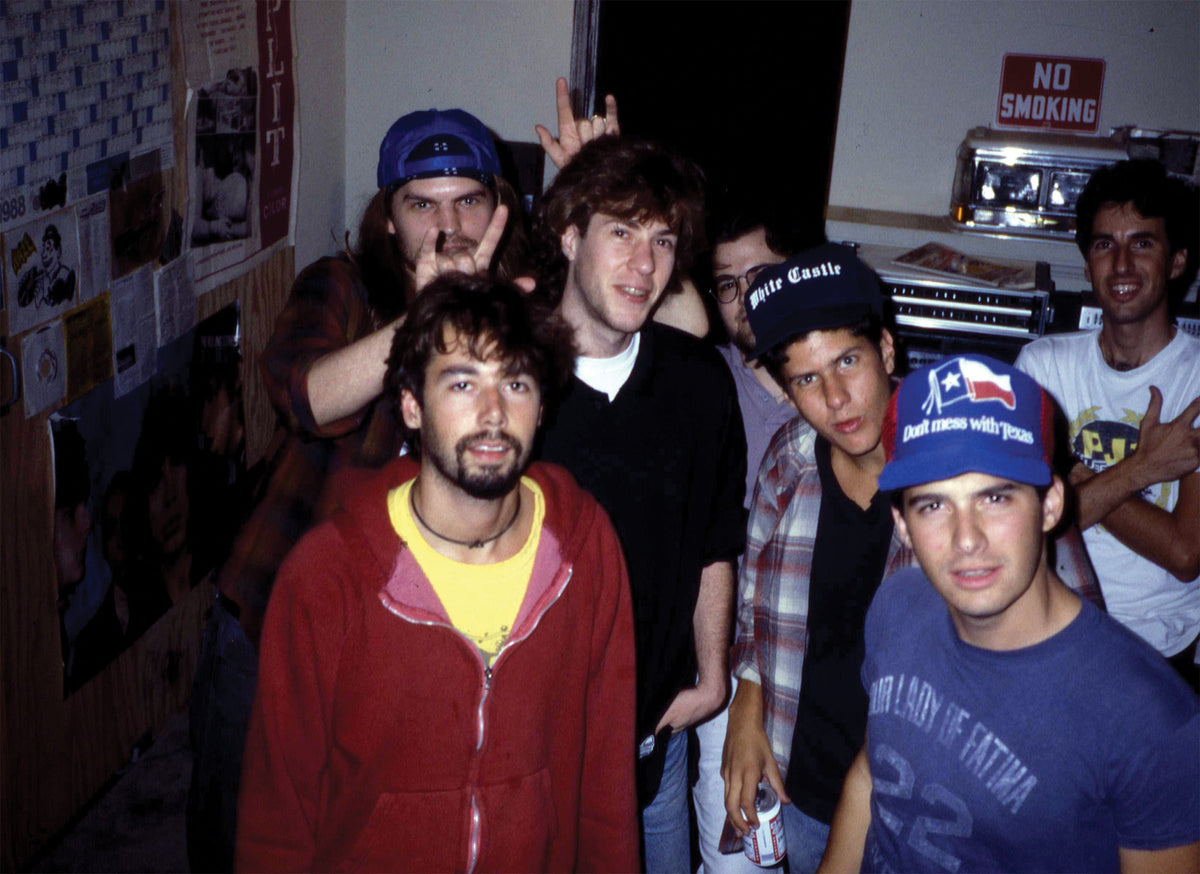
“Adler.” When Bill Adler answers the phone, that’s all you hear. When you hear the greeting, it makes you feel like your call had better be good, because it’s keeping “Adler” from his craft, which is educating the masses about the wonders of hip-hop culture through his current role of running his photo gallery, Eyejammie Fine Arts, in the Chelsea neighborhood of New York City.
Up for auction now from the Def Jam years: Kick It! The Def Jam Sampler Volume One cassette (CBS, 1987), the RAL Spring ’94 sampler and the RAL Fall 1994 sampler.
Adler’s craft has evolved from a number of careers, and it seems that each stop along his path has been surrounded by music with soul. When he was young, the Aretha Franklin, Wilson Pickett, and Otis Redding emanating from Detroit AM radio galvanized his musical tastes, and the sounds of rhythm and blues became the foundation for his love of music and the culture surrounding it.
After spending radical times in Ann Arbor, he DJed at Boston’s WBCN, where he was soon fired from the station for playing a Joe Tex record that wasn’t cleared for airplay. After that incident, Adler quickly learned that he had more freedom as a writer than as a DJ, and he began writing for the Boston Herald as the pop music critic. His next step was moving to New York City in 1980 to work for the New York Daily News, the Village Voice, Rolling Stone, and People as a freelance music critic.
By 1984, Adler had witnessed the booming growth of hip-hop through a young club-show promoter who was setting up parties around New York City. That young promoter was Russell Simmons. When the magnetic Simmons approached Adler with an invitation to join the fledging Def Jam Recordings and Rush Artist Management as a publicist, Adler dove into the pool of hip-hop headfirst. Between 1984 and 1990, he would be part of a whirlwind of success at Def Jam that would pump out music from hip-hop legends such as Run-DMC, the Beastie Boys, Public Enemy, LL Cool J, 3rd Bass, and Slick Rick to the masses.
After working at Island Records, founding his own PR firm, and creating a record label, Adler co-curated the hip-hop exhibit at Paul Allen’s Seattle Experience Music Project in 2000. His success with the exhibit inspired him to turn his personal office into the Eyejammie Fine Arts Gallery. Eyejammie became not only Adler’s personal headquarters for publishing, writing, and curating photo exhibits, but also a creative enclave displaying his love and his respect for hip-hop’s photographers and their images capturing the rise of hip-hop over the previous thirty years. Now Adler has not only created a gallery to display rare photo exhibits, he has also created a place that successfully displays hip-hop history.
Ernie Paniccioli, who exhibited Urban Blight at Eyejammie this past summer, explains the importance of Eyejammie and the respect that Adler holds in the hip-hop community. “When you’re showing photos, there are a lot of cuckoo gallery owners who are dictators, and they don’t get involved in the process. With Bill, he loves and respects what he’s curating, because he knows hip-hop, which is crucial. Because as figures like Biggie and Run get more mythical, there will be no photos of them. At least, no photographs of true hip-hop… What you’re going to see are A&R fantasies and guys with gold teeth that know how to talk the game, but not the art. Bill not only respects those real art images, but he knows how to make it happen to show them. The guy is a straight-up professional.”
Looking into the future, if the hip-hop community decides to have a full-fledged hall of fame, it will need a curator who not only has seen the rise of hip-hop, but who also knows the material needed to support the exhibits. As the insightful visionary Ricky Powell, who this summer released a book published by Adler and Eyejammie called Frozade Moments, snaps, “Bill’s been around so long, he’s the Bob Cousy of rap. He needs to lose the set shot, though.”
At the age of fifty-three, Adler’s chance of adding a Mark Price–like jumper to his repertoire may be slim. However, he did add another line to his bio by writing and co-producing a five-part documentary series called And You Don’t Stop: 30 Years of Hip-Hop that aired on VH1 this past October. I sat down with Adler at his favorite haunt, Cabo Rojo, on 10th Avenue, where he is fondly known as “Guillo” or “Papi.” Over the piercing sounds of steaming espresso machines and chives being chopped, Adler explains his love for “urban culture,” his career path, the current state of hip-hop, curating, and the future for the Eyejammie gallery.
What ignited your passion for “urban culture”?
My story is simultaneously unique and very typical. I predate hip-hop. I predate so-called “urban street” culture, and I’ve had a strong affection for Black music ever since I came into consciousness. I grew up in Detroit in the ’60s when radio wasn’t stratified. Radio then was super, super cool. In ’64, back to back you would hear not only the Beatles and all the great Motown acts, but Aretha, Wilson Pickett, and Slim Harpo’s “Baby Scratch My Back.”
By the time I was 18 I understood that rock & roll was, by and large, black music. By the time 1979 rolled around, and after my time at WBCN, I began working as a music critic at the Boston Herald, which was run by Hearst Publishing but operated in the shadows of the Boston Globe. At that time, “Rapper’s Delight” by the Sugar Hill Gang and “Christmas Rap” by Kurtis Blow came out. Some people thought of those early raps as alien and hard to fathom, but they seemed pretty obviously to me to be in the African American tradition and they were an awful lot of fun. So I dug them.
When I moved to New York City in the summer of 1980, I began working as a freelance writer for the New York Daily News. The good thing as a freelancer was that I had the freedom to choose my own assignments. At the time, Kurt had “The Breaks” out, and I convinced the editors to do a story on Kurt. I talked with Kurt a bit, and he told me about a guy named Russell Simmons, who I had heard a lot about around the shows. It was in the full flush of the Sugar Hill era, and I stayed up with the scene.
By ’84, I had been following the scene for five years. I could see that it was more than a fad, and Russell invited me to work with him. By the summer of ’84, I was in the middle of a whirlwind. I had the feeling that working at Rush Artist Management and Def Jam Recordings was like working at Motown or Stax in the early to mid-’60s. The ’80s was a time of tremendous creative ferment and tremendous commercial success…and I naturally felt a gravitational pull to hip-hop because it was exciting.
Hip-hop is not all of my love. I’m too old just to be hip-hop. Yet I feel branded by hip-hop culture. I’ve done other things, but I keep coming back.
And what keeps drawing you back to hip-hop?
A sense of family more than anything else. Russell and Run are brothers. I was the oldest of three brothers. Working at Rush was like inheriting a new bunch of younger brothers all at once. I understood the energy immediately. I really felt welcomed, and it was very seductive.
Hip-hop is like that in general. Look at what Bambaataa does with the Zulu Nation. He’s a One-Worlder, a devotee of George Clinton and Funkadelic for whom “One Nation Under a Groove” isn’t just a song—it’s a philosophy of life. You don’t have to be from the Bronx to feel at home at one of Bam’s parties. Everyone who shows up, wherever in the world they are, is acknowledged, in effect, as a member of the Zulu Nation. That’s a beautiful feeling and it keeps people coming back for more.
Is that what made you trust the movement that Russ and Rick Rubin had at Def Jam?
First of all, please understand that I was there before Rick. I started working with Russ during the summer of ’84 and Def Jam Recordings started in the fall of ’84. So, much respect to Rick, but I was Russ’s guy… And Russ in many ways is a lot like Bambaataa. He’s very charming, funny, seductive, warm, intelligent, profane, and spiritual. Now he doesn’t go out at night…as much. But from the time he was seventeen until he turned forty, Russell went out every night. He promoted a ton of parties. What was unique were his efforts to create parties without ethnic or racial borders.
He first got the bug when he was going to CCNY [City College of New York] in Harlem, but he was a Queens kid. When he started throwing shows in downtown Manhattan, he got a downtown crowd, a mixed crowd, a much more cosmopolitan crowd with a more peaceful consciousness. And the result was that a slightly more peaceful vibe came to define the whole hip-hop scene.
By 1981, you had this rock band playing out of CBGB called Blondie who meets Fab 5 Freddy. Freddy takes them uptown and introduces them to the hip-hop community. The members of Blondie are musicians, and they start hearing and enjoying rap records…even though they’re not Black. Big fucking deal. They make a novelty record called “Rapture” that goes to number one on the pop charts. In ’82, the Clash comes to town, and Grandmaster Flash opens up for them. By ’84, a band of Jewish punk rockers from New York starts making rap records.
The Beastie Boys weren’t trying to be Black. They were the Beastie Boys before they started making rap records. That’s what’s intrinsically great about hip-hop. There are no borders. It is universally and internally cool. Period.
What do you think has changed about hip-hop?
I don’t know if hip-hop has changed so very much. America’s attitude towards hip-hop has changed. Hip-hop has come in from the cold. It’s very mainstream now. And, at least among young people, the country is much less racist today because of hip-hop.
Thinking about the movement in hip-hop, Chuck D mentioned on his campus tour in Chapel Hill, North Carolina, that he thought rap made a big shift when KRS-One appeared with a rifle on By Any Means Necessary and with NWA. What do you think are some major points where hip-hop has made a shift?
First of all, it’s very typical of the modest Mr. Chuck D to downplay his own contributions and give props to someone else. The emergence of Public Enemy and, in particular, of It Takes a Nation of Millions to Hold Us Back, was a huge turning point in hip-hop. PE was on a mission to make all of hip-hop less party-oriented and more reflective of the problems facing Black youth. And they succeeded. They single-handedly turned the entire culture around. And then NWA came along a year later and turned the culture in yet another direction.
Was that Def Jam’s influence at the time, or was that solely Chuck and PE?
Chuck was who he was; Def Jam never imposed anything. In fact, it was Rick who wanted to sign Public Enemy, not Russ, and it wasn’t because Rick felt any “Black solidarity” with them. He liked Chuck’s voice. He liked their rebellious attitude, which was an eternal rock attitude. [TK] that Russell’s feeling was “If you preach, you’re going to clear the dance floor. Don’t preach.” Russ was going to help the group in any way that we at Def Jam could in terms of artist development, but he was never going to impose our ideas or feelings about America on the group.
Do you think politically charged music will come back?
I think there’s politically charged music around now. It’s not as popular as it once was, but today’s politically minded rappers are not as wonderful musically as PE was. PE were the so-called “Black Panthers of Rap,” but they were not only great because they had a superb political message. The music was dope, dope, dope! They might have won people over if all they did was make party music, because their beats were so great. And I say that as someone who loves the convergence of music and politics; I don’t need it, but I love it when it happens.
People today look back with nostalgia and say, “Where are the days of PE?” Well, what’s missing today is rap groups who are able to combine PE’s consciousness with the Bomb Squad’s beats. That’s rare, rare, very rare. But if you’re looking for it, you can find it in Mos Def and Talib Kweli. You can find it in the Roots and Common and Dead Prez and the Beastie Boys. All of these groups still have major careers. If you find yourself jonesing for a music-political agenda, you can find it.
Touching on the pulse of hip-hop, in October 2000, when talking about the Together Forever Tour stop in Seattle of ’87, you told the Seattle Times, “Rap music is and will be no better than the society from that which it springs. If America is greedy, so is its music. If America is violent, so will be its music. America is getting the rap music it deserves right now. When the smoke clears, people will realize that this is exciting, wildly inventive, astonishingly beautiful music.” Is it still?
That’s good… I said all of that? Well, I still believe those things, as far as America getting the rap it deserves. I think there was a time in the ’60s, when Dr. King and Malcolm X were around, when the African American community set the moral tone in America. Unsurprisingly, the music that came out of that time reflected those politics and reflected that moral leadership. Since the deliberate murder during the ’60s of America’s Black champions of Civil Rights, I think the Black community has lacked a moral compass, and as a community, they’re stuck in the same muck as the rest of us. But when you look at the current Administration and society today, it’s all about materialism and profit. So it’s no surprise that American popular culture today reflects those values.
Does that have an effect on hip-hop? And what can be done to preserve its integrity?
Of course it has an effect on hip-hop. But there are things that can be done. Look at what Russ has done with the Hip-Hop Summit Action Network. He’s becoming a force in the marketplace of ideas by trying to get young people to vote. You could say he is trying to spoon-feed young Black kids to vote. It’s great as far as it goes, but it’s unfortunate that Russ can’t also produce a candidate for them, because a kid from that movement has to wonder, “What does John Kerry have for me…here in East St. Louis?”
But Russ is doing what he can to ignite political consciousness, and what he does is very cool and low-key. Russ has come a long way. As I said, back in his early days he was scared of preaching. But through this organization he’s able to reach people in a more general and diverse way. He doesn’t do it through Def Jam. He doesn’t do it through the RIAA. He doesn’t say, “No more ‘bitch-ho’ records,” or “No more ‘pimp-ho’ records.” If he did, he would not only be compromising his ideals, he could kiss his support in the music business good-bye.
Do I wish that hip-hop was more politically engaging? Yes. Do I wish there were records capable of removing Bush from office, records with the political impact of Michael Moore’s Fahrenheit 9/11? Hell yes. But they haven’t surfaced yet.
So much for preserving the integrity of hip-hop. Regarding the preservation of the culture’s history, I think the day is coming when we will see a hip-hop museum.
And that leads to my next question: Do you think that your gallery could lead that effort?
When I look at my so-called career, it seems like I’ve always done work that I wanted to do and enjoy doing because I believed in the social and cultural value of it, because that’s what engages me.
So with that in mind, by the late ’90s I had worked at a big record label. I had done some consulting, and I had some ideas for big companies like Def Jam Books or a hip-hop version of Corbis, the online photo agency. But I couldn’t get them off the ground. But what I did have was an enduring interest in hip-hop history, a love for hip-hop photography, a lot of great relationships with photographers. And I discovered that my neighborhood had been transformed around me into the center of the New York City art world. So it came to me that without unlimited resources, I could still refurbish my office, call it a gallery, and start putting on shows—and that this work would be a way of continuing, in a different arena, all the work I’ve done during the last twenty-five years.
I’m a cultural worker. I’m an arts worker. I’m a historian, and I’m devoted to it. And I believe these artifacts, these photos, have both historical value and aesthetic value. So running a gallery to expose this work and to create market value for this work is respectable work for me, and that’s why I do it.
Looking at the Sun Studio museum and the Stax Museum of American Soul Music in Memphis, the Chess Recording Studio Museum in Chicago, and the hip-hop exhibit that you consulted for the Experience Music Project in Seattle, is that a direction where you could see Eyejammie heading?
You know what I think? Plant a seed and you don’t know what’s going to grow. Whether or not I have a hand in it, will there be a wonderful hip-hop museum someday? Absolutely. Could Eyejammie be the start of a hip-hop museum? It could.
I also think it would be a great idea to assemble a huge database of hip-hop journalism and photos into a research library along the lines of Rutgers’s Institute of Jazz Studies. Call it the Institute of Hip-Hop Studies. I started pulling together a research library of my own in the forms of books, photos, press releases, articles, that kind of stuff, starting in the ’70s. Because as a working journalist at that time—and it’s very prosaic and very utilitarian to say this—if Bobby Blue Bland came into town and I wanted to do an article on him in the Boston Herald, I’m fucked up. If I wanted research or some record resources to get some background on him, forget it. But if I somehow managed to find a one-page bio on where and when he was born, along with a photo of him, I’m holding onto it all. I want it for myself. Now it’s thirty years later, and I’ve been building up my research library ever since.
Going to the Country Music Hall of Fame in Nashville was a real turning point in my little life. When I was a kid, I couldn’t take country music. But eventually I grew up and acquired a real taste for it: George Jones, Merle Haggard, Johnny Cash, Carl Perkins, Hank Williams, Buck Owens, Ernest Tubb, Kitty Wells…that stuff is just dope—dope! So when I went to Nashville about eight years ago, I went straight to the Hall of Fame. It was really remarkable. Their institution is comprised of two parts. One part is open to the public. You can see beautiful exhibits on great artists, television spots, Elvis’s gold Cadillac, whatever. There’s no shame in their game, not stuffy at all. Then you have a second section, which you can go to by appointment only. That’s the Frist Library and Archive Room. A place open to legitimate researchers by appointment only, where they have every country record, every photo, every book, every film, et cetera, et cetera. To see those things together was so inspiring to me. That’s what hip-hop needs. Could my gallery grow into that? I don’t know. Could I run something like that? I believe I could. The model is the Country Music Hall of Fame.
What would it take to get that going? Country music has it, the NFL has it.
You know what it needs. Money, money, money. And you need someone with more commitment than Paul Allen, because Paul Allen is basically withdrawing his commitment to the Experience Music Project. He’s putting his commitment into science-fiction like the eternal twelve-year-old that he is. Apparently, he’s unhappy that the museum is not making money. It’s not-for-profit! You don’t do it to make money, Paul! You’ve made your money. This is giving back!
What are the next moves for Eyejammie?
What’s delightful and surprising to me is that people are now coming to Eyejammie with great ideas that I myself would never have thought of. Right now we’re working to put on a show for the twenty-fifth anniversary of VP Records. It’s their idea, but I believe it’s a good fit with what we’re doing, because dancehall reggae and hip-hop are first cousins.
It’s going to be great. There’s a local painter named Jackson Brown who grew up in the southeast. He dreamt up a show with the working title The Heroes of Hip-Hop that will feature about a dozen life-sized oil portraits of some of the culture’s greatest movers and shakers. I never did a show of paintings, but Jackson came to me to see if I would be open to an exhibit. I said, “Let’s do it!”
The first Eyejammie book, a postcard book of Ricky Powell’s photos, has been released, and I would love to do more of that kind of stuff.
The important thing is that I want to do work that I want to do, which I’ve been lucky to do for most of my life. If I could snap my fingers and have a job as the director of a Hip-Hop Hall of Fame and know that I could work there for the next twenty years until I was retired, I would be real happy. But running the gallery, curating the exhibits, publishing books, writing and producing a documentary series, these are fun things to do. I’m happy to report that I am not bored.
Bret Dougherty is a graduate student at the University of North Carolina at Chapel Hill. He hosts a sports talk show called SportsRap and a music show called Fifteen Feet and In on WXYC Chapel Hill FM.
Up for auction now from the Def Jam years: Kick It! The Def Jam Sampler Volume One cassette (CBS, 1987), the RAL Spring ’94 sampler and the RAL Fall 1994 sampler.

Chamber Music: Wu-Tang Clan’s Origin Story
Mass Appeal