

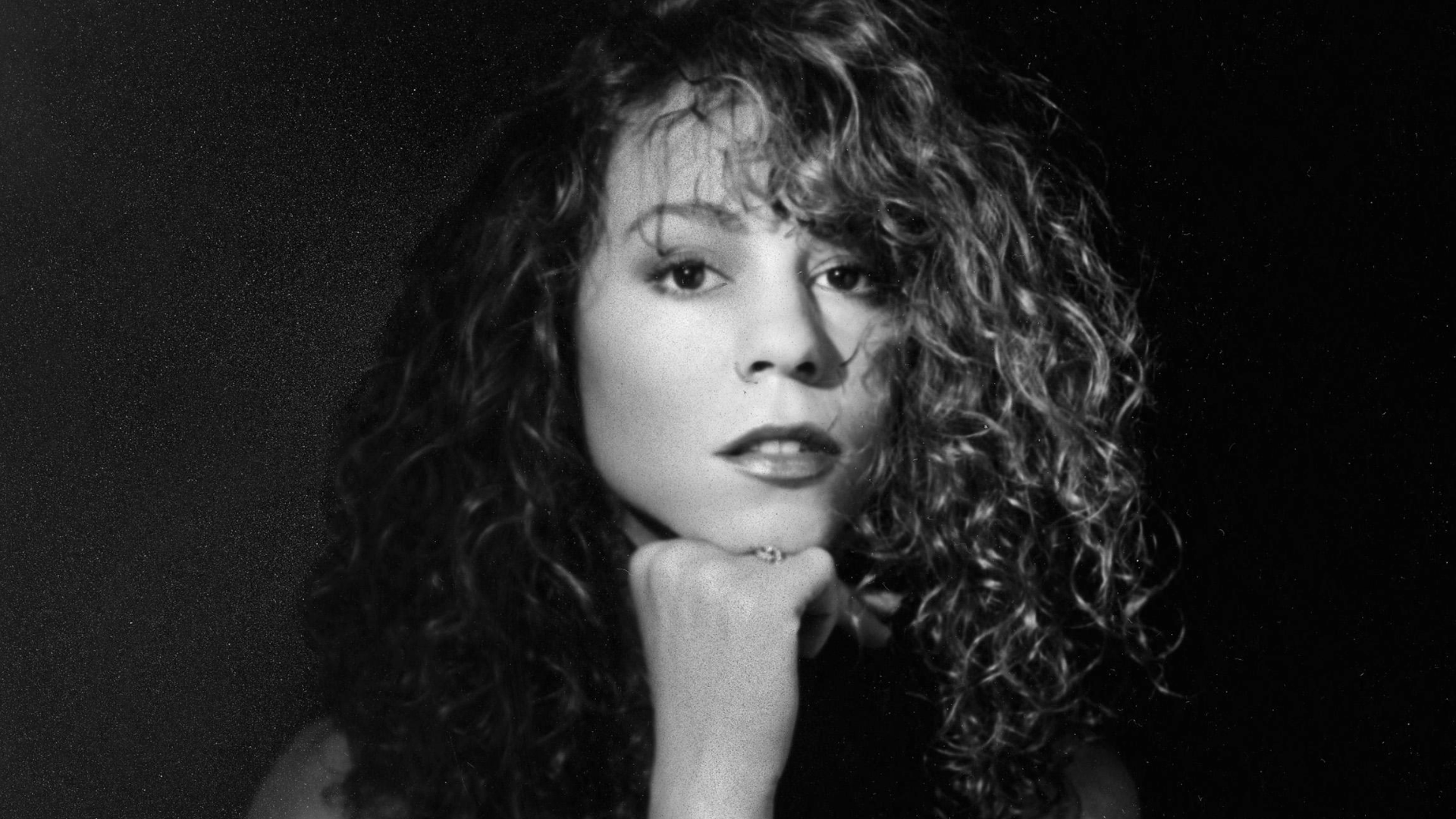
Mariah CareyMariah Carey always knew she was destined to be a star. But she didn’t become one without years of hustling and preparation, from late nights singing jazz at a supper club with her mezzo-soprano mom to the fabled demo she recorded in a Manhattan woodshop.
Before the chart records, the luxurious diva persona, and her ubiquity as the “Queen Of Christmas,” Mariah Carey was a young, working-class singer and songwriter from Long Island striving relentlessly towards her goal of a music career. Along the way, she recorded a demo comprised of songs that would form the nucleus of her self-titled 1990 debut album—an album that went on to yield four #1 singles, and which announced the arrival of a self-made talent who would come to define music in the ’90s.
In the years since, that demo has become an object of myth and speculation, fueled in part by Mariah’s own comments suggesting that she actually preferred these raw, early versions of some of her earliest hits to the more polished iterations on her massively successful debut. These formative recordings were produced and arranged between 1987 and 1988 with musicians Ben Margulies and Chris Toland (collectively calling themselves Marland Productions), who helped shepherd Mariah as they took her earliest compositions from notebook sketches to fully-formed tracks. “The songs were more primitive in [their] demo form, but all the elements that led to the final record are on the demos for the most part,” Toland remembers. “The hooks, the background vocals, the kicks, the chords—it’s all there.”
Arthur Baker was among a small group of insiders who became privy to those early recordings when singer Brenda K. Starr handed him a copy of Mariah’s demo tape at a holiday party in 1988. The Boston native had shaped the sound of electro in the early ’80s with his work on Afrika Bambaataa and the Soul Sonic Force’s “Planet Rock,” and introduced the world to New Edition, releasing their debut album Candy Girl on his short-lived but influential Streetwise label, becoming one of the decade’s most influential producers. Starr, the Latin freestyle singer behind 1985’s “Pickin’ Up Pieces,” was another of Baker’s discoveries. So, when she passed him Mariah’s cassette and introduced him to the skinny, curly-haired girl who sang on it, the producer’s ears perked up. Still, he was hardly prepared for what he was about to hear when he pressed play later that night.
“At the time, I only made it through maybe the first two or three tracks,” Baker recalls. “I didn’t need to hear any more. I listened to it that one time, and knew she was going to be a star.”
SOMEDAY
Music found Mariah Carey from birth. As a young child, her tastes were shaped by her older brother Morgan and sister Alison, who introduced her to the sounds of Aretha Franklin, Stevie Wonder, Minnie Riperton, and the Jackson 5. But it was her mother, Patricia, who inspired her to sing. Patricia (Pat) Carey was an accomplished opera singer and vocal coach who trained at Juilliard, and performed as a mezzo-soprano with the New York City Opera. In 1977, when Mariah was about seven or eight, Pat recorded an album, To Start Again, which featured operatic renditions of songs by Joni Mitchell and Jacques Brel, as well as “Somewhere” from West Side Story.
As the youngest of her siblings, Mariah was pretty much tied to her mother’s hip, which meant she was a constant witness to Patricia’s artful, bohemian lifestyle. It was a life that included late-night jam sessions at the family home with her mother’s jazz musician friends, where she learned how to improvise and harmonize with other singers. At twelve years old, Mariah gained her earliest experiences performing before a live audience. tackling standards by Billie Holiday and Ella Fitzgerald with precocious sophistication alongside her mother at a local supper club.
“I was in the sixth grade, up there at all hours of the night, any day of the week, sitting in with grown-ass musicians,” Mariah recalled in her 2021 autobiography, The Meaning of Mariah Carey. “I’m not sure if my mother just wanted to be able to hang out at night and sing, or if she was consciously developing me as an artist, or if maybe she wanted to present to her friends her little protégé? I do remember her encouraging me while I sang.”
Despite a lineage of Black Pentecostal reverends on her paternal side, Mariah wasn’t raised in the church. She grew up attending services at a Unitarian Universalist congregation with Patricia, a lapsed Catholic. (Pat Carey’s 1977 album was recorded at the Unitarian Universalist Fellowship of Huntington, and released on an affiliated private-press label; “It was a weird church,” Mariah remarked in her memoir). But it was gospel music that Mariah found herself drawn to as she developed her own tastes. “When I got older, I found out that Al Green and Aretha Franklin had recorded gospel records, and I went out and bought them,” she said in a 1991 New York Times interview. In addition to the religious work of her secular idols, the devotional sounds of Vanessa Bell Armstrong, the Clark Sisters, and the Edwin Hawkins Singers would also have a strong sway on Mariah’s emerging musicianship.
“Even when I’m sitting at home at, like, three in the morning—I’m an insomniac—I’ll watch these gospel commercials on TV,” she told J.D. Considine of the Baltimore Sun while promoting her second album, Emotions, in 1991. “Sometimes, I’ve never heard of the group, but I will hear that little three seconds or whatever, and it’ll be a great song, so I’ve ordered all these Old Time Gospel Greats compilations—these insane records that are just incredible music. I collect a lot of that.”
Not long after she began sitting in with Pat and her friends at their supper club gig, Mariah entered a recording studio for the first time, and immediately fell in love with the process. “Like being in the ocean, when I was there, I felt weightless,” she wrote in her memoir.
NATIVE NEW YORKER
Throughout her life and career, Mariah Carey has expertly navigated between different and sometimes diametrically opposite worlds. Black and white. Urban and suburban. The safe, middle-of-the-road fare of her Tommy Mottola years, and the Tunnel-era club bangers she made a few years later with Mobb Deep and the Lox. For perspective, it’s valuable to take a deeper look at her upbringing as a mixed-race child on the economic fringes of Long Island, the dense suburb wholly defined by its relationship to New York City.
Patricia and Alfred, Mariah’s father, met in Brooklyn, where they married and had Morgan in 1960. The couple divorced not long after Mariah’s birth in 1969; Patricia settled in Long Island with Mariah and Morgan while Alfred, an engineer, remained in Brooklyn with Alison. Mariah, by her own count, moved thirteen times growing up, largely within the Huntington area on Long Island’s North Shore.
The North Shore, sometimes called the “Gold Coast,” is known for its many Gilded Age mansions, built by industrialists with names like du Pont, Vanderbilt, and Guggenheim. The Careys’ digs were far more spartan. “We lived in shitty places among other people’s nice houses in the suburbs,” Mariah wrote in The Meaning of Mariah Carey. These “shitty places” included an apartment above the Midway deli in Northport, a quaint maritime village on the Long Island Sound, and a cottage (referred to by Mariah as “The Shack”) on Knollwood Beach, across the harbor from William Vanderbilt II’s Eagle’s Nest estate in nearby Centerport.
The schools Mariah attended (Thomas J. Leahy Elementary, Oldfields Junior High, and Harborfields High School) were just south in Greenlawn, a solidly middle-class bedroom community with a small but established Black community. Still, racist incidents, including one involving the poisoning of the family dog, were a fact of life for her growing up. From a young age, Mariah was keenly aware she was caught amidst a significant racial divide.
From as early as she could remember, Mariah’s ambitions and imagination were focused approximately forty miles west, in New York City. Writing in her memoir, she shared a formative memory from her days above the deli, when she was about seven years old:
We were living in [a] cramped apartment on top of [a] deli, and I used to love hearing the sounds of the radio coming up into our windows. I remember swaying, posing, and singing with Odyssey: ‘Oh, oh, oh, you’re a native New Yorker / You should know the score by now.’ I didn’t know what ‘knowing the score’ was, but I wanted that fabulous New York feeling even back then.
Radio became her constant companion and her syllabus. Mariah studied the airwaves with the same voracity that her more academically inclined classmates applied to science tests. The ’70s and ’80s were a golden age of New York radio, when FM stations like WBLS (“The World’s Best Looking Station”) and WKTU (“The Beat of New York”) and, later, WRKS (“Kiss FM”) and WQHT (“The Hot New Music Mix”) beamed the latest club hits across the New York Tri-State area. In a time before the internet, these stations were a lifeline into the city for young music heads and club kids in training, “trapped” in the sprawling suburbia of Long Island, Westchester County, New Jersey, and Connecticut. Sneaking a portable radio under covers at night, Mariah’s ears grew sharply attuned to emerging music trends.
For a suburb often derided as a cultural wasteland, Long Island produced an uncanny portion of the music acts populating the airwaves in the 1980s, including Pat Benatar, Eddie Money, the Stray Cats, teen pop queen Debbie Gibson, and blue-eyed diva Taylor Dayne. The latter part of the decade brought the rise of Public Enemy, Rakim (Eric B. hailed from Queens), EPMD, and De La Soul, as “Strong Island” added its flavor to hip-hop’s lexicon. No one loomed larger locally than Billy Joel, a graduate of the area’s live music scene who bookended the decade with #1 hits, including 1980’s “It’s Still Rock and Roll to Me” and “We Didn’t Start the Fire” in 1989.
“When you talk about the Long Island music scene, it’s rock, but it’s everything,” says guitarist Paul Pesco, a family friend of the Careys from their Northport days, who later played on Mariah’s Emotions and Music Box albums. “John Coltrane lived in [nearby hamlet Dix Hills]. He went up into the attic, had this little studio, and that’s where he composed A Love Supreme. Chick Corea and Stanley Clarke both lived in Huntington. Their numbers were listed in the phone book.”
By her teens, Mariah was actively seeking opportunities to gain professional music experience. She recorded jingles for local businesses, sang background for other artists, and provided reference vocals for producers looking to shop songs to labels. What she lacked in considerable income from these gigs, she gained tenfold in an understanding of the mechanics of the recording studio and access to a network of musicians who could provide her with free studio time to work on her own material.
Writing in The Meaning of Mariah Carey, she recalled her first professional recording session, singing background vocals on a cover version of Peabo Bryson’s “Feel the Fire,” while in the seventh grade:
The session took place in a dinky little home studio, but it was a real job, and I got paid real money. It was also when I began to discover how to create nuances and textures in vocal arrangements and how to use my voice to build layers, like a painter. This was a major moment that began my journey and my drive to succeed.
Mariah wasn’t striving to be a singer who only sang other people’s songs like Diana Ross, or one who relied on Svengali-like producers to set their sound. Even at this novice stage, her vision was to be a singer, writer, and producer, responsible for her vocal craft and musical direction. The first step towards achieving that dream would be recording demos of her own compositions.
Mariah’s collaborators at this time included two brothers, described in her memoir as “these young Wayne’s World type guys,” who paid her to sing on their demos. The arrangement was mutually beneficial, yet an odd fit. “They were into wild, loud guitar riffs and stuff, while I lived for the radio,” she recalled. “Though our tastes were different, I was learning how to adapt my voice to the task, whatever it was. One day, while working on one of their mishmashes of a song, I told them I was a songwriter too. I figured if we could work on their corny stuff, why couldn’t we work on [mine]?”
The first original composition Mariah recorded was the suitably named “To Begin,” written when she was about fourteen. “It was never released but I still remember it and may revisit it at some point,” she told Rolling Stone in 2022. At fifteen, she recorded an early version of “Alone in Love,” a track she’d revisit on her 1990 debut. By her sixteenth birthday, Mariah had outgrown what the studio scene on Long Island had to offer. She had her sights set on the city.

ONE STEP CLOSER
It was summer 1985, and Paul Pesco had just gotten off the road with Madonna, when he decided to pay a call to Morgan Carey. He and Morgan had met during their first year at Northport High School on Long Island in the ’70s, and become fast friends. Not only was Pesco, whose mother was South Korean, one of few other mixed or non-white kids in the school, but, uncannily, they both had parents who were professional opera singers.
“[Pat Carey] and my father would sing at the library and do concerts together at various times,” Pesco recalls. “They were associates, very interestingly…I’d go over to their house, and Mariah was this little toddler running around the house with her blonde hair.”
Pesco had some money in his pocket and stories to share following Madonna’s massively successful Virgin tour with the Beastie Boys, and was eager to reconnect with friends. “I call Morgan and I say, ‘Hey Morgan, what’s up man?’ And he goes, ‘You know, man, my little sister, she’s fourteen now, my mom’s been working with her, and she sounds so good. She’s really, really good.” [Mariah was sixteen in summer 1985—Ed.]
Pesco by this time had become one of New York’s most in-demand session guitarists, and he’d also joined the System, vocalist Mic Murphy’s electro R&B project with keyboardist David Frank. He’d soon be back on the road, touring with Steve Winwood. He wasn’t in a position to offer mentorship to his friend’s little sister, but he knew just the right person for her to meet.
Gavin Christopher had come up in Chicago around Chaka Khan, with whom he’d briefly had a band called Lyfe. He joined another outfit, High Voltage, with Chaka’s future Rufus colleagues Bobby Watson and Tony Maiden, and wrote Rufus’s Chaka-fronted singles “Once You Get Started” and “Dance Wit’ Me.” After some time in California, he’d made his way to New York, where he signed with Manhattan Records and embraced a more pop-leaning R&B sound with his 1986 album, One Step Closer, reaching #22 on the Billboard Hot 100 with that album’s lead single, “One Step Closer to You.” Paul Pesco played guitar on that album, and he was impressed by Gavin Christopher.
“Gavin was the next best thing to Stevie Wonder, of people that I know personally,” Pesco says. “He had a voice just like Stevie. So I say, ‘Morgan, I’ve been working with this really great singer, Gavin Christopher, you should have Mariah work with Gavin.”
Christopher, who passed away in 2016, recalled meeting a fifteen-year-old Mariah in an interview published on the fan site Mariahcareyarchives.com: “Morgan had asked me to listen to his sister, and tell him what I thought about her voice. I immediately walked into my living room after hearing her voice and told Morgan that his sister [would] be a huge success someday.”
Christopher was so impressed with young Mariah’s voice and personality that he invited her to begin working with him twice a week at his apartment on 23rd Street in Manhattan.
“We had a few songs we were working on with no specific genre in mind,” Christopher said. “We were co-writing. So, there was a bit of guidance on my part. But, I think Mariah already knew who she was, and where she wanted to go. We did not get a chance to work together very long, maybe a few months at the most. But, it was the most rewarding.”
While working on a song called “Just Can’t Hold It Back,” a connection was made with Ben Margulies, a musician and songwriter who’d played in a band with Christopher in California, and, it turned out, now had a band with another of Morgan and Paul Pesco’s high school friends from Northport, multi-instrumentalist and recording engineer Chris Toland. Mariah wasn’t impressed with Margulies’s keyboard playing—he was really more of a drummer—but they clicked as writers, and made plans to keep working together. Meanwhile, Chris Toland and Ben Margulies’s band, which also included Chris’s twin brother, Jeff, had fizzled out. Ben and Chris were looking for the next thing. They found Mariah.
“Mariah came in and immediately her and Ben became inseparable,” Chris Toland recalls. “Ben is an amazing drummer, and a wonderful musician. [They] hit it off amazingly well, as you can see [from] the chemistry and sensibilities in the music they came up with.”
For Mariah, the beginnings of a music career in New York were falling into place. Inspired equally by her new studio life in the city and her strong aversion to her mother’s new fiancé, Mariah moved to the city after finishing high school in June 1987. Her first Manhattan address was at Morgan’s apartment in Greenwich Village, where she house-sat her brother’s cats while he traveled overseas. When that arrangement ran its course, she moved into a place on the Upper West Side with Clarissa Dane, a young singer she’d met while writing with Gavin Christopher. Another roommate, Kennan Keating, was an engineer at Unique Studios in Times Square, where Mariah had started picking up session work. To supplement her meager studio income and make rent, she took a job waitressing at a sports bar.
Compared to Long Island, Manhattan was sparkling with possibility, creativity, and innovation. Hip-hop, freestyle, and house music were all on the rise, competing for space on dancefloors, as well as the pop music landscape. Madonna, Whitney Houston, Cyndi Lauper, and Taylor Dayne were four of the biggest women singers in the world at that point in time, and they’d all come out of the New York scene in fairly recent order. In some combination of their respective careers, Mariah could see a blueprint for the career she dreamed of having. “It was all very competitive at that time,” says Arthur Baker. “Mariah had bits of all of them. She had a bit of a Latin freestyle thing, which Madonna and Taylor also had. They all made records that got played in those clubs.”

THE WOODSHOP
Ben Margulies’s father owned a cabinetry factory and furniture showroom on West 19th Street in Chelsea called Bedworks where, in a woodshop behind the showroom, he and Chris Toland had set up a small, rudimentary studio. It was here, surrounded by sawdust and “weird machinery that looked like it would sever a limb,” as Mariah described it in a 2003 VH1 interview, with the scent of wood and glue in the air, that Mariah Carey’s transformation from striver to superstar began taking shape.
“It was about the size of a pantry,” Mariah recalled in her memoir. “It could have been a chicken coop for all I cared. What mattered was that it was almost a full recording studio, the place where I belonged. For me, the studio is part sanctuary, part playground, part laboratory. I loved being there, writing, riffing, singing, dreaming, and taking risks.”
The trio worked on seventeen songs together between 1987 and 1988. The first, recorded while Mariah was still commuting from Long Island, was “Here We Go Around Again,” an uptempo, Jackson 5-style track that captured the tonal similarities between Mariah and a young Michael Jackson, years before her MTV Unplugged cover of “I’ll Be There.” The song would be shelved for decades as the version she recorded post-signing to Columbia purportedly failed to capture the magic of the original demo. The track would eventually resurface on Mariah’s 2020 compilation The Rarities, subsequently renewing interest in the lore surrounding her earliest demo recordings.
“She and Ben started writing amazing, amazing stuff,” Toland recalls. “So, at that point, I started helping with the arrangements and production and the recording. Basically, I recorded all the vocals.”
This was a period that marked a pivotal shift between analog recording techniques and the eventual digital norms of the incoming ’90s. Toland and Margulies had been band guys, primarily, so the shift to electronic production methods required some trial and error. “We embraced that technology and killed ourselves,” Toland
remembers. “Technology is our friend now, but boy, in those early days…oof!”
This harnessing of new technology is perhaps most apparent on an early version of “Prisoner,” later the penultimate track on Mariah Carey. An uptempo pop track that sits comfortably in the space between new jack swing and Latin freestyle, it might’ve been equally at home on an album by Paula Abdul, Taylor Dayne, or Bobby Brown. Among the other tracks recorded at this time were early versions of “Vision of Love,” “Someday,” “Vanishing,” and “All in Your Mind,” each of which would be re-recorded and included on Mariah’s 1990 debut.
While Toland and Margulies brought experience and technical know-how, Mariah wasn’t just following their lead and relying on them to progress her ideas—she was shaping the music herself. “As schooled and experienced as I was, I didn’t need to coach her in any shape or form,” Toland recalls. “She was an incredible pro [with] amazing vision and a sensitivity to vocal production which was very high level.”
Mariah might have arrived at Bedworks with professional chops, but, as the trio spent more time in the studio together, her talents continued springing forth. “When you’re that age and have acumen and talent, you grow really quickly,” Toland says. “I mean, she did have wonderful command and technique. Great pitch and rhythm. But she grew so much over those couple of years that we were together. It was fascinating to watch. Really fascinating to watch.”
Toland recalls one particular session where he first observed Mariah ascending into the whistle register, the vocal flex that would soon become her signature.
“I don’t remember what song it was, but she would get to a certain part, and her voice would crack,” he remembers. “Maybe it was the second or third time, and instead of stopping, she held the crack. When you go into falsetto, or above falsetto, you literally have a break in your voice and it goes to, like, a harmonic. What would happen is she then would hold the break and start messing around with the break. And that was the next register.”
Mariah has said in interviews that she started experimenting with the whistle register as a child, attempting to mimic her mother as well as Minnie Riperton records. It’s possible then that she merely mastered her command of the technique working with Margulies and Toland at Bedworks. In any case, it was a tool in her arsenal she unleashed on an early demo version of “Alone In Love” and the unreleased club track “Echoes of Love.”
As Mariah hit her stride writing and recording her own material with Chris Toland and Ben Margulies, her simultaneous work on the session circuit brought her into the orbit of New York’s most in-demand background vocalists. Among them was Cindy Mizelle—niece of the legendary production duo Fonce and Larry Mizell, and a studio ace who had lent her talents to songs by Luther Vandross, the Rolling Stones, and Barbra Streisand. “I met [Mariah] at this studio gig doing a jingle for a pharmaceutical company when she was seventeen,” Mizelle says. “In between takes, I would hear her stomach growling. I’m like, ‘Are you hungry?” And she was like, ‘Yeah, but not really by choice, you know.’ I was wondering what she meant by that. I [thought] maybe she’s on a diet. And when I looked down at her shoe, I could see it was coming apart at the front. She was out here trying to make it. After the session, I get in my car, and she’s walking down the street. I said, ‘Listen, do you need a ride somewhere? Something to eat?’”
This was an exact moment in time that Mariah would return to for inspiration on “Make It Happen,” the gospel-inflected third single from her 1991 sophomore album, Emotions.
Not more than three short years ago / I was abandoned and alone / Without a penny to my name / So very young and so afraid / No proper shoes upon my feet / Sometimes I couldn’t even eat / I often cried myself to sleep / But still I had to keep on going.
Prior to their meeting, Mariah had studied the background vocals Mizelle recorded for artists like Shannon, Billy Ocean, and Freddie Jackson. “[Mariah’s roommate and Unique Studios engineer] Kennan Keating would play her tracks I was doing with other singers, and she intimated to me that she really listened intently,” Mizelle explains. “Especially these airy qualities I would apply to the tracks…It was so innate for her to have that sound. She didn’t need coaching because she already had it.”
Though their working relationship was fleeting, Mariah’s connection with Cindy Mizelle proved pivotal, deepening her understanding of both the studio and its behind-the-scenes machinations. It granted her access to what she termed “the inner circle of elite background vocalists,” a fraternity where word-of-mouth recommendations led to better gigs and wider exposure.
One of those sessions—with the band Maggie’s Dream, fronted by a then-unknown Lenny Kravitz—opened the door to Mariah’s first major break: singing backup for Brenda K. Starr.

I STILL BELIEVE
If one were to visit any mall, roller rink, or other teen hangout on Long Island during Mariah Carey’s senior year of high school in 1986-87, the sound they’d most likely hear coming from the Camaro IROC-Zs in the parking lot would be the 808 thump and languorous vocals of Latin freestyle, or simply freestyle, as the young genre was becoming known. Freestyle had developed from electro, and crystallized inside New York City nightclubs like the Funhouse and Devils Nest, guided by a set of largely second-generation Latin-American producers, DJs, and artists. (Sal Abbatiello, the Italian-American owner of the Devil’s Nest and Fever nightclubs, as well as Fever Records, marketed the genre early on as “Latin hip-hop”). WQHT, a few years before its move down the dial from 103.5 to 97.1 and eventual metamorphosis into the hip-hop juggernaut Hot 97, championed the sound to its heavily suburban and white, working-class listenership, a pivotal first step in delivering Puerto Rican-accented acts like TKA and the Cover Girls to unlikely national chart success.
Along with Shannon (“Let the Music Play”), Nayobe (“Please Don’t Go”), and Exposé (“Point of No Return”), Brenda K. Starr had been among the first wave of acts to break the genre onto the charts with 1985’s “Pickin’ Up Pieces.” Starr was the daughter of Harvey Kaye, co-founder of the Spiral Starecase, the California rock band known for their 1969 hit “More Than Yesterday,” but she’d grown up in a Manhattan housing project with her Puerto Rican mother. She was the exact sort of artist Sal Abbatiello had in mind when marketing the music his DJs played at the Devil’s Nest as “Latin hip-hop”: young, Latina, and streetwise, but with cross-cultural appeal.
In 1987, Starr, who’d jumped from Jerry Greenberg’s indie Mirage Records to a deal with MCA, was crossing over from dance to the pop charts with “I Still Believe,” a ballad produced by Deodato, and she was putting together a band to perform the single on tour.
An eighteen-year-old Mariah, only a few months removed from the parking lots of Long Island, was nevertheless thrilled when Tony James, the drummer for Maggie’s Dream, tipped her to an audition that Starr was holding for backing singers.
“I think the audition was at four-thirty or five, and she showed up [before] three o’clock,” Starr recalled in an interview with Arthur Baker for his Looking for the Perfect Beat podcast, produced in association with Wax Poetics. “I was going out to get something from the vending machine, and Mariah was walking in…she said, ‘I know [I’m early], I just didn’t want to be late.’ I guess she walked there. We hit it off, and I was like, ‘You don’t have to wait, just come on in.’ She sang some parts of ‘I Still Believe,’ and I was like: Wow, what a beautiful voice she has. She’s good.” Brenda signaled her to stop singing. “She was like, ‘That’s it?’As soon as she left, I was like, ‘Listen. I don’t care who else comes. This girl can sing. I want to hire her.’
Brenda and Mariah’s relationship quickly transcended the employee-employer dynamic. “I never really had a lot of friends, I was always into my music,” Brenda told Arthur Baker. “When we started working together, we got this relationship where I loved her like a sister. We were besties, always hanging out.”
Touring with Brenda vaulted Mariah onto stages with heavy hitters of the day like Jeffrey Osborne and DJ Jazzy Jeff and the Fresh Prince, experiences that would prepare her for her own fast-arriving career. Mariah had studio chops and experience in intimate rooms, but not yet with performing for large crowds. A decade later, Mariah would acknowledge this pivotal moment in her career by recording her own version of “I Still Believe,” a bonus track and eventual hit single from 1998’s No. 1s compilation.
“This is the first song that I sang as a professional singer,” Mariah told Entertainment Tonight in 1998. “I was a little skinny kid with no money that [Brenda] took under her wing and she was so nice to me. I auditioned to be her back-up singer and she hired me and she used to bring me clothes and food, and really took care of me like a big sister. A lot of people wouldn’t have done that. She believed in me.”
Around this time, early incarnations of Mariah’s demo were beginning to circulate in New York, albeit with mixed results. “All in Your Mind,” at one point, was considered by a publishing company for placement in a movie. Meanwhile, conversations about a prospective deal with Atlantic reached a standstill. Mariah’s age pigeonholed her as a teen pop castaway in the vein of a Debbie Gibson or Tiffany, even though her music was far more mature and soulful. A deal with Motown Records fizzled because they felt her biracial identity would cause confusion among audiences and radio programmers then still operating under an unavoidable regime of racialization.
One day during soundcheck for a show, Brenda noticed Mariah off in the bleachers, locked in with her Walkman. “That’s when I discovered, this girl’s not a background singer, this girl is a singer singer,” she said. “I was like, ‘What are you listening to?’ And she was like, ‘Oh, just some songs I wrote.” And I was like, ‘Really, can I hear?’ She played ‘Prisoner,’ ‘Someday,’ and ‘Vision of Love.’ I looked at her and said, ‘Why are you singing background for me?’ And she said, ‘Because I can’t get a deal.’”
Although Brenda might have already been a star with access to top-flight songwriters and producers, she recognized the quality in Mariah’s songwriting and asked Mariah if she could record some of her demo tracks for a future release. Self-assured in the quality of her as-yet-undiscovered work, Mariah politely declined.
THE INDUSTRY PARTY
Brenda K. Starr didn’t take Mariah’s refusal personally. Recognizing her backing singer’s ambition and potential, she became a de facto ambassador for Mariah’s music, selflessly taking it upon herself to help her friend find a record deal.
In November 1988, Brenda invited Mariah to join her at a CBS Records party, at Mediasound Studios on West 57th Street, that would forever change the course of her life, and, to a degree, Brenda’s as well. “It was a party for a group called Eighth Wonder featuring Patty Kensit,” recalls Arthur Baker. “The Pet Shop Boys had produced a song of theirs, and the record was coming out via WTG, which was [the new imprint of] Walter Yetnikoff, Tommy Mottola, and Jerry Greenberg.”
Spotting Arthur Baker, Brenda introduced him to Mariah, and urged him to listen to her demo. Afterwards, the three headed twenty blocks downtown to Arthur’s Shakedown Sound studio on West 37th Street to play the tape. “She put the tape on and I said, ‘Oh fuck, this girl is going to be huge,’” he remembers. Baker was even more impressed when he learned that Mariah was a writer and had largely written the songs herself. “I’m thinking it’s Madonna meets Whitney. She wrote pop songs like Madonna but sounded like Whitney. I’m like, ‘This is it. I’ve discovered gold.’”
The playback session didn’t only leave an impression on Arthur Baker, but also on others within earshot. “In the other room was a singer I was working with from a group called Vertical Hold,” Baker remembers. “She came in and said, ‘Wow, who is that?’ Mariah goes, ‘That was me,’ and sings a little bit. The girl just went, ‘Whoa.’ That girl was Angie Stone, who was Angie B. at the time.”
Almost immediately, Arthur had his sights set on signing Mariah to a production deal with the help of his new manager, Bennett Freed. Warner Music and MCA Records came to mind as targets. “I said, ‘Benny, you got to get here; this girl is going to be the biggest thing ever. He said, ‘Send me the tape.’ I go, ‘Trust me. Get on the red eye tonight. I’ll pay for your first-class ticket.”
This haste would prove futile. Baker wasn’t the only music man who’d left the party with a copy of Mariah’s cassette. His former manager, Tommy Mottola—now the head of U.S. operations for CBS Records—had one, too. In fact, he had witnessed the entire transaction.
Arthur Baker and Brenda K. Starr offer slightly varying accounts of the interaction and exchange, but both involve some version of Mottola quipping, “Hey, who’s the broad with the body?” According to Baker, Mottola finagled a copy of the tape—Mariah and Brenda had only brought two—after Brenda had passed it to her old Mirage Records boss, Jerry Greenberg. “Jerry had signed Brenda four years earlier, so she figured she should give one to him,” Baker explains. “He had the tape, I think he put it in his pocket, and Mottola took it and put it in his pocket.”
As legend has it, Tommy Mottola listened to the tape in his limousine while driving home that evening, and was so immediately struck by what he heard that he doubled back to the party to track her down. Unlike Baker, whose copy of the tape had phone numbers for Ben Margulies, Mariah, and Brenda scrawled on the label in magic marker, his copy was unlabeled, leading him to begin a frantic search for Mariah the next day, beginning with a call to Brenda K. Starr’s manager, Buddy Allen.
Baker, meanwhile, tried to run interference, as best he could. “I called her the next day and talked to the guys she had written the songs with, and said, ‘Mottola will totally cut you out in a second and bring in [Sony staff producer] Ric Wake, or someone else he [was] working with, which ended up being exactly what happened.”
It wouldn’t matter. Mottola had already beaten him to the punch, initiating contract negotiations with Columbia Records, then a subsidiary of CBS Records Group—an entity soon to be rebranded as Sony Music, following the completion of its acquisition by the Japanese tech giant, with Mottola at the helm as chairman and CEO. “I [had] connections but I couldn’t compete with Tommy being president of the label,” Baker said. “He could do whatever he wanted.”

VISION OF LOVE
Released by Columbia Records on June 16, 1990, Mariah Carey’s self-titled 1990 album is among the most commercially successful debuts in music history. It topped the Billboard album sales chart for eleven consecutive weeks, and was certified nine times platinum in the U.S. by the RIAA, with global sales estimated near fifteen million. Its first four singles—Mariah’s first four singles—each topped the Hot 100, a feat even the Beatles and Elvis couldn’t claim. (The Jackson 5 being the only other act that could). Mariah won the Grammy for best new artist on the back of the album in 1991, an honor she capped with a performance of “Vision of Love” that is often cited among the greatest in the award show’s history. (Proof that marketing budgets are occasionally worth the spend, Mariah Carey was also one of the most heavily promoted debut albums of all time).
Yet Mariah has suggested over the years that she wasn’t happy with many of the versions of her songs that appeared on her debut. In a 2003 promo clip for VH1’s Behind the Music, she admitted, “A lot of the stuff I made in that woodshop studio was much better than what ended up being made in real expensive, multi-million-dollar studios. Something about that woodshop was never really recaptured.” Even while promoting Emotions, her follow-up, just one year later, she’d already come to this conclusion. “I felt the uptempo songs were a little over produced on the first record,” she told the New York Times.
While the demos Mariah recorded with Ben Margulies and Chris Toland captured a raw talent in its relative infancy, they also highlight a tension that followed Mariah as she transitioned into the major-label world. Listening to demo versions of the tracks that eventually made her debut album, the creative push and pull that clearly happened between Mariah and Columbia/Sony over creative direction is readily apparent. “Someday,” in its early incarnation, pulses with a funk that recalls the Minneapolis sound of Prince and André Cymone. There’s an elegance to the chord progressions on “Alone in Love” that quiet storm radio would’ve embraced had it been pushed in that direction, showing that Mariah’s R&B inclinations, at least in these early years under Tommy Mottola, were often a point of contention. “Do You Ever Wonder,” one of two as yet unreleased tracks on the seven-track 1988 demo, feels like something Vanessa Williams might have recorded in her Right Stuff era, while hinting at elements later heard on “Sent From Up Above,” from Mariah’s debut. The demo version of “All in Your Mind,” meanwhile, carries a new wave, almost Cyndi Lauper-esque tone; the reggae inflections of the album version are there, if not yet fully realized. All together, this set of songs reveal a more musically diverse Mariah than the world was initially privy to. “I thought it was an interesting decision to take somebody capable of honoring so many different styles into just one thing,” Chris Toland says. “I guess it worked because, en masse, the people embraced her to the moon.”
In the end, everything that Mariah accomplished as a pop superstar was built on the back of her own ambition, ingenuity, and artistic vision. What was once a humble collection of amateur DIY recordings is now a cultural and historical artifact, crystallizing her rags to riches story with deeper clarity and nuance.
The world saw Mariah Carey as an overnight success; critics noted her rise was fast-tracked by her relationship to “the boss.” While there is some truth there, Mariah offered a more complete and accurate summation in her 1991 New York Times profile: “Most people don’t think I’ve paid any dues,” she told writer Stephen Holden. “But I condensed ten years of work into three. It was like fast-forwarding. I worked around the clock. I would waitress until midnight, then go to the studio and work till seven in the morning on the album, sleep, then do the whole thing again, day after day. No one helped me out [financially], and I lived on very little money.”
EPILOGUE (FANTASY)
“They kept trying to smooth me out while I just wanted to get a little more rough.” - Mariah Carey, in The Meaning of Mariah Carey
A dozen years after she graduated from Harborfields High School and began her three-year crash course on the New York City studio scene, Mariah returned to Greenlawn, Long Island, to record Mariah Carey’s Homecoming Special, a one-hour concert film that aired on Fox TV in December 1999. The main performance segment, which featured cameos from Jay-Z, Jermaine Dupri, Missy Elliott, and Da Brat (while DJ Clue held her down on the turntables wearing a Harborfields basketball jersey), was recorded in the gymnasium of Oldfield, the junior high she’d been attending during her earliest forays into studio life and performing. The audience for the performance was made up of students from both the junior high and high school, and children from Camp Mariah, a performing arts summer program for New York City kids she’d founded in 1995.
Mariah might have had one foot looking out the front door during her high school years (a detail confirmed in the special by faculty members, who noted her frequent absences and lateness). But, at age thirty, she basked in the opportunity to return “home.”
“It’s hard to describe the feeling that I got when I went back to my junior high, and I sang for the kids,” Mariah said in one of the special’s interview segments. “It made me feel like I’d come full circle. I had so many issues within myself growing up that I think this was a very important part of my healing process.”
By this time, Mariah was several years deep into her career’s second act, a period that saw her shed the pop princess image fashioned by her now ex-husband Tommy Mottola in favor of a sound and aesthetic closer to her own taste. In short, her music had gotten Blacker and, paradoxically, more youthful. It was an evolution that kicked into gear with the 1995 release of one of her most beloved singles, “Fantasy.”
“Fantasy,” in both its original and remixed form, prominently sampled Tom Tom Club’s “Genius of Love,” a track Mariah had grown up hearing on WBLS and Kiss FM in the early ’80s. Dave “Jam” Hall, who had produced “Dreamlover,” the Music Box smash built around a sample of the Emotions’ “Blind Alley,” co-produced “Fantasy” with Mariah, bringing a similarly nostalgic quality to both tracks.
Tom Tom Club had been a side project of the Talking Heads’ Tina Weymouth and Chris Frantz, but “Genius of Love” had been inspired, and embraced, largely by hip-hop. Grandmaster Flash and the Furious Five (“It’s Nasty”) and Dr. Jekyll and Mr. Hyde (“Genius Rap”) issued notable rap versions of the track in 1981, the same year of its release. Fourteen years later, the track’s bubbly melody, as sampled by Dave Hall, brought instant pangs of nostalgia for those who remembered. “It felt like all the fun that I had missed out on in my childhood,” Mariah wrote of “Fantasy” in her memoir.
“Fantasy (Bad Boy Remix)”—for most, the definitive version—featured Ol’ Dirty Bastard, in one of the all-time great rap cameos, and Mariah’s first collaboration with the artist-producer then known as Puff Daddy. Mariah directed the video, which was shot at Westchester amusement park Rye Playland (just across the Long Island Sound from the gilded homes of the “Gold Coast”), and it too epitomized young, summertime fun.
Cory Rooney, who’d been one half of the songwriting and production team behind Mary J. Blige’s early hip-hop soul hits like “Real Love” (along with the late Mark Morales, better known as Prince Markie Dee, of Fat Boys fame), was now a vice president of A&R with Sony Music, helping support Mariah in her new streetwise direction. (Rooney would later head up A&R for Mariah’s short-lived Sony Music imprint, Crave Records).
“One night, we went to dinner at Sylvia’s in Harlem—me, Tommy, and Mariah,” Rooney recalled in a 2016 Billboard interview. “On our way back, we were riding in the limo and every club, every car was bumping ‘Fantasy.’ Mariah put her sunglasses on, and tears came down her cheeks, because she couldn’t believe her record was getting played all through the hood. That was the beginning of her not turning back to pop.”
The influence of “Fantasy” went beyond Mariah’s own career. As Danyel Smith recently wrote in the New York Times, it “institutionalized hip-hop’s marriage to pop soul,” effectively setting the tone for the last three decades of popular music.
As the decade went on, Mariah’s engagement with hip-hop deepened. Jermaine Dupri and Da Brat became some of her steadiest collaborators, as well as confidants. DJ Clue, the pre-eminent voice of the late ’90s mixtape explosion, was a steady presence, setting off Mariah’s 1999 Rainbow album with his hype talk on “Heartbreaker.”
With “Fantasy,” Mariah had struck on a formula she would revisit on successive singles like “Honey” and “Heartbreaker,” blending nostalgia-fueling samples from the ’80s (the World Famous Supreme Team’s “Hey DJ” and Treacherous Three’s “Body Rock” on “Honey”; Stacy Lattisaw’s “Attack of the Name Game” on “Heartbreaker”) with timely cameos from the moment’s most relevant rappers (Mase, the Lox, Jay-Z).
Mariah also apparently excelled at putting her collaborators in the right headspace to make studio magic. “She had all the medicine we needed to get our minds right when we went up there,” Bone Thugs-n-Harmony’s Krayzie Bone told Billboard, speaking on the recording of “Breakdown,” another Butterfly single. “She had the Hennessy for us,” Bone Thugs rapper Wish Bone added. “We were just like, “Oh wow.” It’s Mariah Carey, bringing the goodies. We’re dapping each other up under the table like, ‘You see this shit?!’”
Mariah wrote “The Roof (Back in Time)” following her first rendezvous with Derek Jeter, right as she was breaking away from her stifling marriage to Tommy Mottola. As Mariah shared in The Meaning of Mariah Carey, she heard Mobb Deep’s “Shook Ones (Pt.
II)” playing on Hot 97 on her way home, and encouraged Poke and Tone of production team the Trackmasters to make a new track sampling the Queensbridge classic. For Mobb Deep’s Havoc, who appeared on the remix alongside late partner Prodigy, as well as in the throwback-themed video, the experience surpassed his expectations. “It’s almost like we were guiding each other,” he remembers. “She was introducing us to the R&B world, and we were introducing her to hip-hop.”
Hip-hop wasn’t the only subculture Mariah slid into and left her stamp on. In 1993, she entered Quad Recording Studios in Times Square to record a remix for the Music Box hit “Dreamlover” with house music DJ/producer David Morales. The Brooklyn native was among the first wave of New York-area house DJs, spinning at formative venues like Zanzibar (in Newark) and Paradise Garage before entering the remix field. As a DJ at underground clubs, Mariah’s music hadn’t been on his radar. So when he was approached about the remix, his first impulse was to turn it down. “Dreamlover” was in a major key. What was a house producer supposed to do with that? Figuring there was no way the label would take him up on it, he told her rep at Sony the only way he would work on the track was if Mariah returned to the studio with him, and re-sang the entire song in a minor key.
“Yo, I was bullshitting!” an animated Morales recalls during a Zoom call from his home in Bologna, Italy. “I was like, ‘I’m not doing the record: It’s bubblegum, man, I can’t do nothing with it.’ And they got back and said, ‘Okay, she’ll re-sing it.’”
Mariah had some feel for dancefloor fillers already, having worked with Robert Clivillés and David Cole, of C + C Music Factory fame, on a variety of house-inflected tracks that brought her gospel influence to the fore, including “Emotions,” “Make It Happen,” “To Be Around You,” and “Now That I Know.” And Shep Pettibone had remixed “Someday,” resulting in Mariah’s first #1 dance single in 1991. (“Emotions” was her second, a few months later).
So, she was prepared. She showed to Quad Studios that day with her background vocal crew, at that time consisting of Melonie Daniels, Marian Tate, Kelly Price, and Cherise Price, their rich melodies bringing a soulful, gospel edge that brilliantly buoyed Morales’s production. “We did everything in the studio in one evening, and she killed it,” Morales recalls. “She’s the real deal…she was part of the backgrounds as well, because if anybody can sing any note there is to sing, it’s Mariah. The woman knows how to produce backgrounds.”
Morales credits the “Dreamlover (Def Club Mix)” remix with opening the door for more artists to work collaboratively with remixers. “People got to hear Mariah, as they’ve never heard before,” he says. “Now they heard the diva. Now they heard the sister with some soul. And people that weren’t Mariah Carey fans, such as myself, went ‘Uh-oh.’ She expanded her wings. I guess she wanted to come down a few notches, and get into the street.”
Mariah worked with David Morales to create remixes for ten tracks between 1993 and 2003’s The Remixes compilation, including “Fantasy” and “Honey,” each wholly reimagining the original single from the ground up. “It’s become one of my trademarks to revisit my songs when we do remixes,” Mariah told Billboard in 1999. “To me, it’s not good enough to just let someone go into the studio and add some beats or samples to my songs. Inevitably, I wind up rewriting a lot of the song, or rearranging the vocals and melodies. It’s a fun exercise in that it allows me to rethink the song and add some new ideas.”
Today, Mariah is known to different people for many different things. For some, it’s the “schmaltzy ballads” (her words) that still define her; for others, it’s showing up at Christmas every year. Yet, pulling R&B, house, gospel, and hip-hop together through remixes to create new paradigms in music is one of her great legacies. Certainly, it’s a dimension that connects her back to the genre-fluid, agnostic artist who first emerged in those eclectic demos from the woodshop.
“She turned out to be such a great producer,” says Cindy Mizelle, who, years after welcoming Mariah into the sisterhood of New York studio singers, would go on to provide backgrounds for some of Mariah’s own hits, including “All I Want for Christmas Is You.” “She knew what she wanted. She knew what to say, and how to say it. She knew how to direct each section and how to direct me. It was always respected.”
Chris Toland and Ben Margulies never worked with Mariah again following their contributions to her 1990 debut. Their legacy is the 1988 demo, still largely unheard by the world. Toland has watched her growth since her debut album only from afar. But he can vouch that the talent she would go on to demonstrate as a producer and songwriter was there even in those earliest phases, a mix of both natural vocal gifts, and exceptional dedication to her craft.
“Mariah has the real artist’s ability to make it real, so that you believe what she’s singing,” Toland says. “That’s the real craft of singing and production.”


DJ SCREW - SLOW REVOLUTION
Chamber Music: Wu-Tang Clan’s Origin Story